How carbon capture is failing the capital discipline test

Key Findings
CCS projects can struggle to clear ordinary commercial tests even with substantial subsidies; viable returns still depend on credible costs, firm demand and durable revenues.
Technical performance is inseparable from financial risk for CCS: capture shortfalls and uncertain transport and storage performance can raise costs, weaken emissions benefits and create long-term liabilities.
CCS should compete with other decarbonisation options for scarce capital; in some sectors, alternatives may offer investors stronger economic and emissions outcomes.
IEEFA Market Signals (Edition #2, 2026) is a monthly global newsletter synthesizing IEEFA analysis from across regions to identify global energy-market trends, risks and opportunities. Each edition draws on existing IEEFA work, with review from relevant analysts. Read and subscribe on LinkedIn.
Carbon capture and storage (CCS) rests on two promises: that it can cut emissions through secure, permanent carbon storage; and that the projects can make commercial sense. Project results are showing both promises may be difficult to meet.
CCS’ commercial viability has come under fresh scrutiny after the latest project cancellation. U.S.-based Air Products recently announced it would not proceed with its Louisiana Clean Energy Complex, a major blue hydrogen project. Blue hydrogen is produced from natural gas, with CCS used to capture some of the resulting emissions. The company said expected financial returns did not meet its “stringent return criteria.”
More than a year before the cancellation, IEEFA had identified risks around the project’s dependence on federal tax credits, ambitious capture assumptions, and limited emissions benefits.
The decision does not settle the case for every CCS project or application. But it places a harder question at the centre of the debate: can these projects withstand financial and technical scrutiny?
Evidence across proposed and operating projects points to four questions investors and policymakers should ask before committing scarce capital.
Will it see ROI?
Capital discipline starts with a basic question: can a project generate acceptable returns on credible commercial assumptions? Tax credits, subsidies and costs passed through energy bills may improve a developer’s returns, but they can also obscure weak underlying economics and shift much of the cost and risk to taxpayers and consumers.
IEEFA’s 2025 analysis estimated that the Louisiana project could have claimed up to US$6.3 billion under the federal 45Q tax credit – even if it produced no net reduction in greenhouse gas emissions. Air Products later made its own commercial judgment saying the project did not meet its return criteria. These are different findings, but together they highlight the need to separate private returns created by policy support from wider economic and environmental value.
The same question arises in the United Kingdom. IEEFA estimates that more than £50 billion in subsidies has been earmarked for projects accounting for only 8% of the UK’s 2050 CCS target, with about three quarters financed through levies on electricity consumers. That scale of support suggests the projects may not be viable without shifting significant costs onto taxpayers and consumers.
Is there a real market?
Having an array of projects in the pipeline can create the appearance of momentum. But it does not establish that customers will buy hydrogen, ammonia, low-carbon power or carbon transport and storage services at prices that support investment.
Europe’s experience is instructive. In 2025, 5.4 million tonnes of proposed annual capture capacity was cancelled, while projects representing 4.2 million tonnes reached final investment decision. Blue hydrogen accounted for 71% of the cancelled volume. The companies behind four cancelled hydrogen projects cited weak hydrogen demand, planning challenges and funding uncertainty.
These cancellations show why announcements should not be treated as evidence of a bankable market.
Can the technology deliver?
Technical and financial performance are inseparable. When capture volumes fall short, the effective cost of each tonne rises and projected emissions benefits weaken.
The world’s largest commercial CCS project – Chevron’s Gorgon LNG facility in Western Australia – stored only 25% of the carbon dioxide (CO₂) removed from its reservoir, one third of its annual target. IEEFA calculated an effective cost of A$265 per tonne captured, nearly four times the project’s original estimate of A$70. IEEFA reviewed 13 flagship CCS projects, finding that underperformance and failure were the norm rather than the exception.
Lower capture rates can also undermine the value of the product itself: IEEFA found that more realistic capture assumptions could push blue hydrogen’s carbon intensity to more than three times the U.S. clean-hydrogen standard.
Capture is only one link in the chain. CO₂ must be transported and stored for decades. IEEFA has found limited long-term operating data for commercial-scale storage, alongside regulatory uncertainty and potential long-term liability.
IEEFA’s analysis of Norway’s widely cited Sleipner and Snøhvit projects shows that long-term CO₂ storage remains technically uncertain and requires sustained oversight and investment.
Safety and containment risk runs across the chain. A 2020 pipeline rupture in Mississippi forced evacuations and led almost 50 people to seek medical attention. In Algeria, excessive underground storage pressure fractured caprock, leading to a project’s suspension. And in Illinois, corrosion caused a monitoring-well casing failure, allowing leakage of 8,000 tonnes of CO₂.
The costs of preventing and responding to such failures need to be priced in.
Is it the best use of capital?
We should not compare CCS against doing nothing. It should be compared against other ways capital could cut emissions in the same sector.
IEEFA’s analysis of the International Energy Agency’s (IEA) World Energy Outlook 2025 found that carbon capture, utilisation and storage (CCUS) contributes less than 5% of emissions reductions in a net-zero scenario. Renewables, electrification, fuel-switching and energy efficiency together account for more than 82%. This does not mean every CCS application has no role. It does show why the technology should be assessed against alternatives rather than granted priority by default.
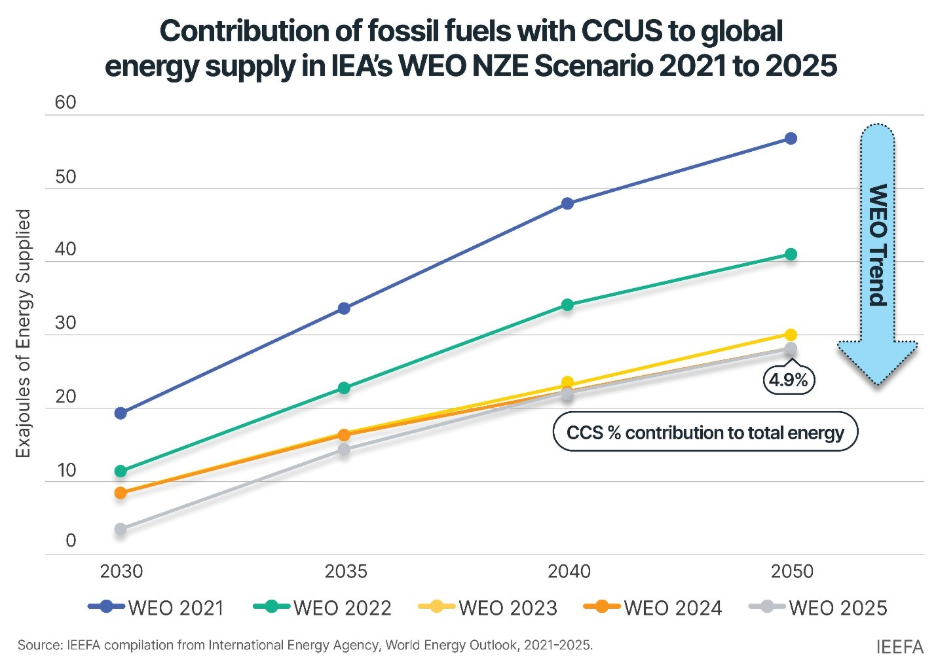
Figure: The IEA’s Net Zero Emissions by 2050 (NZE) Scenario shows fossil fuels with CCUS supplying just 4.9% of global energy in 2050, down sharply from the role projected in its 2021 World Energy Outlook (WEO).
The comparison is especially important in industrial applications. India’s 2026 Union Budget allocated US$2.2 billion over five years to industrial CCUS, which could lock its expanding steel sector into a high-emissions pathway and deepen its reliance on imported metallurgical coal. IEEFA argues that green hydrogen-based ironmaking and recycled steel may offer better value. Steel analysis found that Al Reyadah in the United Arab Emirates – the only commercial-scale CCUS plant in the sector – captured less than 27% of emissions from the gas-fueled steel plant it supports. No commercial-scale blast furnace steelmaking currently operates with CCUS.
Capital discipline does not mean ruling out every CCS proposal. It means requiring a convincing commercial case before investors, taxpayers or consumers are asked to carry the risk.
Explore IEEFA’s carbon capture and storage research
This article is adapted from IEEFA Market Signals, IEEFA’s monthly LinkedIn newsletter connecting regional energy-market analysis to global trends, risks and opportunities. Developed by IEEFA Global Communications Project Manager Adam Hunt. For future editions read and subscribe to IEEFA Market Signals.
Related Content