Indonesia’s electricity planning framework needs a single, transparent benchmark
Key Findings
Indonesia’s national electricity utility, PT Perusahaan Listrik Negara (PLN), operates under two official electricity infrastructure targets: those in the publicly available Electricity Supply Business Plan (RUPTL) and those in a separate performance contract. The two set different infrastructure delivery targets and implementation timelines.
Indonesia’s RUPTL projected USD14.3 billion in electricity infrastructure investment for 2025, compared with USD3.1 billion under the Ministry of Energy and Mineral Resources (MEMR) performance contract. PLN reported USD4.63 billion in realized investment, meaning assessments of investment progress vary substantially depending on the benchmark used.
The government’s 100-gigawatt-peak (GWp) solar program overlaps with major planned additions to generation, transmission, and substation infrastructure. Scaling installed solar capacity from approximately 1.5GWp in early 2026 to 100GWp by 2029 would further increase financing and delivery requirements.
A single, transparent planning framework aligning the RUPTL, annual performance targets, and PLN’s project pipeline would strengthen accountability, provide a clearer basis for assessing progress, and help mobilize the private and development capital needed to deliver Indonesia’s electricity goals.
Indonesia’s national electricity utility, PT Perusahaan Listrik Negara (PLN), is implementing the country’s electricity plans in line with multiple official infrastructure targets. Differences in their scale and timing create conflicting benchmarks for assessing implementation.
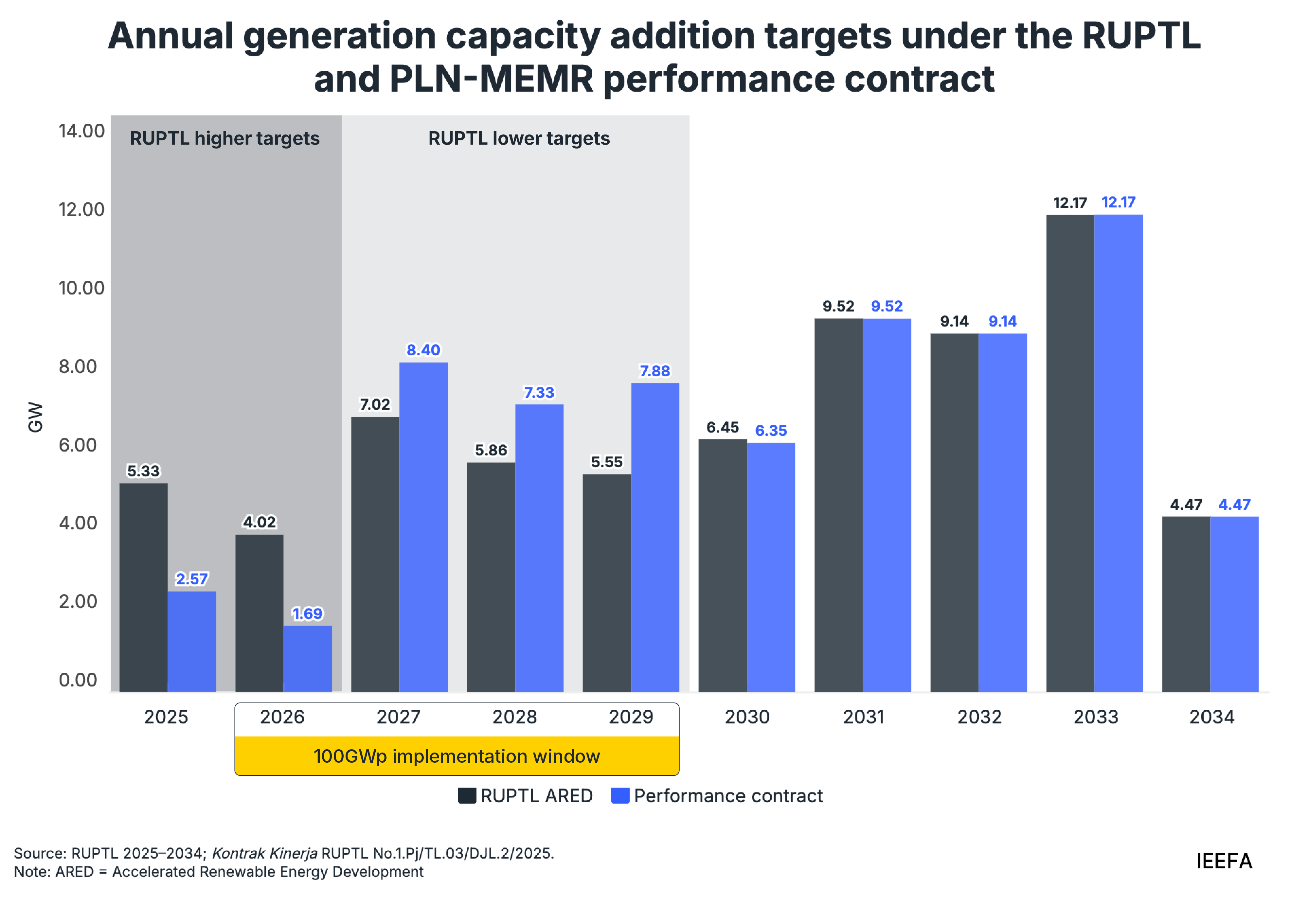
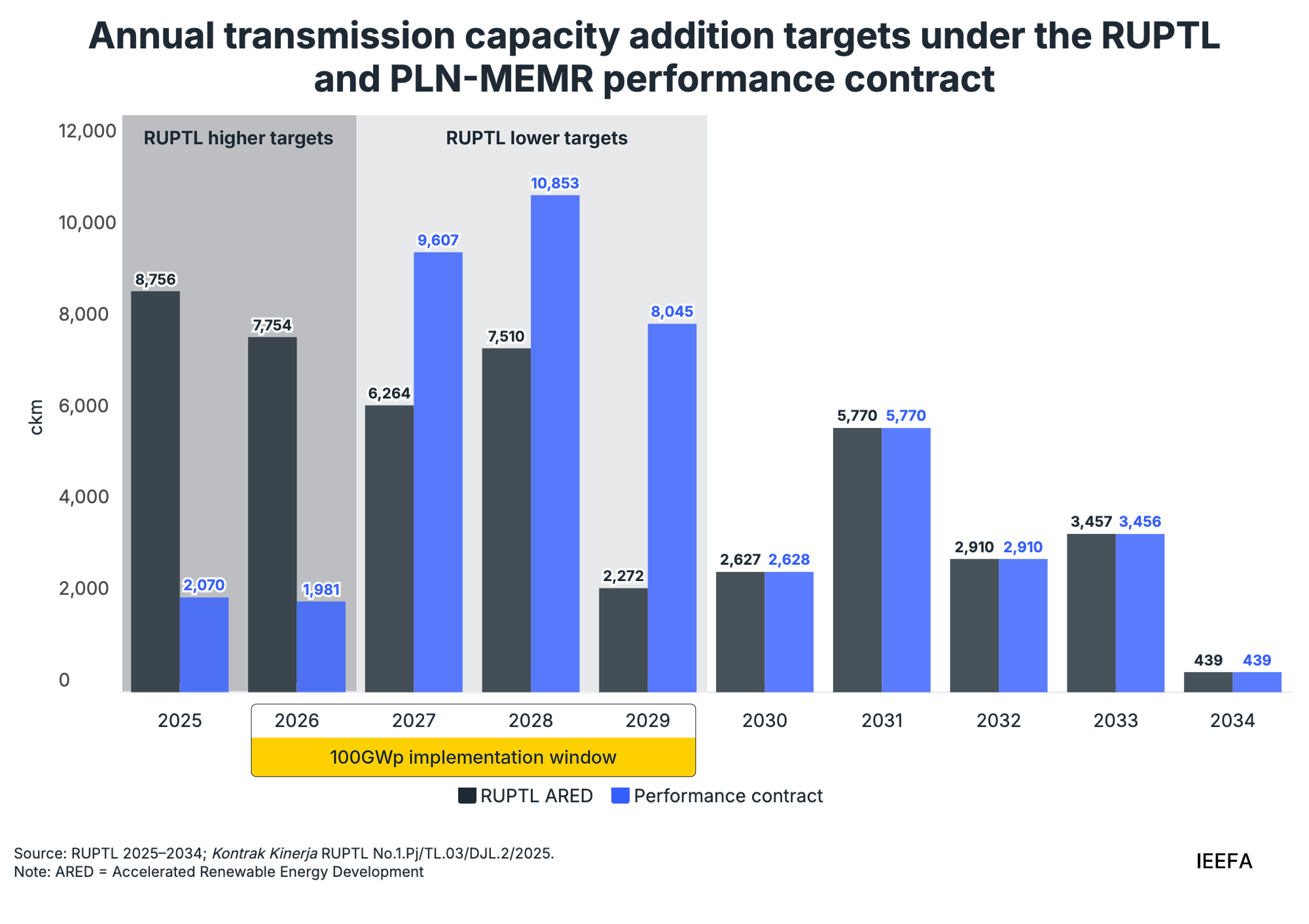
PLN reported adding 2,317 circuit-kilometers (ckm) of transmission in 2025, equivalent to 26% of the 8,756ckm target under the 2025–2034 Electricity Supply Business Plan (RUPTL). However, a separate performance contract between the Ministry of Energy and Mineral Resources (MEMR) and PLN set a lower target of 2,070ckm. Against this benchmark, PLN achieved 112% of the target, producing a contrasting assessment of delivery progress, and leading to conflicting conclusions.
This discrepancy also extends to investment. The RUPTL projected IDR244.7 trillion (USD14.3 billion) in electricity infrastructure investment for 2025, while MEMR’s 2025 performance report used a separate target of USD3.1 billion. PLN’s reported investment of USD4.63 billion represents 149% of the MEMR target but only 32% of the RUPTL projection. The benchmark used therefore fundamentally changes the assessment of implementation.
A single, well-defined, and transparent benchmark is essential for assessing implementation of Indonesia’s electricity plans. Greater clarity would strengthen accountability and give investors and developers more certainty when evaluating generation, transmission, and other infrastructure projects.
RUPTL implementation and delivery targets
The RUPTL 2025–2034, Indonesia’s approved roadmap for PLN's electricity system, aims for 69.5 gigawatts (GW) of new generation and storage, 47,758ckm of transmission, and 107,950 megavolt-amperes (MVA) of substations over the decade. The plan references a separate performance contract (Kontrak Kinerja) between PLN and the Directorate General of Electricity (DGE-MEMR), which sets out stages for RUPTL implementation. In a presentation to the House of Representatives (DPR) in July 2026, PLN described the performance contract as the mechanism through which MEMR sets RUPTL delivery targets based on electricity demand and national system requirements.
The RUPTL and performance contract broadly converge on 10-year infrastructure requirements but differ in their annual delivery schedules. Such differences are not inherently problematic, as long-term electricity plans must be translated into executable project pipelines that reflect changes in demand, system requirements, project readiness, procurement, and financing.
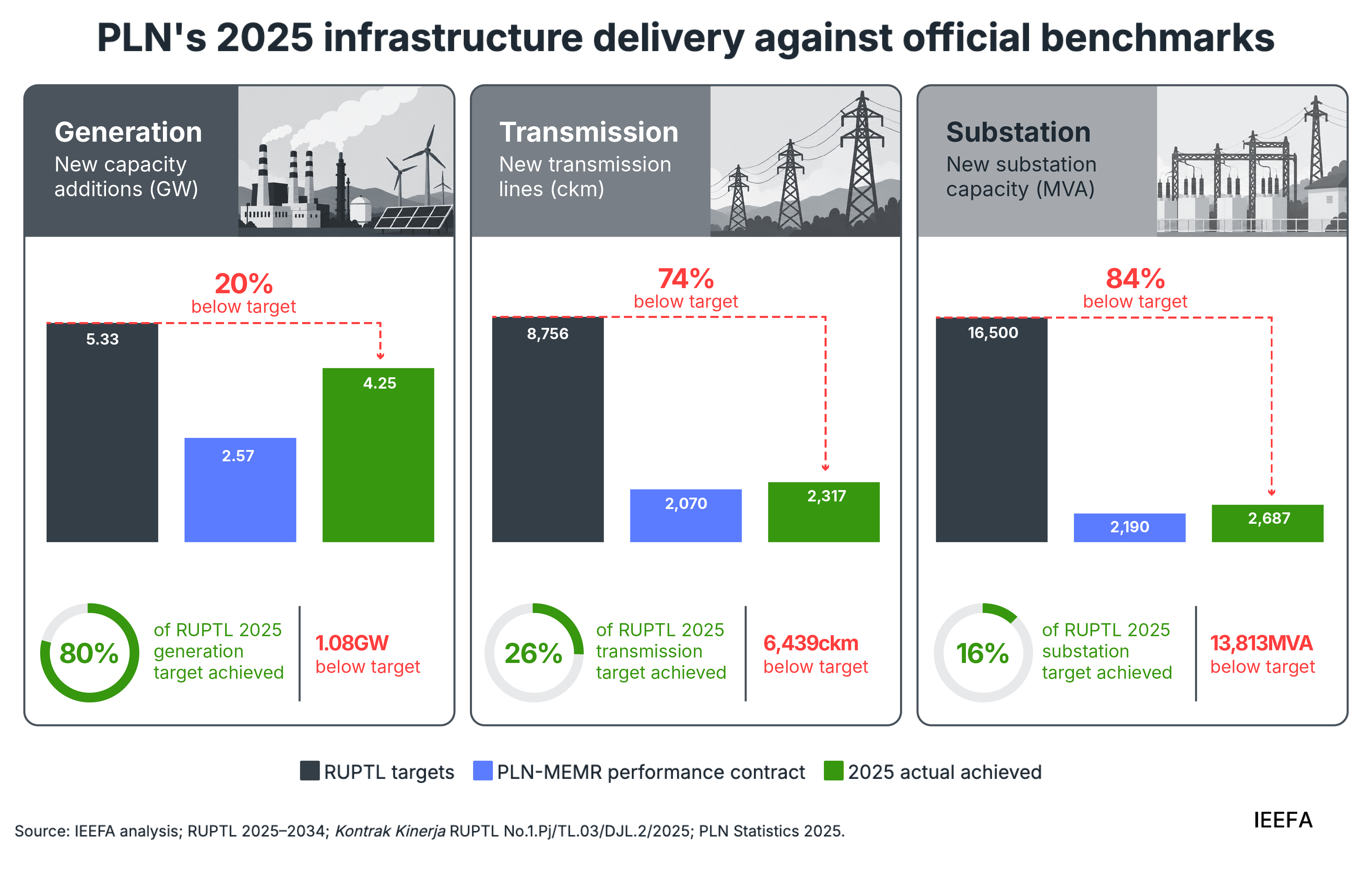
A key issue is how the two schedules relate. If the performance contract translates the RUPTL into more realistic annual implementation targets, stakeholders would need clarity on the basis for those targets and why they differ from the public RUPTL schedule.
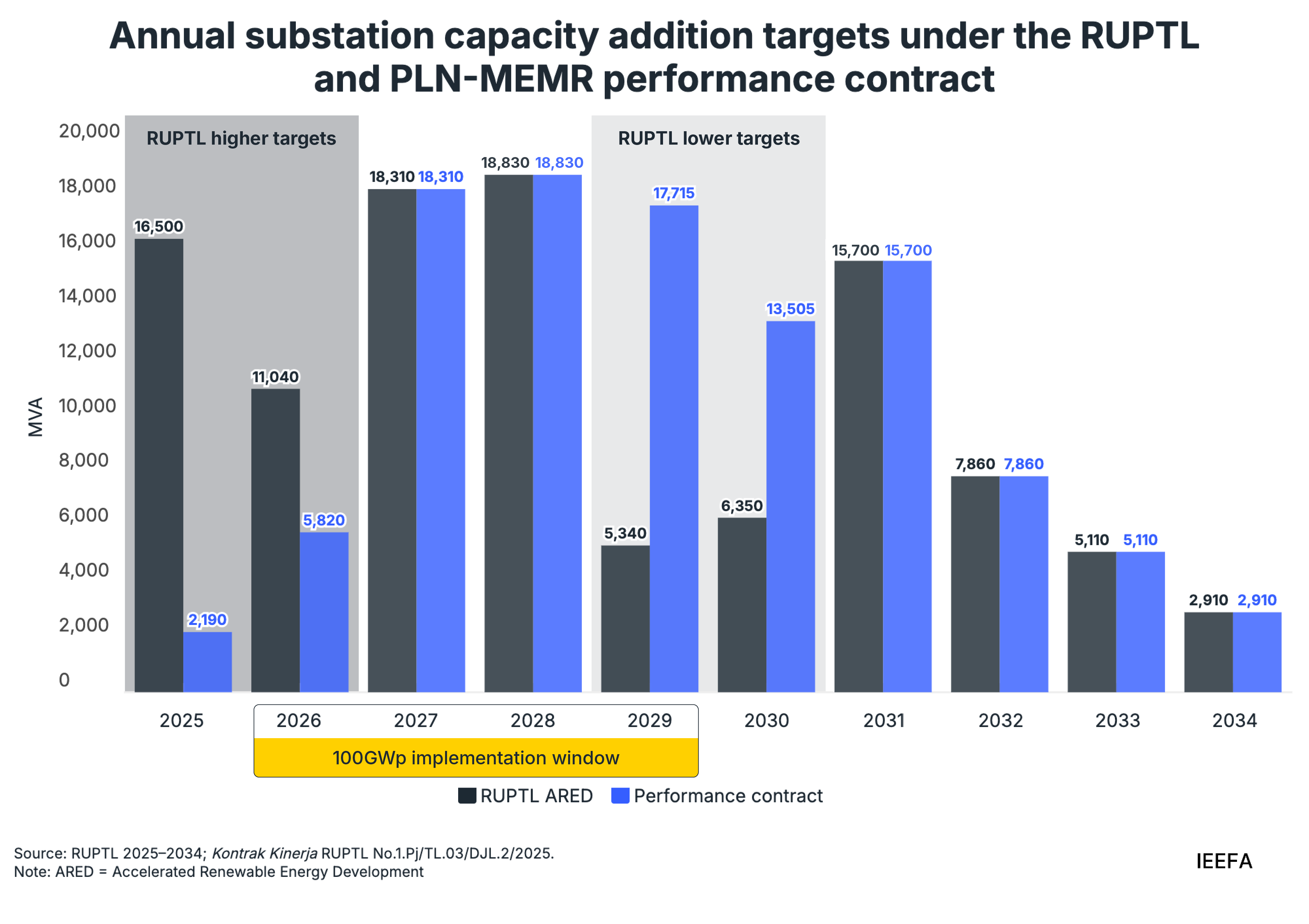
The three figures below show substantial additions in generation, transmission, and substation concentrated between 2026–2029, coinciding with the government's 100-gigawatt-peak (GWp) solar implementation window. Delivering these investments will require significant capital from PLN and the government, alongside private and development finance. This increases the importance of predictable planning and transparent targets. Without clarity on how targets are set and revised, stakeholders cannot readily distinguish between deliberate reprioritization, changing system needs, or implementation delays.
The evolution of the Sumatra-Java interconnection
The Sumatra-Java interconnection illustrates the importance of clear benchmarks. Announced in 2012 with a 2017 completion target, the 3,000-megawatt (MW) high-voltage direct current (HVDC) project was included in the RUPTL 2013–2022. It was later removed from the RUPTL 2021–2030 after lower demand projections and the cancellation of a Japan International Cooperation Agency (JICA) development loan made the project economically unfeasible.
The RUPTL 2025–2034 reintroduced the interconnection as part of the Green Enabling Super Grid, with a 500-kilovolt (kV) HVDC connection targeted for completion in 2031. A 2022 JICA study estimated the project at USD1.14 billion (approximately USD1.23 billion in 2025), excluding alternating-current (AC) equipment. This is about 20% more than PLN's total combined USD1.02 billion investment in transmission and substations in 2025, illustrating the financing scale required for a single major interconnection.
Long-term electricity plans must adapt as demand, system needs, and project economics evolve. However, clear explanations for major project changes and updated implementation timelines are essential for stakeholders to distinguish necessary adjustments from implementation delays.
Generation and transmission interdependence
In renewable energy projects, generation and transmission are often interdependent. For example, the RUPTL 2025–2034 identifies 5.7GW of hydropower potential in central Sulawesi, far from major load centers, alongside 4,012 kilometers (km) of new 275kV backbone transmission lines to evacuate the electricity. The network would connect existing hydropower facilities, such as Bakaru, and enable planned projects, including Pokko, to supply major load centers. This interdependence means generation targets cannot be assessed in isolation: new renewable capacity depends on timely delivery of the transmission infrastructure needed to bring its output to market. Without a credible transmission schedule, a generation target may not represent a complete investment opportunity.
PLN reported that 1,646 of the RUPTL’s 4,118 projects (40%) had progressed in the first year, including 1,083 in procurement, 420 under construction, and 143 reaching commercial operation. Tracking projects through these implementation stages alongside actual capacity additions would provide a clearer picture of RUPTL delivery and help identify where implementation may be constrained.
Updating the planning framework for new renewable energy targets
The RUPTL is based on the National Electricity Plan (RUKN), which derives from the National Energy Policy (KEN), translating national energy priorities into PLN's investment pipeline. This planning hierarchy becomes particularly important as the government introduces new renewable energy targets. The RUPTL 2025–2034 includes 42.6GW of renewable generation and 10.3GW of storage, while the government launched a separate 100GWp solar program in August 2026, with President Prabowo Subianto targeting completion by 2029. With only around 1.5GWp of solar capacity installed in early 2026, meeting the target would require more than a 60-fold expansion in three years.
The program sets phased targets of 17GWp, 18GWp, and 30GWp, including a 30GWp target in 2026 alongside the retirement of 13GW of diesel-fired generation. Achieving this deployment pace from a base of 1.5GWp would require rapid mobilization of financing, equipment, and grid infrastructure.
The 100GWp solar program would require major updates to the RUPTL, including changes to generation planning, transmission, storage, procurement, and financing, as well as the incorporation of distributed and rooftop solar. The current RUPTL allocates only 3GW of rooftop solar capacity, underscoring the gap between the existing planning framework and the scale of the new program.
The financing challenge is equally significant. The government estimates that the solar program would require around USD73 billion over three years, or an average of USD24 billion per year. This is roughly 15 times the USD1.59 billion in realized generation investment by PLN, independent power producers (IPPs), and power private utilities (PPUs)/operations permit holders (IOs) combined in 2025. The scale of investment required reinforces the need to mobilize substantial private and development capital alongside public financing.
A predictable project pipeline would be critical to securing capital at this scale. It would help the government plan budgetary requirements, enable PLN to anticipate funding and system-balancing needs, give development partners time to program financing, and allow private developers to prepare projects. Government support through tariff mechanisms, access to state land, and concessional financing could improve project bankability, while clear procurement schedules would give developers and lenders greater visibility to prepare investments.
Turning electricity plans into measurable commitments
Indonesia does not necessarily need another electricity plan. It needs a single planning and implementation framework that incorporates new government commitments and translates them into clear, measurable delivery targets. PLN and MEMR could establish a public RUPTL implementation scorecard that integrates these layers. For major projects, the scorecard could track the original RUPTL schedule, current contractual target, procurement status, expected commercial operation date, and any timeline changes.
When priorities or project schedules change, the RUPTL could be updated with revised targets and rationale disclosed. The objective is not rigid adherence to the original plan, but a consistent and transparent record of how implementation evolves as demand, project readiness, and system requirements change.
RUPTL delivery is also not PLN’s responsibility alone. Major power and transmission projects depend on land availability, permitting, procurement, financing, and cross-agency government coordination. A cross-ministerial mechanism could connect national policy priorities with PLN's project pipeline, public budgeting, and financing requirements, while tracking delivery against agreed timelines. Private and development capital could then be mobilized against a clearer pipeline, supporting financing and delivery of Indonesia’s electricity infrastructure goals.
Strengthening the case for a predictable pipeline
Indonesia has set ambitious electricity targets, but delivering them requires a transparent, consistent, and regularly updated planning framework. The 100GWp solar program reinforces this need. With an estimated cost of USD73 billion over three years, its delivery will require substantial private and development capital alongside public financing.
A single framework aligning national priorities, the RUPTL, annual performance targets, and PLN's project pipeline would provide greater certainty about what needs to be delivered, when, and by whom. Clear accountability across PLN, MEMR, and other relevant government agencies would strengthen investor confidence and help identify financing and implementation constraints before they become systemic bottlenecks.

Related Content