The LNG glut has been delayed, not cancelled
Key Findings
The LNG market is still heading toward oversupply, but the Middle East conflict has pushed back the timing. New supply outside the Gulf is already offsetting some losses, while a much larger wave of capacity remains under development.
The market is moving through distinct stages: looming oversupply gave way to a supply shock, high prices are now reshaping demand, and continued capacity growth is expected to eventually swing the balance back toward oversupply.
The same forces are playing out differently across regions. Asian buyers are reassessing LNG demand, Europe’s gas use is forecast to fall further, while producers in North America and Australia continue adding supply – increasing the risk of a future mismatch between supply and demand.
IEEFA Market Signals (Edition #3, September 2026) is a monthly global newsletter synthesizing IEEFA analysis from across regions to examine global energy-market trends, risks and opportunities. Each edition draws on existing IEEFA work, with review from relevant analysts. Read and subscribe on LinkedIn.
IEEFA was an early voice warning that an unprecedented wave of new LNG supply could leave exporters chasing too few buyers. By 2024, the International Energy Agency (IEA)’s World Energy Outlook was pointing in the same direction.
Market analysts were expecting the glut to start hitting this year, causing prices to drop materially. However, the Middle East conflict has sharply disrupted LNG flows through the Strait of Hormuz, and IEEFA estimates that it would take well over half a year for flows to return to pre-conflict levels, even if hostilities ended today.
Growth in U.S. production and supply from smaller producers largely offset the reduction from Qatar in the first half of the year, but the conflict still pushed back the expected onset of a glut. Rather than ending the oversupply story, it changed its timing. The market is again moving through a series of stages that will shape when that oversupply emerges.
Stage 1: Supply risk builds
Before the Middle East conflict, the LNG industry was heading into its biggest supply expansion on record. IEEFA’s November 2025 analysis, drawing on International Energy Agency (IEA) data, noted that more than 220 million tonnes of liquefaction capacity was expected to come online between 2025 and 2030 – an increase of more than 40% on 2024 capacity.
Much of the investment case rested on fast growth in Asia. But Asian LNG demand has plateaued since 2021 and fell about 5% in 2025. Across China, India, Thailand, Japan and Pakistan, demand has weakened for different reasons, including energy-security concerns, high prices, slower growth, domestic energy production, surging renewables, mild weather and infrastructure constraints.
Nor was Europe offering a clear growth story. Gas demand fell sharply after the 2022 energy crisis, while import capacity kept expanding. IEEFA forecasts that European LNG demand could fall about 23% between 2025 and 2030.
Stage 2: Conflict interrupts the supply cycle
The pattern has echoes of the 2022 energy crisis. Russia’s invasion of Ukraine sparked a structural shift in European gas supply from lower-cost Russian pipeline gas to seaborne LNG imports. This demand shock sent global LNG prices soaring to record highs, priced some Asian buyers out of the market and induced a wave of new LNG capacity investment .
The Middle East conflict has delivered another sudden shock to LNG markets, this time to supply. The Strait of Hormuz had carried close to one-fifth of global LNG trade, mostly from Qatar and the United Arab Emirates. Damage to infrastructure and restricted shipping pushed Asian and European gas prices sharply higher.
The IEA now estimates that the conflict could remove about 140 bcm of cumulative LNG supply from the market between 2026 and 2030, delaying any market-easing effect of
New projects outside the Gulf are already filling part of the gap. The IEA expects production in North America, Africa and Australia to add close to 50 bcm of LNG supply in 2026, helping keep global supply broadly flat despite the Gulf disruption.
For existing exporters, tight markets can be profitable. Australian LNG producers, for example, stand to benefit from another period of elevated global prices. For buyers, the picture is less attractive.
Stage 3: High prices and volatility reshape demand
Even at its early stages, the conflict began weakening LNG demand in Asia, through the cancellation or reconsideration of projects in China, the Philippines and Vietnam. IEEFA estimates that these developments, together with potential nuclear restarts and the fast-tracking of renewable deployment, could erase 16 Mtpa of long-term LNG demand. Independent consultancies are also trimming their long-term demand forecasts for LNG’s growth engine, including China.
In July, IEEFA found that high and volatile LNG prices were already curbing demand and constraining market growth. In Asia, weaker imports, scaled-back infrastructure, and higher renewables commitments are challenging the demand growth exporters have been counting on. By July, China’s year-to-date LNG imports had fallen to their lowest level since 2019.
Policymakers are rewriting long-term energy development plans to reduce their exposure to LNG imports. In April, Korea announced an accelerated roadmap to achieve 100 GW of renewable capacity by 2030. Stuck with an underutilized, expensive gas fleet that cannot expand due to turbine shortages, in August Thailand unveiled plans to pivot away from gas and towards renewables. IEEFA’s research on Thailand’s rooftop solar policy framework includes recommendations that can aid the country in fast-tracking 5 GW of residential solar panels in 2027 as part of that plan.
The accelerated deployment of rooftop solar in Pakistan stemming from the last crisis provided a cushion during the onset of this one. While shortages have returned due to the prolonged conflict, IEEFA estimates that the country could face a long-term LNG surplus of 177 cargoes by 2032.
Europe is responding with an increased reliance on U.S. LNG, while renewables, heat pumps and lower gas use are reducing the volume of imported gas it needs. IEEFA estimates those technologies could cut EU gas demand by around a quarter by 2030 if deployment targets are met.
For exporters, LNG volatility is a double-edged sword: higher prices improve margins today but give buyers more reason to conserve gas, build domestic energy supply, and invest in alternatives.
Stage 4: The supply wave keeps moving, with added urgency
Despite these market challenges, the war has provided an impetus for LNG expansion as buyers look to escape price volatility and secure supplies outside the Persian Gulf. Around 345 bcm per year of new export capacity is due online between 2025 and 2030, according to the IEA’s June tracker. And since the conflict began, developers have given the go-ahead to three more major U.S. LNG projects.
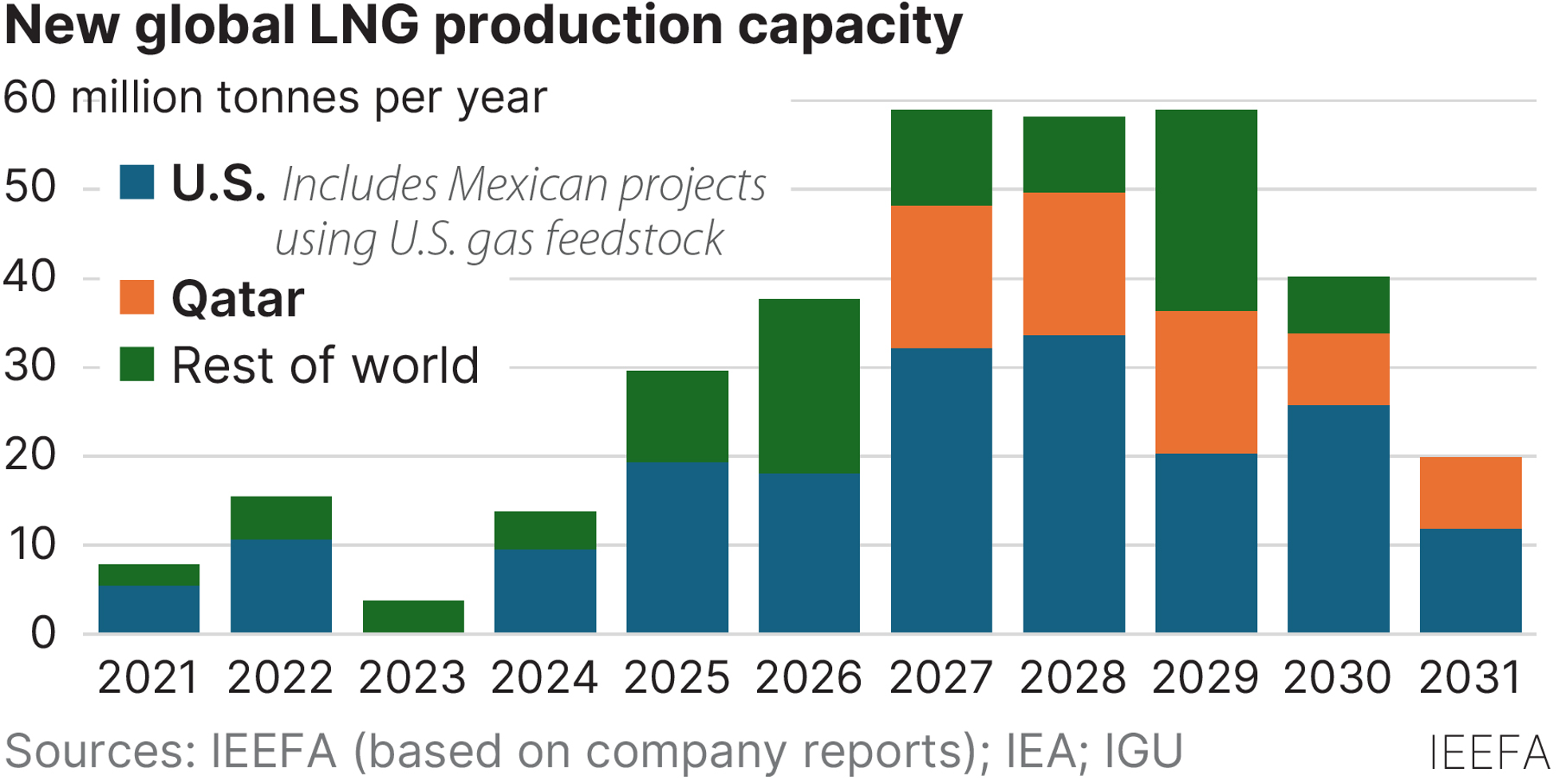
Canada is also trying to expand into Asian markets. In July, IEEFA warned that new Canadian projects could start operating after Gulf supply has recovered, when they may face weaker demand, more abundant supply, and lower prices. That leaves a growing mismatch risk: supply keeps expanding even as high and volatile prices constrain demand growth.
The path from here still depends heavily on the Middle East. Gulf flows may recover more slowly than anticipated, repairs could take years, and further escalation of conflict could tighten the market again. But new supply outside the Gulf is already offsetting much of the disruption, and more capacity is coming. As Qatari supply returns, that could push the market back towards oversupply – a challenging prospect for LNG projects being sanctioned today.
For investors, the lesson is simple: today’s high prices do not guarantee strong returns once more LNG supply comes online.
Explore IEEFA's gas and LNG research
IEEFA’s monthly LinkedIn newsletter connects regional energy-market analysis to global trends, risks and opportunities. Drafted by Adam Hunt, IEEFA Global Communications Project Manager. For future editions, subscribe to IEEFA Market Signals