Europe bets on mild winter when it should be cutting gas demand
Key Findings
The weather will determine how tight Europe’s gas supply becomes this winter and how high prices go. Demand reduction remains the biggest lever within Europe’s control.
European buyers must outbid Asian rivals to secure liquefied natural gas (LNG) cargoes, pushing up consumers’ gas and electricity bills.
Europe’s pivot to LNG has left it vulnerable to global shipping bottlenecks and international bidding wars.
EU LNG imports fell by 3.5% year on year between January and August 2026.
Europe is approaching winter with high gas prices, escalating conflicts disrupting supply and gas storage at the lowest level for this time of year since records began in 2011. Compounding these challenges are intense competition with Asian buyers for liquefied natural gas (LNG) cargoes and doubts about how El Niño will impact the weather.
Consequently, Europe faces several uncertainties this winter:
- Whether disruption to LNG transit through the Strait of Hormuz is prolonged
- Whether Asian buyers outbid Europe for US LNG
- Whether gas price volatility surges
- Whether storage levels remain critically low
- Whether the winter is exceptionally cold
- Whether gas supply from Norway or other major producers is disrupted
- Whether other critical shipping routes are obstructed
Only some of these need to materialise for buyers to pay a steep premium to guarantee security of supply. That pushes up gas and electricity bills. Where households and businesses cannot pay, the result is involuntary demand destruction that efficiency and electrification policies were meant to limit.
Europe faced similar uncertainties after Russia’s 2022 full-scale invasion of Ukraine, when the continent depended on Russia for almost half of its gas imports. Europe responded by reducing its dependency on Russian gas, diversifying suppliers, curtailing gas demand and accelerating renewable energy deployment.
The 2026 crisis differs structurally. Europe has successfully reduced its reliance on Russian pipeline gas, only to replace it with dependence on the global LNG spot market and supply from the US. This pivot has left the continent highly vulnerable to global shipping bottlenecks and international bidding wars.
Europe must prepare for another imminent supply squeeze when the EU’s complete ban on Russian LNG imports under existing long-term contracts takes effect on 1 January 2027. This deadline arrives at a highly sensitive time, given that Russia supplied about 19% of the EU's LNG imports in the first half of 2026.
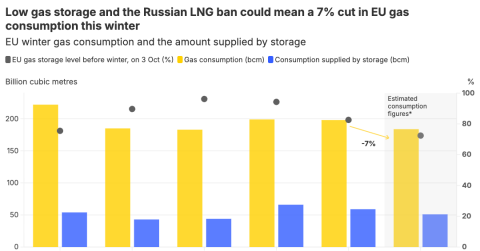
EU gas demand fell by 17.7% between 2021 and 2025, providing a crucial buffer against supply shortages. Meanwhile, each new renewable energy project, battery storage system and grid upgrade helps to reduce Europe’s reliance on gas.
Wind output and temperatures will determine how tight Europe’s gas supply becomes this winter and how high prices go. Demand reduction remains the biggest lever within Europe’s control.
EU LNG imports fall in 2026
EU gas import volumes from January to August 2026 were virtually flat year on year at about 200 billion cubic metres (bcm): LNG imports decreased by roughly 3.5% and pipeline imports rose by 2.5%.
EU LNG imports began 2026 higher than in 2025 but declined steadily from April to July before rebounding in August. Pipeline gas imports also started the year stronger but have followed a similar trend to 2025 volumes since April.
Due to the ongoing Iran war and disruption to shipping through the Strait of Hormuz, EU imports of Qatari LNG fell by 5.1bcm year on year between January and August 2026. Pipeline gas imports from Türkiye decreased by 0.7bcm. EU countries offset these losses with increased imports from several other suppliers over the same period:
- Norway (pipeline gas and LNG): +3.2bcm
- US (LNG): +1.8bcm
- Russia (pipeline gas and LNG): +1.5bcm
- Algeria (pipeline gas and LNG): +1.1bcm
- UK (pipeline gas): +1.0bcm
- Nigeria (LNG): +0.5bcm
The US share of EU LNG imports has risen steadily since 2022. So far this year, around 60% of the EU’s LNG imports have been from the US, jumping to 70% in August. The EU purchased 43% more LNG in August than in July as countries filled storage ahead of winter.
But Europe’s gas storage levels are far lower than in previous years because summer prices have been higher than winter forward prices, leaving little commercial incentive to inject gas into storage. EU gas storage was 68.04% full on 12 September 2026, down 12.1 percentage points from 80.12% on the same date in 2025.
UK increases pipeline gas exports to EU countries
The UK increased its net pipeline gas exports to EU countries by 12% year on year between January and August 2026. Britain's gas network operator National Gas expected the country to export gas to continental Europe over the summer, when domestic supply exceeds demand.
Norway and the US remain the UK's primary gas suppliers, together providing the bulk of imports from January to August 2026. Norway accounted for 73% of UK gas imports over that period, despite deliveries from the country decreasing slightly year on year, while the US supplied 20% of total UK gas imports and 76% of LNG shipments. UK LNG imports rose by 6% year on year between January and August 2026.
The US accounted for 62% of EU and UK LNG imports combined between January and August 2026.
Europe’s gas supply mix
As Europe enters the critical winter heating season with low levels of gas storage, the market is relying heavily on increased shipments of US LNG and high flows of Norwegian pipeline gas.
US exporters are ramping up shipments across the Atlantic to replace lost Qatari volumes. However, European buyers must outbid Asian competitors to attract these flexible spot cargoes, pushing up gas and electricity bills.
As Europe's largest pipeline gas supplier, Norway is running its infrastructure at near full capacity to deliver gas to the UK and continental Europe.
Meanwhile, despite ongoing geopolitical tensions and sanctions, certain Russian pipeline routes have seen demand spikes as European buyers scramble for available supply.
To cover the remaining deficit, European buyers are sourcing smaller, incremental volumes from a diversified mix of exporters, including Algeria, Nigeria, Mauritania, the Democratic Republic of Congo and Mexico.
None of this changes the underlying problem: Europe is scrambling for cargoes it may not win, at prices it cannot control. Cutting gas demand is the response that reduces Europe’s exposure permanently rather than shifting it to a different supplier.

Related Content