Labrador Trough vs the Pilbara and South Australia: Who will win the green iron race?
Key Findings
Canadian government support to accelerate projects that could underpin the green iron transition provides a potential model for other contenders in the market, including Australia.
The prolonged lead times for mining projects globally could constrain the growth of high-grade iron ore supply. Streamlining necessary approvals for new high-grade iron ore mining operations will therefore be essential.
Upgrading existing mid-grade iron ore to DR-grade is established practice in Canada. For Australian magnetite producers, this could provide a faster, more direct pathway to DR-grade production than developing entirely new projects.
The Canadian government has announced one of the largest investments in clean energy (CAD70 billion), which could support the development of high-grade iron ore and pair it with clean power to produce green iron. In addition, the Labrador Trough Clean Power, Critical Minerals and Infrastructure Corridor (the Labrador Trough Corridor) has been referred to the Major Projects Office, which aims to streamline permitting and approvals processes, facilitate financing, and support engagement with Indigenous communities.
The government is also supporting pre-development projects in the Labrador region, including the Kami iron ore project, one of several projects in Canada with the potential to produce high-grade iron ore feedstock. Major Japanese steelmaker Nippon Steel holds a stake in the Kami project, alongside Champion Iron and Sojitz Corporation. The Labrador Trough has been central to Canada’s high-grade iron ore production since 1954, producing about 50 million tonnes a year (MTPA).
Regardless of the size of its latest investment in clean energy, Canada’s approach to developing its iron ore industry offers some valuable lessons for Australia.
Strong position in high-grade iron ore
Backed by significant high-grade iron ore deposits, Canada is already a major producer and exporter of direct reduction (DR)-grade iron ore, an essential feedstock for green iron production, and is looking to expand this capacity. Canada is one of the largest exporters of DR-grade pellet along with Brazil, Sweden and Bahrain, which itself relies on Brazilian iron ore concentrate.
Australia has never been a major supplier of high-grade ore; it has built its iron ore industry around low-cost, large-scale production for blast furnaces (BF) in Asia.
Transitioning from BF-grade to DR-grade ores
Producers such as ArcelorMittal and Champion Iron are investing in upgrading their operations from BF- to DR-grade concentrate, positioning Canada to address the expected long-term supply deficit in DR-grade iron ore in the coming decade. This transition is also being strongly supported by government funding, as demonstrated by ArcelorMittal’s Port-Cartier pelletising project, which is expected to commence by 2029.
Australia has nominal magnetite concentrate production capacity of almost 65MTPA. However, actual production remains below that, and none of it meets the specifications required for direct reduced iron/hot briquetted iron (DRI/HBI) production (i.e. DR-grade concentrate). Fortescue’s Iron Bridge is the newest and most advanced of these concentrators. Just 10% of its 22MTPA nominal capacity would be sufficient to supply a first-of-a-kind (FOAK) 1.5MTPA ironmaking facility in Australia. This volume may already be available without significant upgrading or process modifications, such as flotation to reduce silica content.
Recognition as a critical mineral
In 2024, Canada classified high-grade iron ore as a critical mineral, highlighting its strategic importance to the country’s industrial and energy transition. It may have been inspired by South Africa, which included iron ore as a high-criticality mineral in 2022. The move gives Canadian iron ore and green iron projects access to a broader set of policies and financing mechanisms, such as the Critical Minerals Infrastructure Fund.
Iron ore (particularly high-grade iron ore) is not included on Australia’s critical minerals list, despite being its highest-value export. As prospects for Australia’s cash-cow export continue to deteriorate sharply, providing greater support for the iron ore sector, including by adding high-grade iron ore to the list of critical minerals, might be prudent.
Streamlining project approvals
Canada also recently introduced the Building Canada Strong Act, centred on the concept of “one project, one review, one year”. The legislation aims to streamline project assessment and approval processes while considering economic benefits, investment and job creation, alongside environmental protection and Indigenous rights.
The government hailed it as, “the most comprehensive and ambitious reform to Canada’s ability to get big things built in a generation. It will reshape the regulatory approvals process, maintain Canada’s rigorous standards and uphold Indigenous rights.”
Canada’s Major Projects Office is intended to streamline the approval process for strategically important projects and accelerate their development.
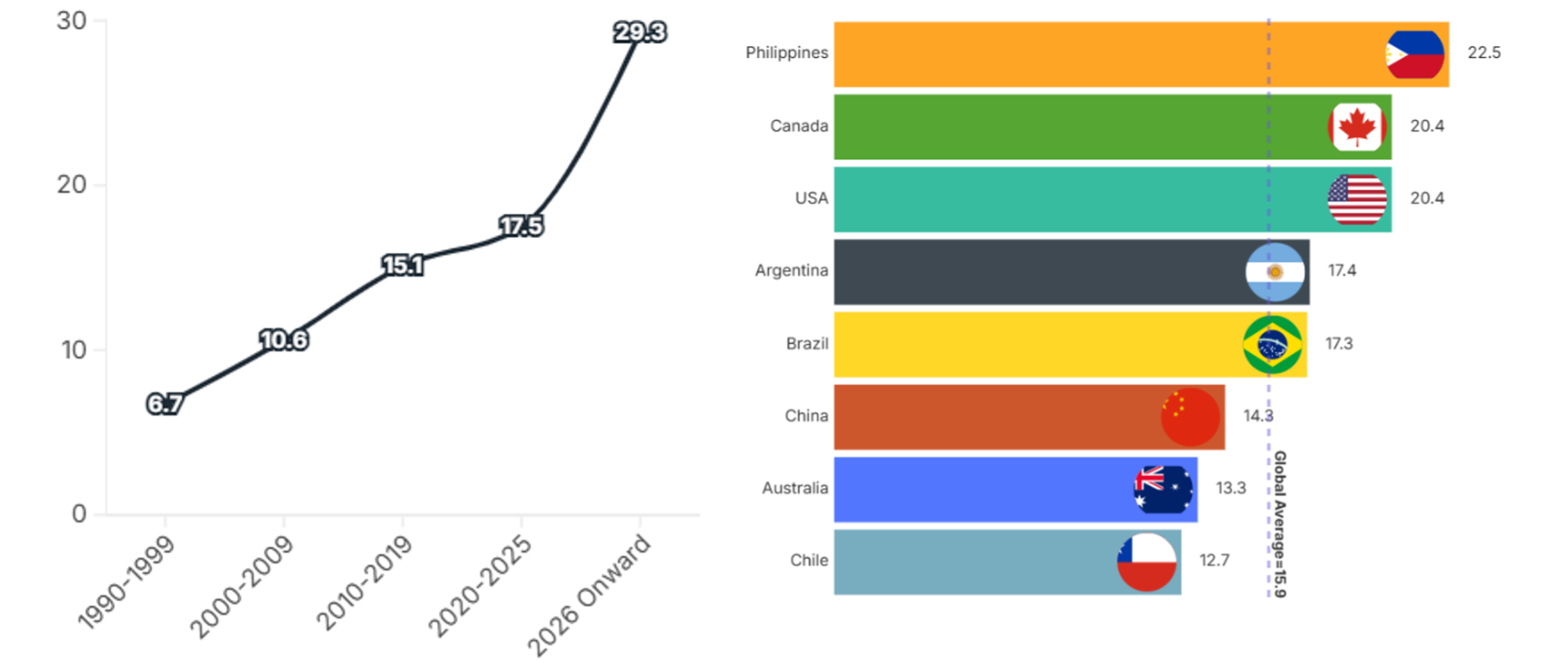
Australia has taken similar steps, including granting Major Project Status to the Razorback magnetite project to help streamline the mining approvals process. These initiatives are intended to address the prolonged lead times of up to 30 years from discovery to operation for new greenfield mining developments in the pipeline (2026 onwards) due to permitting delays.
Mining projects’ discovery to production timeline (year)
Sources: S&P Global, IEEFA.
Note: Mining processes are becoming increasingly lengthy, with growing delays in project approvals. This is likely to drive greater competition among jurisdictions to streamline processes and reduce approval timelines.
State governments, including Western Australia and Queensland, have also introduced reforms to improve the efficiency of mining activities and streamline approvals through a single point of access. The WA government’s performance report for the mining sector shows that while most approvals are processed within the target timeframe, there is still room for improvement.
Bottom line
By investing in infrastructure and access to clean electricity (mostly hydro), Canada is building the foundations for domestic green iron production and potentially becoming a major exporter of green iron. At the same time, a new generation of high-grade iron ore projects, including Iron Bear and Champion Iron’s Kami project, is emerging, with the government supporting new production capacity through transformative infrastructure initiatives such as the Labrador Trough Corridor. Furthermore, market volatility, value-chain resilience and decarbonisation are creating new pathways for potential strategic partnerships, such as EU–Canada co-operation on green iron trade. Geopolitical turmoil and trade wars are bringing the two regions closer together. While green iron could give Canada a competitive advantage, the EU may also be keen to work with Canada to import more cheaper iron metallics and accelerate its own transition.
In Australia, the Pilbara and South Australia both have the natural endowments to become major suppliers of high-grade iron ore and green iron. The country’s long-held position as a key trade partner with China, Japan and South Korea cannot be taken for granted. While Australia may not compete head-to-head with Canada in this evolving market, it will need to respond swiftly to changing market conditions to maintain its position with the right policies and government support.

Related Content