Subsidy reduction signals headwinds for Japan’s ammonia co-firing plans
Key Findings
In June 2026, Japan’s Ministry of Economy, Trade and Industry (METI) reduced the budget for the Fuel Ammonia Supply Chain Establishment subsidy program by over 50%, after several funded projects fell short of technical and timeline milestones. The program supports the government’s ammonia co-firing strategy.
METI’s decision suggests that Japan faces supply-side challenges in using ammonia as an emissions-reduction solution in its power sector. Significantly lowering ammonia production costs through alternatives to the standard Haber-Bosch process is likely to remain difficult.
Demand side constraints are also emerging. Developing ammonia burners for coal-fired power plants (CFPPs) remains expensive and time-consuming, while retrofits are costly and subject to long, unpredictable construction timelines. With only one company poised to commercialize the technology, equipment availability could become a bottleneck in retrofitting Japan’s coal fleet.
The economics present a further obstacle. IEEFA estimates that 20% ammonia co-firing could cost 145–220% more than onshore wind and 240–464% more than commercial solar by 2040. This cost disadvantage could make Japan’s target of increasing ammonia co-firing in CFPPs from 20% in 2030 to 100% by 2050 increasingly difficult to achieve.
Read this commentary in Japanese: 補助金削減が日本のアンモニア混焼計画への逆風を示唆
In June 2026, Japan’s Ministry of Economy, Trade and Industry (METI) halved the budget for a subsidy program supporting the government’s ammonia co-firing strategy. The decision followed several research and development (R&D) projects falling short of the technical and timeline milestones required for continued support.
The budget cut highlights challenges on both the supply and demand sides of ammonia use in Japan’s power sector, casting doubt on its potential as an emissions-reduction solution and the feasibility of the country’s co-firing targets.
On the supply side, the subsidy reduction suggests that significantly reducing ammonia production costs may be difficult, even with government support.
On the demand side, developing ammonia co-firing equipment for coal-fired power plants (CFPPs) remains expensive and time-consuming. Moreover, only one company, IHI, has been able to produce ammonia burners for CFPPs, suggesting that equipment availability could become a bottleneck in retrofitting Japan’s coal fleet.
Cancellations in the Fuel Ammonia Supply Chain Establishment program
The Japanese government aims to achieve 20% ammonia co-firing in the country's CFPPs by 2030, rising to 50% or more after 2030, and 100% by 2050. These targets are supported by four subsidy programs, including the Fuel Ammonia Supply Chain Establishment program, administered by the New Energy and Industrial Technology Development Organization (NEDO). Launched in January 2022, this program supports R&D and demonstration projects for key ammonia-related technologies.
Four R&D projects were selected for financial support under this program. Two focused on developing new ammonia production methods that could reduce costs compared with the conventional Haber-Bosch process and electrolysis. The other two projects aimed to develop burners capable of mono-firing or co-firing ammonia at rates above 50% in existing power plants.
However, in June 2026, NEDO requested METI’s approval to reduce the program’s budget by more than half after two of the four projects were canceled or scaled back.
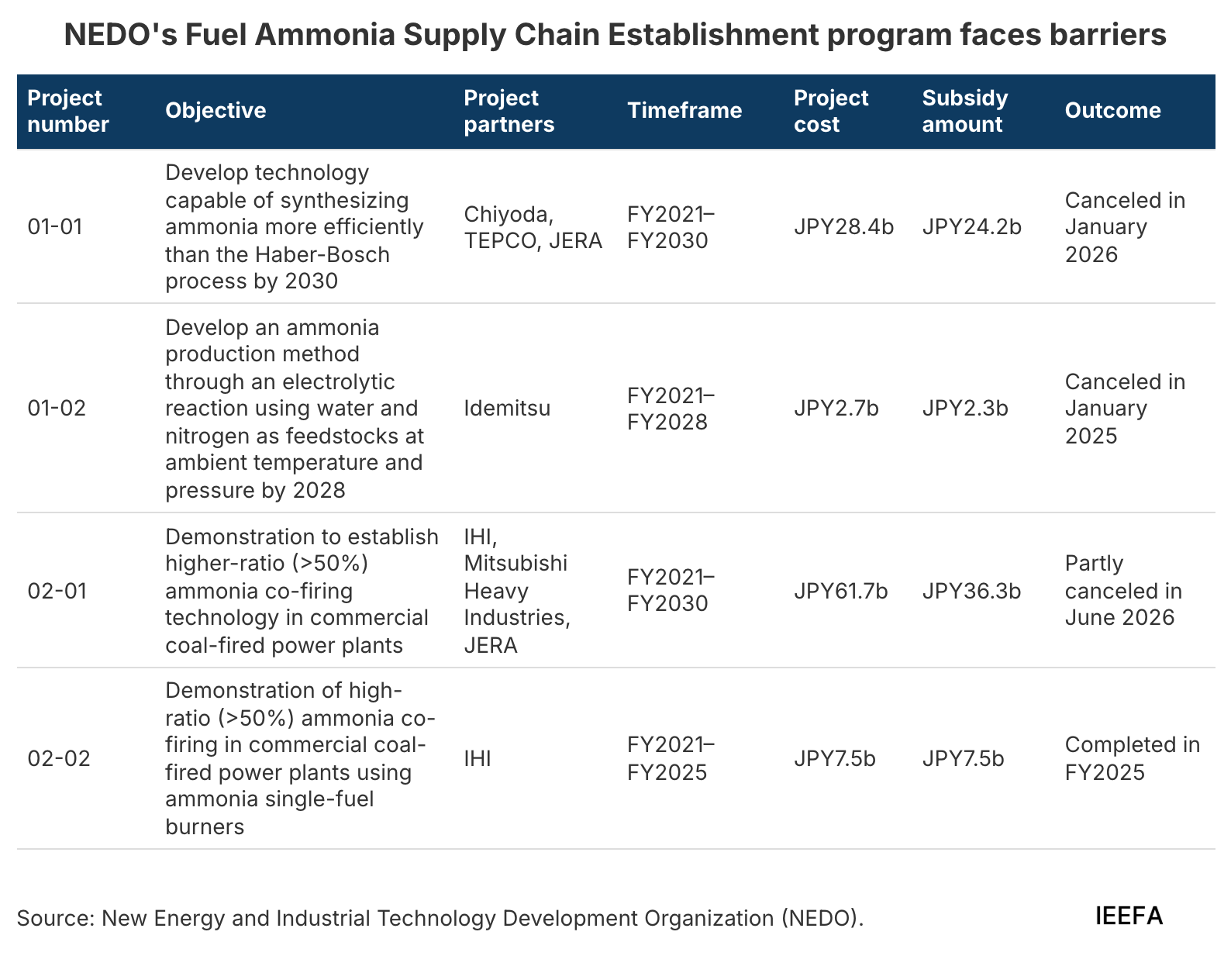
The first project (project 01-01 in the table above) — led by engineering company Chiyoda Corporation, major electricity utility Tokyo Electric Power Company (TEPCO), and JERA — aimed to develop an alternative to the carbon-intensive Haber-Bosch process that could synthesize ammonia at lower temperatures and pressures by 2030. Launched in fiscal year (FY) 2021 with a JPY24.2 billion subsidy, the project was scaled down in January 2025 after falling short of a technical milestone and failing to reduce capital expenditures. Despite a one-year extension for further research, NEDO determined that the project had not significantly improved existing production methods and lacked commercial viability. NEDO subsequently canceled the project in January 2026.
IHI, Mitsubishi Heavy Industries, and JERA led the second project (project 02-01). IHI and Mitsubishi separately developed ammonia burners capable of co-firing at rates above 50% in CFPPs, while JERA was to pilot the burners at its generation facilities. However, NEDO’s feasibility study in January 2025 found that piloting Mitsubishi’s burner would require costly retrofits and a lengthy construction timeline, pushing completion approximately five years beyond the FY2030 target. As a result, Mitsubishi’s project was removed from the Fuel Ammonia Supply Chain Establishment program. The company plans to continue developing the burner without NEDO support.
The program had also seen an earlier cancellation of a project aimed at lowering the cost of producing green ammonia (project 01-02). This project sought to produce ammonia through an electrolytic reaction using water and nitrogen at room temperature and atmospheric pressure. Launched in January 2022, it initially succeeded at the laboratory scale but failed to meet its ammonia generation rate target. NEDO canceled the project in January 2025, well ahead of its planned completion in FY2028.
Following these technical and timeline setbacks, NEDO requested a 53% reduction in its initial JPY69.8 billion budget to JPY32.6 billion.
This leaves only one project under the Fuel Ammonia Supply Chain Establishment program: IHI’s demonstration of ammonia single burners at JERA’s Hekinan Thermal Power Station between April and June 2024.
Subsidy cut signals supply- and demand-side barriers
The budget reduction for the Fuel Ammonia Supply Chain Establishment program suggests that the government, leading equipment manufacturers, and power companies face headwinds on both the supply and demand sides.
On the supply side, significantly reducing ammonia production costs through alternatives to the standard Haber-Bosch process is proving difficult. On the demand side, retrofitting ammonia burners in CFPPs remains expensive, with long and unpredictable construction timelines — evident in Mitsubishi’s delay of over five years past its FY2030 target.
In material submitted to METI, JERA explained Mitsubishi’s exit from the Fuel Ammonia Supply Chain Establishment program, stating that “domestic construction costs escalated enormously, and construction timelines became extremely prolonged.”
This leaves IHI as the only major company with a realistic prospect of commercializing ammonia co-firing equipment.
As ammonia co-firing faces challenges, renewables offer an alternative
The supply- and demand-side challenges suggest that power generation from ammonia co-firing is likely to remain expensive, particularly compared with renewable energy. Institute for Energy Economics and Financial Analysis (IEEFA) assessment based on METI projections finds that by 2040, 20% ammonia co-firing could cost 145–220% more than onshore wind, and 240–464% more than commercial solar by 2040, depending on the production method and whether ammonia is imported or domestically produced. Combined with the technical and deployment challenges facing subsidized projects, these costs cast further doubt on the feasibility of Japan’s targets to increase ammonia co-firing rate in CFPPs from 20% in 2030 to 100% by 2050.
Japan’s strategy of using ammonia to reduce emissions in its power sector is increasingly distinct from that of its global peers. In early August 2026, South Korea announced that coal-ammonia projects would no longer qualify for its clean hydrogen power auction, consistent with its commitment to phase out coal by 2040. While China has included an official ammonia co-firing strategy in its 2024–2027 economic action plan, NEDO has noted that ammonia co-firing pilots in China have shown no progress since November 2023.
The reduced subsidy budget raises questions about Japan’s ammonia co-firing strategy and the allocation of public funds. Rather than continuing to fund the development of economically uncompetitive technologies that do not significantly reduce carbon emissions, subsidies could be better allocated to commercially available technologies that can cut emissions and strengthen energy security. Renewable energy sources, battery energy storage, and expanded transmission and distribution networks could be prioritized for such subsidies.

Related Content