Puerto Rico government continues to plan for major overbuilding of grid with fossil fuel-based sources
Key Findings
The Puerto Rico government is planning to sign contracts for far more electrical generation than the island needs.
A federal oversight board has raised questions about a 3,000-megawatt procurement process but says its concerns are being ignored.
Current and pending contracts would lead to the addition of more than 5,200 megawatts of power generation.
This represents a major overbuilding of the centralized power system, even as residents and businesses continue to move towards rooftop solar.
The Puerto Rican government is in the midst of multiple procurement processes for new power generation that could result in significant overbuilding of the electrical system with fossil fuel-based generation.
A major element of this overbuild is the outstanding procurement process for 3,000 megawatts (MW) of new generation (likely gas-fired), including as much as 600 MW to replace the Costa Sur power plant.
In July 1 and July 17, 2026 letters July 1 and July 17, 2026 letters to the Puerto Rico Public-Private Partnership Authority (P3 Authority, the agency managing the RFP process) and the Puerto Rico Electric Power Authority, the Financial Oversight and Management Board (FOMB) raised questions about the contracting process. The board noted that “significant structural and procedural matters remain outstanding, including port access, fuel infrastructure and logistics, permitting and interconnection requirements, technical and financial qualification criteria, project costs, deliverability, and ratepayer affordability.”
The board also expressed concern that its previous feedback had been ignored and requested responses to its questions before the procurement process concluded. As of Aug. 20, the board said it had not received a response to its questions. The P3 Authority has also not made any public announcements about the process, despite its plan to select the winning bidder(s) in late July.
The lack of transparency around the P3 Authority’s process is particularly problematic given the recent scandal around a contract for emergency generation. The P3 Authority had previously managed an RFP process that resulted in a signed contract with a consortium of Power Expectations, Enchanted Rock, and Reyes Contracting Group to supply Puerto Rico with 400 MW of emergency generation.
But in August, Enchanted Rock announced that it was no longer a party to the contract—and, indeed, never had been. Enchanted Rock alleged that Power Expectations had fraudulently signed the contract on its behalf. Upon notification that Enchanted Rock was not participating, the FOMB canceled the contract.
IEEFA has previously expressed concern that the Puerto Rico government is engaging in multiple generation contracting processes outside of its integrated resource planning process, which is supposed to guide the long-term development of the island’s power system.
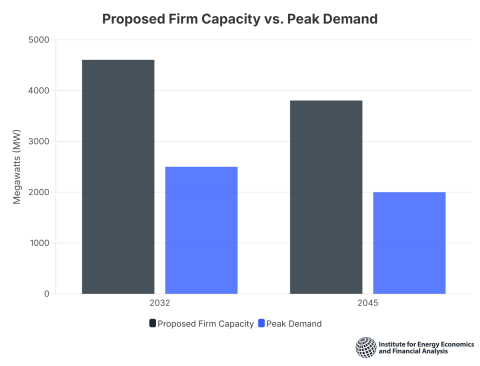
The P3 Authority’s process to contract 3,000 MW of new generation was made on top of approved contracts for more than 1,000 MW of utility-scale battery storage; the 528 MW new Energiza gas plant; 244 MW of new fossil-fueled peaker units; and more than 1,500 MW of approved contracts for utility-scale solar projects. For comparison, the peak demand of the electrical system in 2024 was less than 3,200 MW, significantly less than the amount in approved and proposed power generation contracts.
The FOMB’s July 1 letter to the P3 Authority addresses this “apparent lack of coordinated and targeted generation planning” and raises basic questions about which government entity oversees coordinating these various generation procurement efforts, the alignment of the plans with Puerto Rico’s goal of 100% renewable energy by 2050, and the projected impact on rates.
Meanwhile, residents and businesses in Puerto Rico continue to install rooftop solar at a rapid pace. As of June 2026, more than 1,600 MW of rooftop solar has been installed on the island, a 28% year-over-year increase. Rather than encouraging and planning for a more distributed grid, however, the Puerto Rican government insists on overbuilding the centralized generation system with fossil fuels.
Puerto Rico is in desperate need of coordinated electrical system planning before residents are locked into an overbuilt and unnecessarily expensive centralized generation system for decades to come.
Related Research