Red flags raised over Puerto Rico emergency power generation contract
The Financial Oversight and Management Board for Puerto Rico has raised red flags about a proposed contract for 400-megawatt (MW) of emergency power generation to back up the island’s fragile grid.
The proposal raises three significant issues:
It is unclear why Florida-based Power Expectations was chosen over other bidders.
It is unclear who decided to award the contract to Power Expectations.
It is unclear why the government is pursuing the contract with Power Expectations for fossil-fueled (LNG or diesel) generation when less-expensive, non-fossil alternatives are available.
In February 2025, Genera PR—the private company that operates and maintains the Puerto Rico Electric Power Authority’s power plants—proposed acquiring 800 MW of temporary generation to stabilize the island’s power system for the next 18 months. Genera argued that this was necessary because of the overall lack of reliability of the island’s power fleet and, in particular, a major outage at the 300 MW Aguirre Unit 1 power plant.
The Puerto Rico Energy Bureau agreed and ordered a competitive bidding process, to be run by the Third-Party Procurement Office (an office that is part of the Puerto Rico Public-Private Partnerships Authority). This office, known as 3PPO, issued a request for proposals in March 2025, received bids and began negotiations. At some point in this process, according to a later PREPA board resolution, unidentified “stakeholders” introduced “non-negotiable terms” into the negotiations, which only one bidder—Power Expectations—was able to meet.
The 3PPO office recommended that PREPA contract with Power Expectations; according to PREPA, 3PPO had confirmed that Power Expectations had the financial capacity to complete the project.
PREPA signed a contract with Power Expectations for 800 MW of temporary generation capacity for two years and sent it to the Puerto Rico Energy Bureau for approval; the contract and accompanying documentation are not publicly available. PREB conditionally approved the contract but asked that it be renegotiated to a 10-year term with better pricing, which Power Expectations had allegedly offered as part of its bid.
At around the same time, one of the unsuccessful bidders, Javelin Global Commodities U.S. Holdings, a UK subsidiary, challenged the RFP process in court and at the PREB. A local court in San Juan ordered a stay of all proceedings related to the contract in July.
In response to the court action and the PREB’s new directive for a 10-year contract, 3PPO decided to re-do the RFP process. This process has resulted in two proposed contracts, a contract with Power Expectations for 400 MW of temporary generation operating on LNG and/or diesel, and a contract with Gothams Energy for 200 MW of floating LNG-based generation units, both of which have been approved by the PREB. The contracts have not been made public.
In January and February 2026, the FOMB sent extensive requests for information to PREPA seeking to understand how Power Expectations was (again) chosen for the contract. In the second request, the FOMB revealed that 3PPO had produced a document in August 2025 expressing serious concern about Power Expectation’s financial capacity. According to the FOMB’s summary, Power Expectations “did not provide adequate evidence of organizational or financial capacity to sustain performance over a ten-year contract term and that the proposed annual award value is approximately 100 times its current reported annual revenues (i.e., reported revenues of $17 million, on this contract estimated at $1.2 billion).”
The FOMB information is difficult to reconcile with PREPA’s assertion just two months prior that 3PPO had confirmed Power Expectations’ financial capacity to complete the original contract. The FOMB also found that Power Expectations had failed to demonstrate prior experience on similar projects and did not provide all-inclusive pricing or binding supplier agreements—all requirements of the RFP.
The final pricing on the 10-year contract is also higher than what the PREB had ordered, putting the project among the most expensive generation facilities on the island. The FOMB asked PREPA to explain how it had awarded a contract to the bidder "presenting the highest financial capacity risk and … receiving the lowest overall evaluation score among the proponents.”
In its requests for information, FOMB also pointed to a 3PPO document that had compared Power Expectations to Whitefish, the tiny and politically-connected firm at the center of a widely-publicized contracting scandal after Hurricane Maria in 2017. Whitefish, a Montana-based company with two employees, was awarded a $300 million electrical system reconstruction contract after the storm; the contract was subsequently canceled in the ensuing scandal over the decision to choose Whitefish over mutual aid from other utilities, high fees, and White House connections. In short, the FOMB’s request for information of PREPA raises many red flags about the contracting process and how Power Expectations was chosen as the preferred bidder. The FOMB has not yet made a decision about approving the contract.
A review of publicly available PREPA and PREB documents also raises questions about who was calling the shots in this process. Was it 3PPO, PREPA, PREB, or the unnamed “stakeholders” who had introduced “non-negotiable terms” into 3PPO’s negotiations with the bidders?
Fundamentally, it is also unclear why this project—10 years of “temporary” generation—is even being pursued. Puerto Rico’s generation system continues to be highly unreliable, but the most recent resource adequacy study produced by transmission and distribution system operator LUMA Energy found that adding all utility-scale storage resources currently in development would improve generation system reliability by almost a factor of 20, bringing anticipated outages from 196 hours of lost load per year to just 10 hours. Adding these storage resources will have a greater impact on reliability than adding 500 MW of new natural gas power generation (more than the Power Expectations contract would provide).
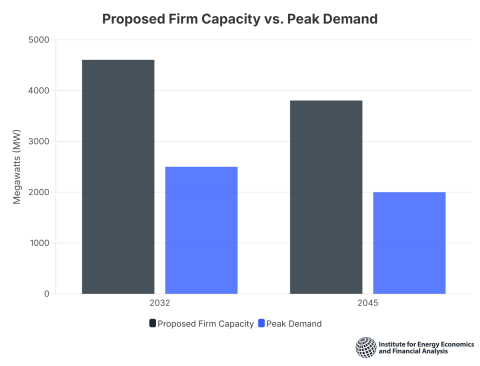
The Puerto Rican government is poised to overbuild its generation system with fossil fuels, including the Power Expectations 10-year contract; the new contract for a 530-MW Energiza gas plant; and an ongoing procurement process for 3,000 MW of additional capacity. If these projects come to fruition, Puerto Rico will be locked into more capacity than it needs and will have to retire fossil fuel plants early to reach its target of 100% renewable energy by 2050.
It appears that the Puerto Rican government has awarded a fossil fuel contract to a firm with little track record or financial capacity to execute a project that is not needed.

Related Research