Hydrogen and carbon capture and storage (CCS) in water-stressed Texas
Download Full Report

Key Findings
The 2027 State Water Plan predicts Texas demand will outpace supply by 16% by 2030.
The five-year plan estimates Texas will need to spend $174 billion by 2080 to meet the future demand of a growing population and expanding economy.
The Texas plan, however, does not account for the increasing demand for water from growing hydrogen, carbon capture, and direct air capture industries.
Evidence suggests that water may be the weak link in Texas's efforts to promote the hydrogen, carbon capture, and direct air capture industries.
Executive Summary
Water availability poses a major risk to planned hydrogen and carbon capture and storage projects. Texas is a prime example of a state struggling to meet existing water demand while simultaneously encouraging the development of new water-intensive businesses and industries. The 2027 Texas State Water Plan projects that by 2030 demand will outstrip supply by 16%, even if all recommended water development projects are completed within their planned timeframes. The plan estimates the state will need to spend $174 billion by 2080 to meet the future demand of a growing population and expanding economy.
However, the state’s water plan fails to include sources of significant water demand that have emerged in the last few years. Hydrogen production operations and other industries dependent on carbon capture and storage (CCS) use enormous amounts of water. More recently, data centers and artificial intelligence (AI) training facilities have been proposed in the state. All three types of facilities will require significant amounts of water, and these newly announced projects are not included in the 2027 water plan.
Proponents of hydrogen and CCS are working to position Texas as a prime location for growth in these emerging sectors. International customers in regions or countries that have clear greenhouse gas (GHG) reduction mandates are the target market for green and blue low-carbon hydrogen, ammonia, and methanol.
The fossil fuel industry believes low natural gas prices from fracked fields in Texas and Louisiana, coupled with generous federal 45V and 45Q tax credits for clean hydrogen production and CCS, are paths to profitability. However, the lack of firm offtake contracts, challenging realities of demand-side incentives, and the shifting politics around federal subsidies make hydrogen and CCS-dependent projects risky undertakings.
In addition to economic risks, hydrogen and CCS-dependent projects also pose substantial risks to local communities. Community concerns about the effects of these projects on local air quality and pipeline routes, as well as storage and transport of hazardous substances such as hydrogen and carbon dioxide (CO2), are significant.
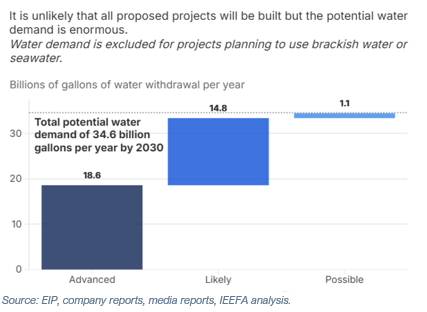
To date, the water demands of these projects have gone largely undiscussed, but they will have very real consequences for other local users. Hydrogen production, CCS systems integration, and direct air capture are water-intensive. Cooling accounts for most of the water required, and even more is needed in states such as Texas, which have large areas that are hotter and may be more humid than the baseline used in system modeling.
In a state already facing serious water challenges, the hydrogen and CCS buildout could bring unwelcome surprises. In some cases, particularly in areas currently experiencing water shortages, there may be conflict between these emerging sectors and residents, ranchers, farmers, or data centers.

Related Content