Improving the EV charging experience in India: Beyond charger deployment
Download Full Report
View Press Release
Key Findings
Several factors influence electric vehicle (EV) sales and adoption rates. One key factor is how easy it is to charge the vehicle, which can make EV ownership either convenient and enjoyable, or frustrating.
Poor reliability of public EV chargers, interoperability hurdles among charging networks, expensive public charging, home charging challenges, and delays in grid connection are some of the issues that currently negatively affect EV charging.
Addressing these issues will require a holistic approach that addresses convenience, cost, and ecosystem enablers in tandem. Policy interventions should aim to reduce friction in EV charging, strengthen charging economics, and accelerate India’s transition to electric mobility.
Introduction
India’s electric vehicle (EV) industry is gradually maturing, enabled by growing sales, steadily rising adoption rates, and improving EV model availability as local manufacturing expands. EV sales have increased over the years, with growth accelerating rapidly to double digits in 2026 across vehicle segments, driven by the West Asia crisis and the resulting rise in fuel prices. Annual sales increased from about 50,000 vehicles in 2016 to around 2.5 million in financial year (FY) 2025-2026. Monthly EV sales in July 2026 grew 63.2% year-on-year to 307,752 units, reflecting the accelerating shift towards electric mobility.
Despite this sales growth, adoption rates (share of EVs in total vehicle sales) remain in the single or low double digits in most vehicle segments. In July 2026, electric two-wheelers accounted for 11.2% of overall sales, electric cars 7.9%, and the adoption rate across all vehicle categories combined was 12.7%.
While several factors influence EV adoption, a key consideration is the availability of and ease of access to charging infrastructure.
Recognising this, both the Government of India and state governments have implemented a range of measures, including direct financial subsidies, regulatory reforms, policy mandates, and simplified administrative processes. Supported by these, the number of public charging stations increased from 5,151 in 2022 to 52,718 by July 2026. With a meaningful number of charging stations installed and the momentum continuing, the task now is to tackle the pain points that undermine the EV charging experience.
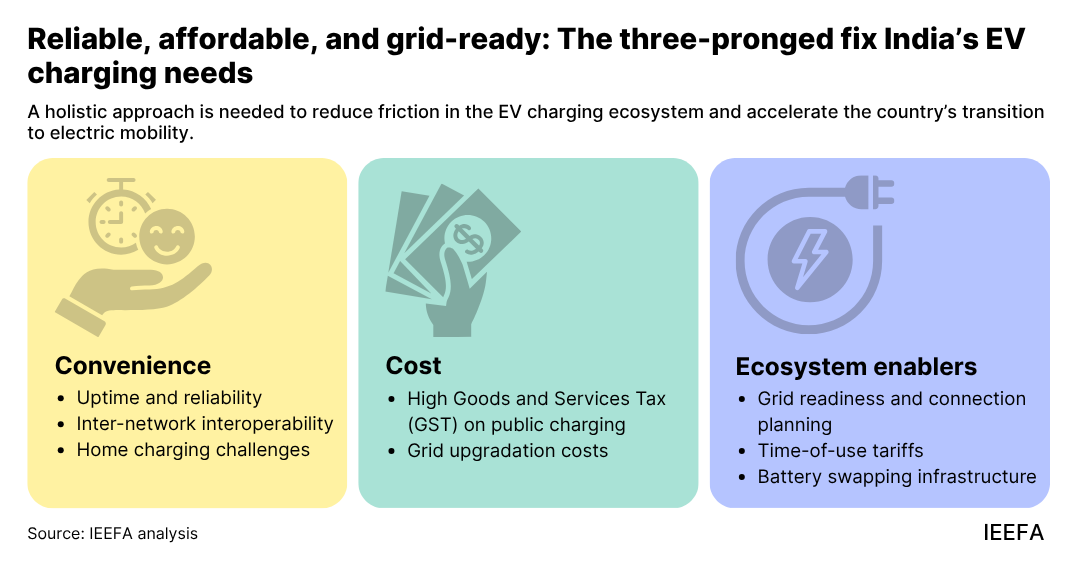
Ease of EV charging depends not just on the number of public chargers, but also their reliability and affordability, and on how seamlessly users can access electricity at home, at work, and in public settings. Three broad dimensions (Figure 1) determine the charging experience: Convenience, which hinges on charger uptime and reliability, interoperability across networks, and the practical challenges of home charging; cost, influenced by the high Goods and Services Tax (GST) on public charging, and the capital expenditure required for grid upgradation; and ecosystem enablers, which include grid readiness and connection planning, the availability of battery-swapping infrastructure, and the design of time-of-use (ToU) tariffs that can shift demand to off-peak hours.
In this briefing note, IEEFA examines factors that affect the ease of charging and proposes solutions to reduce friction, drawing on Delhi (the state that notified the most ambitious EV policy in 2026) as a case study, as well as from a broader India perspective. Our recommendations were shaped by on-the-ground insights gathered from charge point operators (CPOs), which install and operate EV charging stations; Delhi power distribution companies (DISCOMs); and EV users.


Related Content