Recent decisions unearth inconsistencies in coal mine planning and approval processes
Key Findings
A recent spate of legal, planning and legislative decisions have embedded jobs and the public benefit of coal mines as the key criteria for mine approvals in NSW.
The NSW government required a formal job guarantee to support Mount Pleasant, but coal mine approvals don’t guarantee jobs as mines close when they become uneconomic.
Government guidelines should be updated to ensure public benefit assessments account for all emissions and the value of post-mine developments.
Enforceable transition plans should be required three years ahead of a mine’s lease expiry, with failure to provide them resulting in rejection of mine applications.
Note: This analysis is for information and educational purposes only, and is not intended to be read as investment advice. Please click here to read our full disclaimer.
Over a three-week period commencing at the end of September, four landmark decisions were announced that will help shape the future of coal mining in New South Wales (NSW). Encompassing planning, legislation and legal rulings, they highlight the policy and planning improvements that will be needed to support net zero transition pathway legislated by the state government.
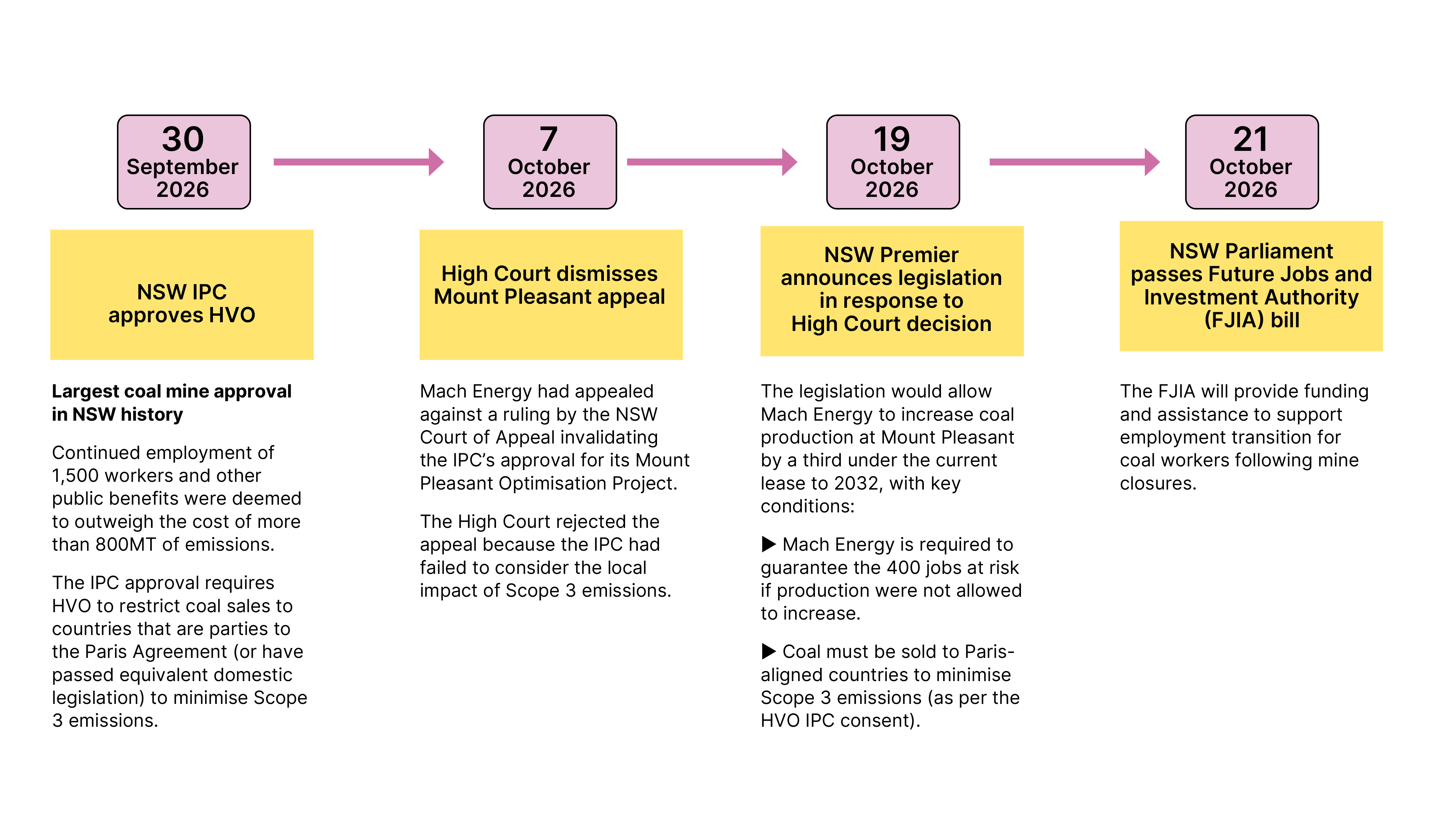
The first decision came on 30 September, when the NSW Independent Planning Commission (IPC) announced the largest coal mine approval in the state's history – Hunter Valley Operations (HVO)'s application to extend operations at two of its mines. A week later on 7 October, the High Court dismissed an appeal by MACH Energy to reinstate the IPC's approval of its Mount Pleasant Optimisation Project, which the NSW Court of Appeal had overruled because it had failed to consider the impact of Scope 3 emissions caused by Mount Pleasant.
In response to the High Court decision, the NSW Premier on 19 October announced legislation that would allow MACH Energy to increase coal production at Mount Pleasant by a third under the current lease to 2032. Finally, on 21 October the NSW Parliament passed a bill to establish the Future Jobs and Investment Authority (FJIA), which will provide funding and assistance to support employment transition for coal workers following mine closures.
Jobs and public benefits are key themes
Each of the decisions is significant in its own right, but viewed together, they highlight the key themes and priorities of the NSW Government within their legal obligations, especially as defined by the High Court of Australia. These are:
- Job protection is the critical factor in IPC and NSW government decisions. The legislation announced on 19 October specified that Mach Energy must guarantee 400 jobs that would be at risk if production were not allowed to increase, while the IPC's HVO ruling indicated that the continued employment of 1,500 workers and other public benefits of the mine outweighed the costs of more than 800 million tonnes of greenhouse gas (GHG) emissions.
- Mining approvals and consequent job protection are justified by reference to the net public benefit created by projects.
- Consideration of all emissions – including Scope 3 – is required as part of the approval process.
- A limitation on exporting only to countries that are a party to the Paris Agreement (or have passed equivalent domestic legislation) is considered sufficient to minimise Scope 3 emissions. Both the IPC's HVO approval and the NSW Premier’s legislation required that coal sales be restricted to Paris-aligned countries.
- Creation of enforceable mine exit plans and the provision of at least three years notice ahead of closures are critical for community certainty.
- The NSW Coal 2026-2050 framework is the keystone policy position to view the assessment of all coal projects.
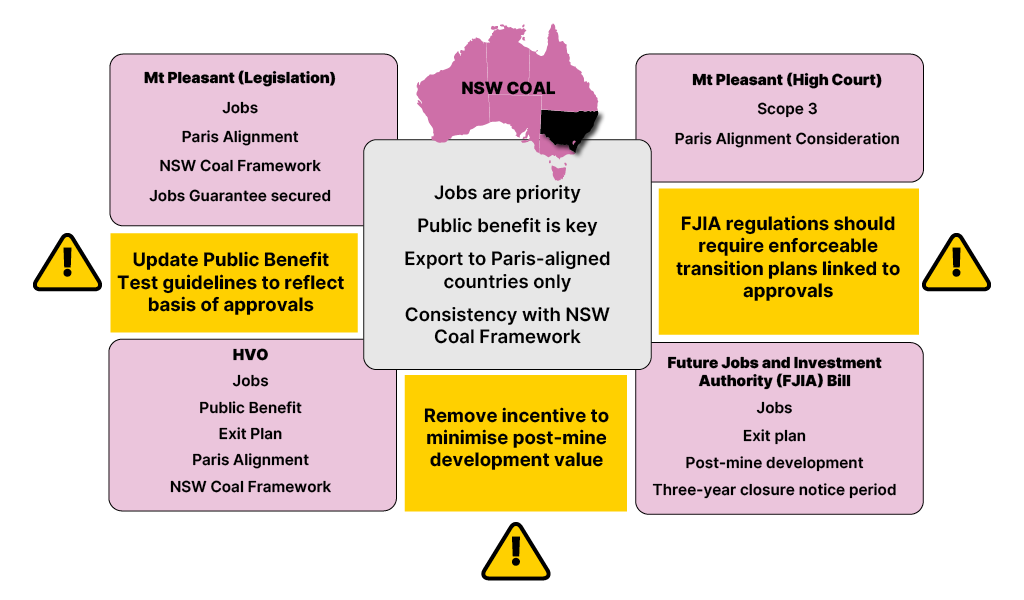
The intersection of the recent decisions with these themes, and the policy adjustments required, are illustrated below:
Decision-making rests on flawed benefit assessments
The prioritisation of public benefits over emission impacts is clearly expressed in the IPC’s statement explaining the HVO approval: “Having regard to the totality of the material, the Commission is satisfied that the GHG impacts of the Project do not warrant refusal and are outweighed by the Project’s economic and social benefits.”
IEEFA has previously commented on the flaws in the methodology outlined in the NSW government’s Guidelines for the economic assessment of mining and coal seam gas proposals. These flaws don’t just reflect a failure to value emissions at the cost established by NSW Treasury to meet legislated emission targets. They also effectively eliminate a large portion of those costs by allowing them to be reduced in line with NSW’s share of the global population.
We are therefore pleased by the Department of Planning, Housing and Infrastructure (DPHI)’s recent statement that the Guidelines are under review. The necessity of this review is heightened by the further inconsistencies the recent decisions highlight:
- The restrictions of sales to Paris-aligned countries highlights the importance of the Paris Agreement to the process, yet there is no requirement to link market assumptions with forecasts aligned to Paris outcomes. IEEFA has previously shown how some market assumptions are based on significantly worse projected temperature outcomes than the Paris targets.
- Notwithstanding the High Court-determined obligation for the IPC to consider the impact of Scope 3 emissions, the cost of these emissions is excluded from the economic impact assessment and should be included. The IPC referenced NSW’s share of international emissions in its HVO decision, which should be a minimum approach for future decisions.
- A proportion of international Scope 3 emissions is, however, a direct consequence of NSW projects. A recent survey of the competitiveness of the NSW coal industry implied that, if mines are not approved, supply would be substituted from less competitive sources, driving up international prices. This in turn would reduce international demand and hence emissions. In IEEFA’s view, demand-side impacts should be fully accounted for in economic assessments.
Moreover, any price increases stemming from project refusals would also raise the royalty value of production from the remaining NSW mines. This would further reduce the public benefit of proposed mines, highlighting the importance of establishing the price effect of the mine. - The significant economic value of post-mine developments is reflected in both the FJIA bill and the NSW Coal Industry 2026-2050 framework, but inclusion of this value is not required in economic assessments of coal projects. IEEFA has previously highlighted the incentive for coal mines to minimise post-mining values (and plans) in applications to maximise the reported public benefit of the mine.
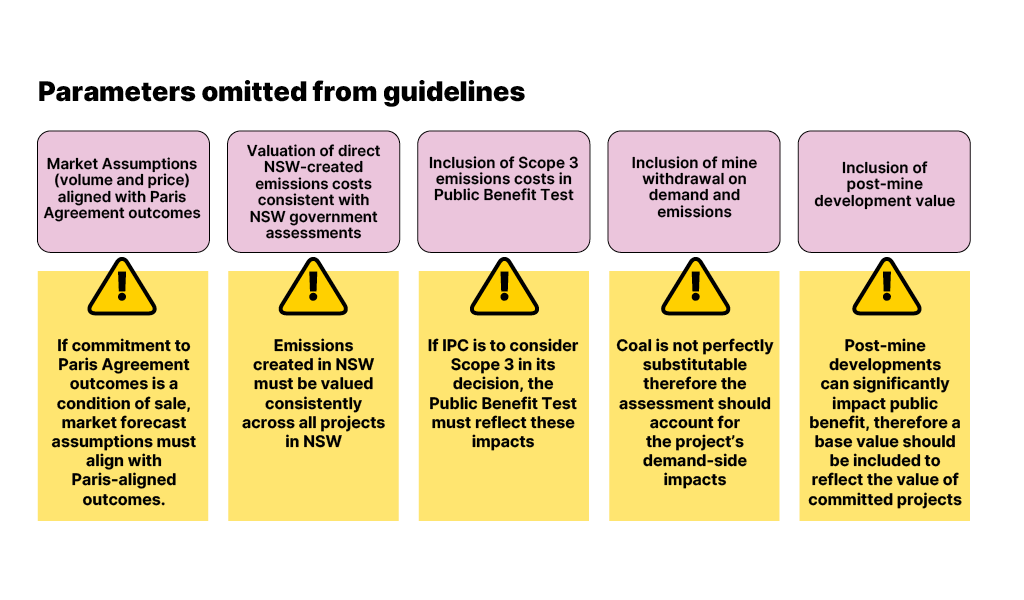
These inconsistencies and omissions can be summarised as follows:
Exit plans are critical
The immediate protection of 1,500 jobs at HVO and 400 jobs at Mount Pleasant has been the priority in the IPC and NSW government’s decisions. IEEFA has suggested the HVO jobs were at risk due to the absence of an exit plan. It is therefore pleasing that the IPC has made provision of an exit plan a key condition of its approval.
This is consistent with the FJIA bill, which requires coal mines to provide three years notice of closure and commence community engagement. Although closure is defined broadly to relate to the permanent end of coal extraction at the mine, the NSW minister does have the power (under Clause 60(2)) to require a mine to develop a workforce transition plan.
As IEEFA has discussed, a mine approval does not guarantee jobs – it merely provides an option to operate while it is economic to do so. By defining the closure of the mine in respect to the continued extraction of coal, the FJIA does not link continued operations to the term of mine approvals.
Submissions from NSW coal producers have highlighted that mine approvals are a key factor in assessing the life of a coal mine. The HVO and Mount Pleasant approval processes showed what occurs if transition plans are not created ahead of extension applications: the lack of a transition plan and the consequent uncertainty on jobs are used as justification to approve further mining.
To avoid these outcomes, IEEFA believes the development of workforce transition plans should be linked to the approved mine life. As a condition of any lease extension, FJIA regulations should require enforceable transition plans be provided at least three years ahead of expiry, with consultation commencing at that point. Transition plans included as part of the application documentation.
With jobs and public benefit underpinning the future assessment of coal mines, IEEFA recommends planning processes be updated to support these priorities. The economic assessment guidelines should accurately assess the public benefits of coal mine projects and the impact of Scope 3 emissions, while enforcing the requirement for rigorous, timely transition plans would offer certainty for communities faced with mine closures.

Related Content