Different geology, different risks: what can go wrong underground in carbon capture and storage?
Key Findings
Apart from enhanced oil recovery, carbon capture and storage projects generally store carbon dioxide (CO2) either in saline formations or depleted oil and gas fields, and each option brings different advantages and risks.
Saline formations offer large storage potential, but pressure can limit injection rates and reduce operational flexibility. At the Gorgon facility in Western Australia, only about 30% of the CO2 removed from its gas was injected during 2022–25, well below the 80% benchmark.
Depleted gas fields offer more information from past production, which can reduce uncertainty, but old wells create potential leakage pathways and can lead to additional costs before and during operation.
Storage problems raise costs for operators and investors, and where governments accept long-term liability, some of that risk can fall on taxpayers.
To evaluate the risks arising when carbon capture and storage (CCS) fails to perform as expected, it’s essential to understand the differing characteristics of the main types of storage used.
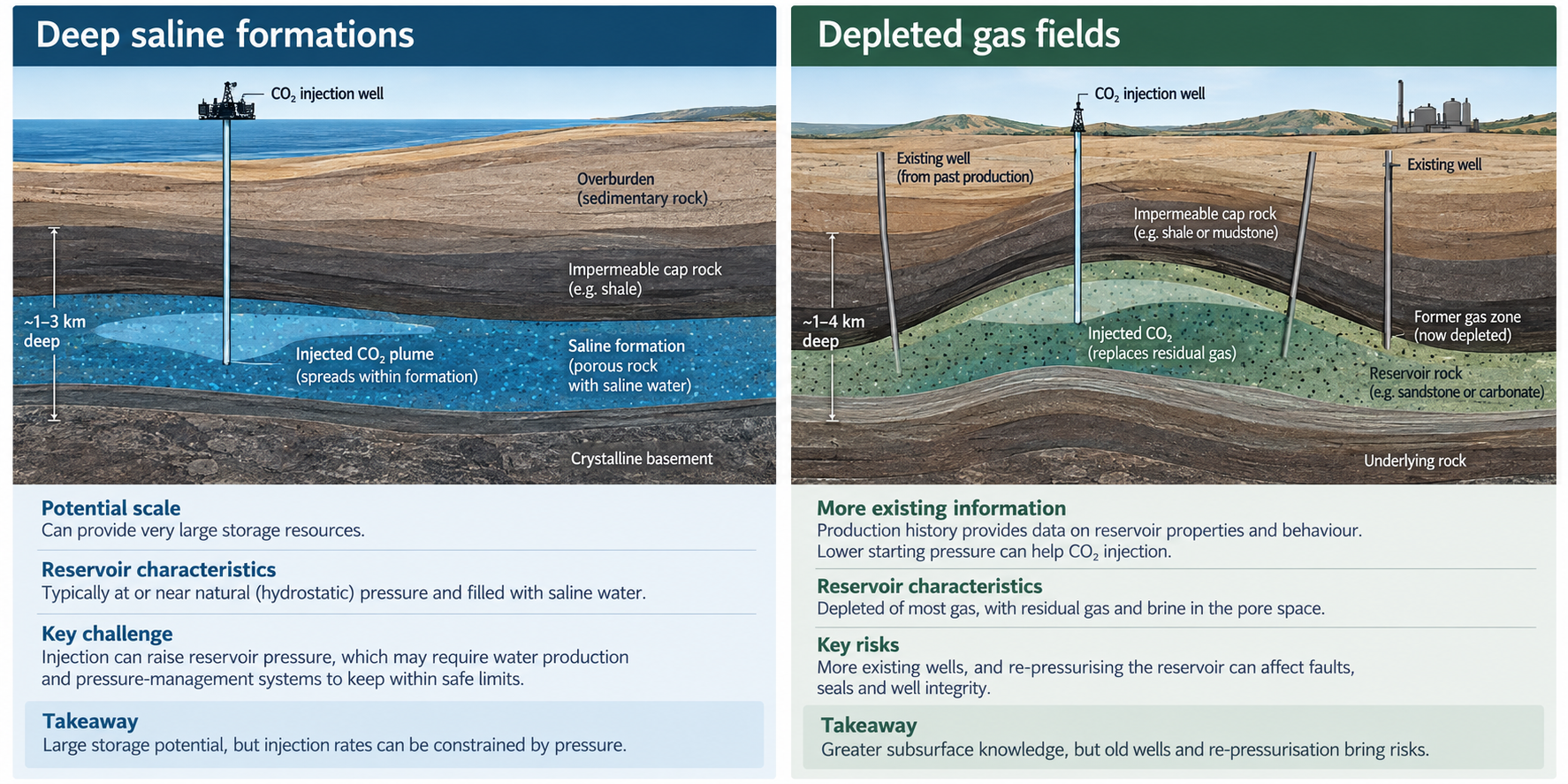
Apart from enhanced oil recovery (EOR), CCS projects usually store carbon dioxide (CO2) in one of two geological settings: depleted oil and gas fields; or deep saline formations – each offering different advantages and risks (Figure 1). Oil and gas fields account for just over half of all operating CCS facilities worldwide. Of the 113 listed by the Global CCS Institute in July 2026, IEEFA counted 53 that use active oil fields for EOR (where CO2 is injected underground to extract more oil). Another six are linked to depleted fields, but three of these are capture plants, not storage sites.
Another 41 facilities are linked to saline storage. Saline formations, however, dominate estimated underground carbon storage potential, accounting for about 96% of the potential resource in the Oil and Gas Climate Initiative’s 2025 catalogue, though much of this potential has not yet been studied in enough detail.
Identifying geological formations capable of storing CO2 does not guarantee a CCS project will be able to inject it at the planned rate or keep it underground. If injection falls short, the project may store less CO2 than planned, raising the cost per tonne stored. CO2 leakage can also create long-term liabilities, some of which could ultimately fall on governments.
Figure 1: CCS risks differ between saline formations and depleted gas fields
Source: IEEFA illustration, based on Worden (2024).
Saline formations: big storage potential, with pressure constraints
Saline formations are deep layers of porous rock filled with saline water, and their CO2 storage potential can be huge. But because they already hold water, injecting CO2 can materially increase subsurface pressure, which may require operators to slow injection or implement pressure-management systems (by drilling wells to extract water from the formation).
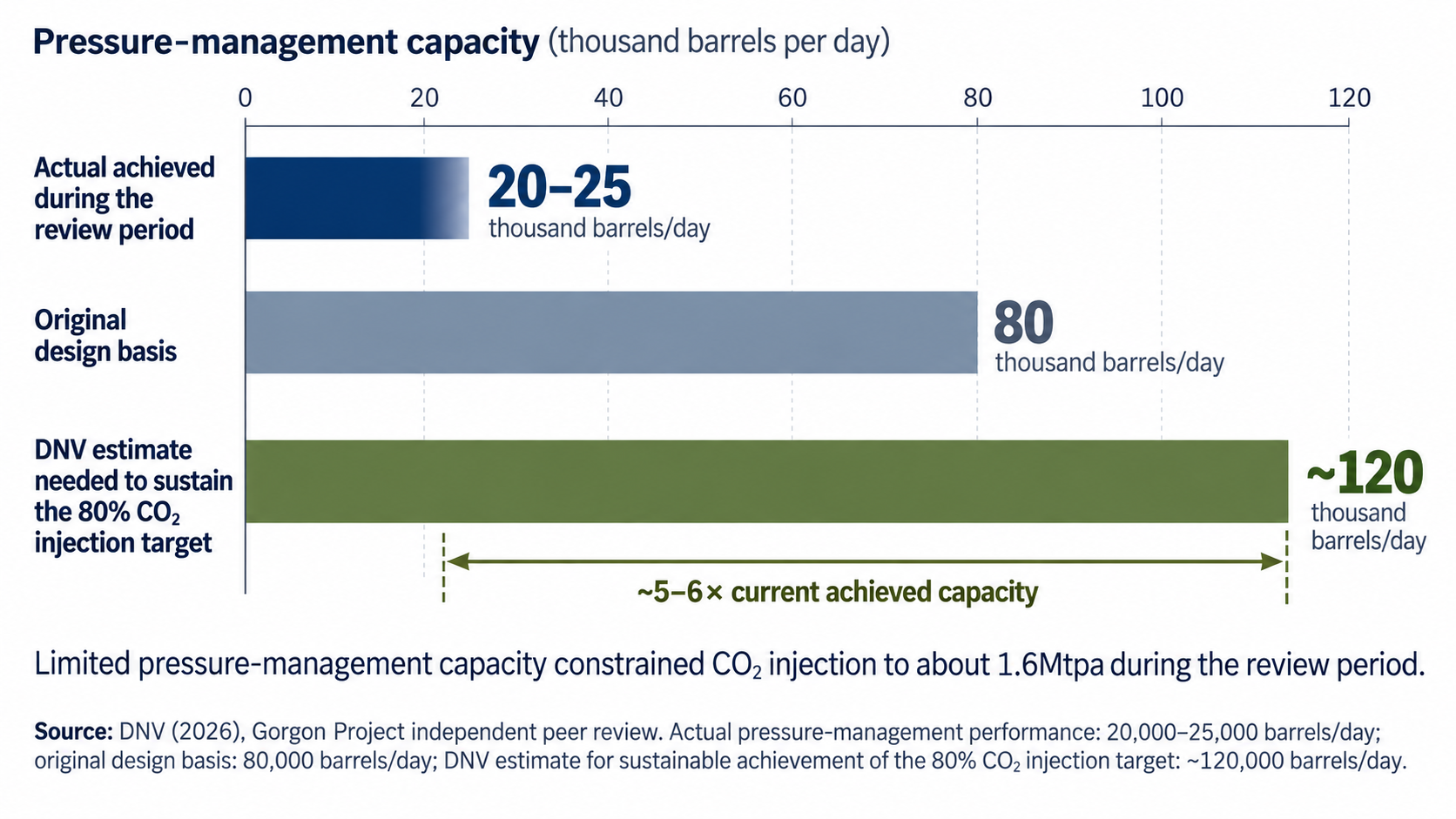
The Gorgon CCS project, located at Chevron’s Gorgon LNG facility on Barrow Island off Western Australia’s north-west coast, is one of the largest in the world. Since August 2019, it has injected CO2 removed from natural gas into a deep saline formation, but annual injections have remained well below the planned rate of 3.3–4 million tonnes a year. One major constraint has been its pressure-management system: an independent review in 2026 found it did not have enough capacity to manage pressure at the planned injection rate (Figure 2).
Figure 2: Gorgon’s pressure management fell well short of what was needed
Source: IEEFA analysis based on DNV’s 2026 independent review of the Gorgon CCS project.
The pressure problems are reflected in Gorgon’s performance. Chevron’s March 2026 report shows that Gorgon injected about 30% of the reservoir CO2 removed from its natural gas between October 2022 and June 2025, well below the 80% benchmark in its approval conditions. To manage underground pressure, Chevron limited injection to about 1.6 million tonnes a year and cut injection rates further during remediation work. Annual injections fell from 1.59 million tonnes in FY2023–24 (30% of the CO2 removed) to 1.33 million tonnes in FY2024–25 (25%), and rose slightly to 1.46 million tonnes in FY2025–26 (26%), still less than half the planned rate.
The financial consequences extend beyond lower storage volumes. Gorgon CCS’s reported capital cost rose from AU$2.5 billion in FY2019–20 to AU$3.2 billion by FY2022–23. Based on analysis of Chevron’s performance figures, IEEFA estimated an effective cost of AU$265 per tonne of CO2 captured in FY2024–25. This is nearly four times IEEFA’s initial estimate of a theoretical cost of AU$70 per tonne, based on project costs of AU$2.5 billion and annual capture rate of 4 million tonnes of CO₂. Further spending is already under way: Chevron began site works in late 2025 for seven new wells and a new pressure-management facility, but has given no cost or date for reaching the 80% benchmark.
Norway’s Snøhvit project, often cited as a CCS success, encountered similar issues. It began injecting CO₂ removed from natural gas beneath the Barents Sea in 2008, into a saline formation expected to hold around 18 years of injections. Pressure rose faster than expected: the formation still had space for more CO2, but the rock around the injection well could not accept it at the planned rate without risking damage to the sealing rock. In 2011, the operator switched injection to a shallower formation. The CO2 still went into water-filled rock, but that rock was connected to the producing gas reservoir, so in 2016 the operator drilled another injection well in a separate part of the field to reduce the risk of CO2 reaching the gas wells.
While there are large resource estimates for saline aquifers, these reveal little about how much CO2 can actually be stored. The International Energy Agency (IEA) notes that volume-based estimates do not represent actual storage capacity because injection rate and duration can be the limiting factor. At Gorgon and Snøhvit alike, the binding constraint was the injection rate, and in both cases a lower-than-expected rate required additional wells and equipment. For project economics, a site’s sustainable injection rate may matter more than the size of its estimated storage resource. Lower injection spreads fixed costs over fewer tonnes, raising the cost of each tonne stored.
Depleted fields: a head start, but old wells bring new risks
Depleted oil and gas fields offer one clear advantage over saline formations: years of production data. That data gives operators much more information about the reservoir’s geology, pressure, chemistry and fluid behaviour, allowing more informed project design, which may reduce uncertainty. Depleted gas fields can offer another early advantage because past extraction has lowered reservoir pressure, giving operators more room to inject CO2 before pressure builds again.
Past production, however, introduces a key risk: old wells. Depleted fields generally contain more wells than saline formations because of their production history, and some were plugged before CCS was considered, leaving potential pathways for CO2 leakage. That said, saline formations are not entirely free of this risk. They can be crossed by wells drilled to reach deeper oil and gas reservoirs, and some contain wells used to inject wastewater.
Faults can occur naturally in both saline formations and depleted fields. If injection pressure rises too far, existing faults could move or the sealing rock could fracture, potentially creating pathways for CO2 to escape. In depleted fields, years of production have already changed the stresses on faults and seals, which must be assessed as pressure rises again. Operators will face ongoing costs to monitor both CO2 plume behaviour and existing well sites.
Old wells can create costly problems before injection starts or during operation. A 2009 study for the IEA Greenhouse Gas R&D Programme assessed plans to store CO2 in the depleted De Lier gas field in the Netherlands, where 51 wells had been abandoned. Many crossed the proposed storage reservoir with no cement plug at the level of the sealing rock, because they had been abandoned without CCS in mind. Urban and industrial development above some wells also made them hard to reach. Because numerous wells would need expensive remedial work, storage at De Lier was not considered economically feasible.
At Algeria’s In Salah project, CO2 was injected into the water-bearing part of a gas field that was still producing gas. In 2007, injected CO2 reached an old well drilled to assess the gas field, and a small amount escaped through a leaking valve. The leak was minor, but injection at a nearby well was halted for more than two years, not resuming till November 2009 after the old well was permanently sealed.
CCS risks can raise costs and leave lasting liabilities
Routine monitoring, maintenance and closure are expected costs for CCS operators. However, financial risk arises when storage does not perform as planned: extra wells, unplanned work and suspended or slower injection increase the cost per tonne stored.
Long-term liability creates a different financial risk. Unexpected CO2 movement, well failures or loss of containment can require remediation and extend monitoring obligations after injection stops. The IEA notes that this exposure can continue for decades beyond a project’s operating life, and it can be difficult for lenders and investors to quantify, price or insure this risk, which can increase the cost of capital.
Some long-term storage risks can fall on governments. At Gorgon, the Western Australian state government has agreed to cover certain third-party claims relating to CO2 injection once closure conditions are met, no earlier than 15 years after injection ends. Subject to conditions, Australia’s federal government would cover 80% of any amount the state has to pay under this arrangement.
Understanding the risks presented by different underground storage formations is crucial, because when underground performance falls short, the costs do not disappear. They fall on the operator and its investors – and can ultimately be transferred to taxpayers.

Related Content