Polluter pays or taxpayer pays? Weaker EU carbon prices widen the carbon capture funding gap
Download Full Report
View Press Release

Key Findings
Concerns over industrial competitiveness are reshaping the EU’s Emissions Trading System (ETS). Political pressure in 2026 has already contributed to lower carbon prices. European Commission proposals would increase the number of allowances in the market, bringing prices down further.
Long-term EU carbon price expectations have fallen sharply, with Dutch bank ABN AMRO cutting its 2030 forecast by 37% in under a year. This weakens the market incentive for expensive industrial decarbonisation.
This is particularly problematic for carbon capture and storage (CCS) projects. IEEFA estimates that a CCS portfolio equal to the EU’s 2030 target would cost €351 billion over 25 years. Lower forecast carbon prices mean the ETS would cover less of these costs, widening the funding gap by 38%, from €103 billion to €142 billion.
Europe risks replacing the polluter pays principle with a taxpayer pays model. Lower carbon prices, extended free allowances and much larger public decarbonisation funds protect industry. But they weaken the ETS’s incentive to cut emissions and shift technical and economic risk to the public.
Executive summary
The EU is weakening its carbon price, which will require more public money to support industrial decarbonisation. Proposed EU Emissions Trading System (ETS) changes respond to real concerns about industrial competitiveness, but they would also slow the reduction in the supply of EU allowances (permits to emit one tonne of carbon dioxide) and extend free allocation. The effect would be to reduce the cost of emitting and weaken the carbon price signal on which investment in lower-carbon technologies depends.
That matters particularly for carbon capture and storage (CCS), where costs remain high. Dutch bank ABN AMRO’s 2030 forecast for the price of an EU allowance fell from €145 per tonne of carbon dioxide (tCO₂) in September 2025 to €91/tCO₂ in its August 2026 reform scenario. Against estimated full-chain CCS costs (capture, transport and storage) of €191–265/tCO₂, the carbon price leaves project owners a substantial gap to meet through lower costs, higher prices for industrial products, lower returns to companies or public support.
The scale of that gap is significant. In an illustrative CCS portfolio storing 50 million tonnes of CO₂ a year, annual costs reach €11 billion in 2030, compared with €3.8 billion of eligible ETS value. Over 2030–2054, the modelled funding gap rises from €103 billion under ABN AMRO’s May 2026 price assumptions to €142 billion under its August reform scenario. These estimates are illustrative, and actual costs will vary by sector, technology, location, utilisation and transport route. They nevertheless show how much CCS depends on the carbon price and continued public support.
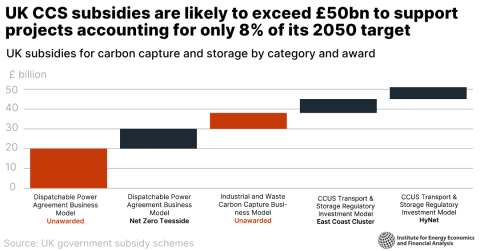
The European Commission’s proposed Industrial Decarbonisation Bank and the recycling of ETS revenues may help projects proceed. But this changes who pays. If industry faces a lower carbon cost, keeps free allowances for longer and then receives public support to decarbonise, more of the financial burden shifts to taxpayers or levy payers. Using auction revenues also leaves less funding available for other public priorities.
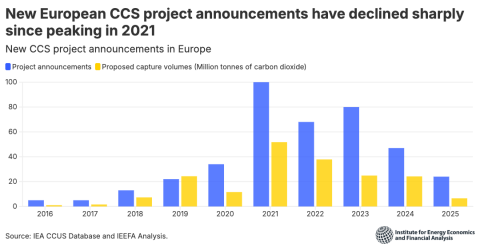
The economics are not the only constraint. The EU’s 2030 CCS ambition is 50 million tonnes of CO₂ of annual injection capacity, yet projects face long development times, permitting delays and technology risks. IEEFA previously found that 66% of proposed European capture volumes were in applications at technology readiness level seven (pre-commercial demonstration) or below and that more proposed capacity was cancelled in 2025 than reached final investment decision.
Europe may still build successful CCS projects, but lower EU allowance price expectations make an already difficult investment case harder. The emerging approach risks making pollution less expensive for emissions-intensive industries while relying on public money to pay for the technologies intended to reduce it. In effect, the EU could be replacing the polluter pays principle with a taxpayer pays model.
Related Research