Solar's growing economic advantage is reshaping power markets
Solar has been among the cheapest sources of new electricity for years. Now rooftop systems are reducing demand for grid electricity, while increasingly affordable batteries are extending solar's usefulness beyond daylight hours.
For investors, the implications extend beyond solar's cost advantage to include lower exposure to volatile fuel prices, changing demand for coal- and gas-fired power, and substantial untapped potential, particularly on business and household rooftops.
Four developments, backed by evidence from markets around the world, are shaping this investment outlook.
1. Cost: Solar’s cost advantage is reshaping power investment decisions
For utilities and investors planning projects that may operate for decades, the comparison with coal and gas is becoming harder to ignore.
Take Indonesia, where coal has long been considered the cheapest generation option. IEEFA's latest analysis estimates utility-scale solar generation costs at 5.6–8.4 US cents per kilowatt-hour, compared with 10–15 cents for coal and 14–21 cents for gas. At the low ends of their respective ranges, solar is about 44% cheaper than coal.
Meanwhile, conventional power is getting more expensive to build in some markets. In the United States, IEEFA found that new combined-cycle gas plant proposals cost at least US$2,500 per kilowatt of capacity, roughly triple the cost of projects built in the early 2020s. Add turbine shortages and construction delays, and the investment case for new gas generation becomes increasingly difficult to justify against available alternatives.
IEEFA’s India analysis reinforces the cost story, citing solar power at around ₹2.7–2.76/kWh (3.2–3.3 US cents), while emphasising the need for storage and demand flexibility to extend its value beyond daylight hours.
2. Energy security: Solar cuts exposure to fuel shocks
Unlike a gas or coal plant, a solar project has no ongoing fuel costs. That gives buyers more certainty over generation costs, especially in countries exposed to imported fuel and unpredictable shipping routes.
Pakistan illustrates how rapidly households and businesses can adopt solar at scale, and how it can reshape electricity markets. Distributed capacity reached 34 gigawatts (GW) in 2025, according to IEEFA, while demand for grid power was nearly 11% lower in FY2025 than in FY2022. Solar contributed to that change alongside weak economic growth and expensive grid electricity. With LNG power less competitive and demand weaker, buyers have sought to divert surplus contracted cargoes.
Europe faces a similar calculation. IEEFA estimates that additional solar and wind generation, alongside heat pumps, reduced EU gas demand by 8.8 billion cubic metres in 2024. That saving cannot be credited to solar alone, and whether renewables displace gas depends on the national power mix. For gas investors, lower future demand matters as much as today's prices.
In Bangladesh, the fuel-price risk was immediate. During 2026 disruptions, the country bought 11 emergency LNG cargoes at nearly three times typical prices, at a cost of around US$880 million. Rooftop solar cannot replace those imports overnight, but it can reduce future exposure.
3. Storage: Solar + batteries are expanding what solar can do
Rapidly falling battery costs are making solar more useful and valuable. Installed utility-scale battery storage costs have fallen 95% since 2010, making it increasingly economical to store cheap daytime electricity for use during evening peaks. Households and businesses can reduce electricity purchases at peak times, while the wider grid benefits from lower demand and reduced reliance on gas generation.
Australia shows how quickly this is reshaping the electricity generation mix. Gas generation fell 34% to its lowest third-quarter level since 2000. During evening peaks, batteries supplied 8% of generation, overtaking gas at 5.1% for the first time. Households with solar and batteries also drew around 75% less grid electricity during evening peaks than those with solar alone.
The household economics can be equally significant. IEEFA modelling in Australia found that combining rooftop solar and batteries with efficient electric appliances and other home upgrades could cut energy bills by 80%–90% for a typical household, depending on location and the upgrades made. These investments can also reduce gas demand and pressure on the electricity grid during peak periods.
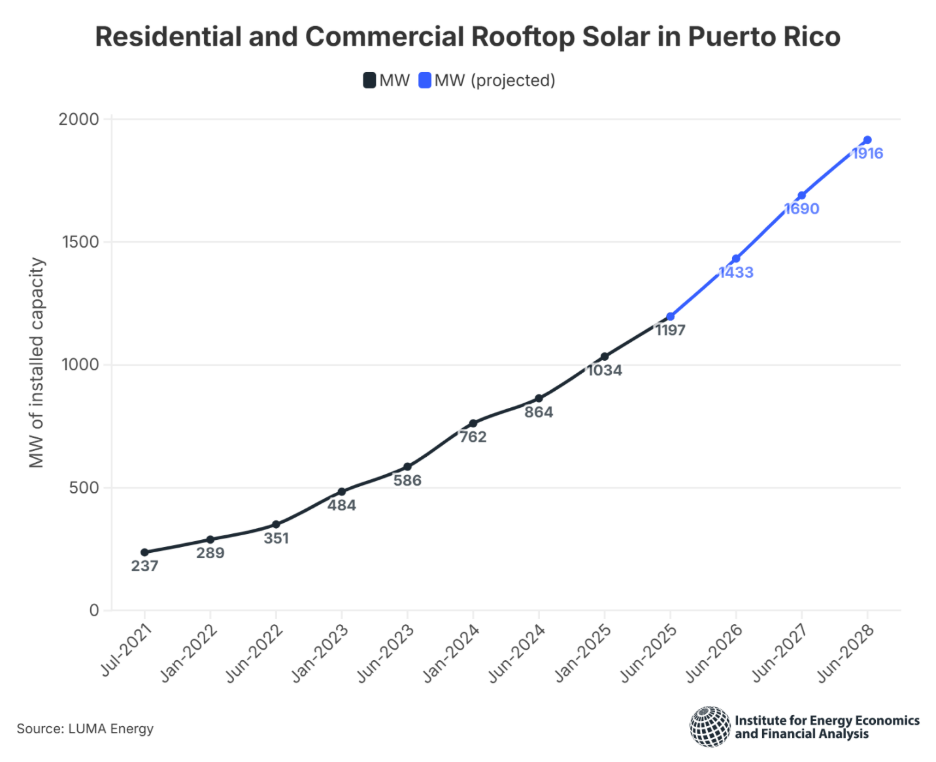
Puerto Rico shows how distributed solar and storage can support grid reliability. By 2025, rooftop solar supplied more than 10% of electricity consumption, and about 83% of rooftop systems included batteries. These batteries are increasingly being aggregated into virtual power plants, with more than 81,000 customers representing 500MW of battery capacity enrolled to help meet peak demand.
4. Untapped potential: Policy and market design are shaping solar growth
Solar's low costs do not automatically translate into widespread adoption. For households and businesses, access to financing, grid connections and electricity tariffs can determine whether rooftop installations make financial sense.
Thailand shows how policy and market design can constrain solar deployment despite attractive economics. IEEFA identifies reforms including net metering, higher buyback rates, tax incentives and relaxed capacity limits. Net metering alone could cut residential payback periods from six to seven years to around four.
Australia offers a contrast. Supportive policies have helped put solar panels on 40% of homes, but business rooftops remain largely untapped, with just 5.6GW installed against nearly 40GW of technical potential. IEEFA analysis finds that better tariffs, targeted incentives and easier grid connections could unlock further investment in commercial solar and storage.
South Asia also has considerable rooftop solar potential. In India, IEEFA and JMK Research found that the PM Surya Ghar programme added 4.9GW across 1.6 million households by July 2025, but only 22.7% of applications had resulted in installations, reflecting financing, installer and approval bottlenecks. In Bangladesh, rooftop solar is central to the government’s 10.45GW renewables roadmap, with a 5.5GW target by 2030 and a new 1% duty cap expected to cut upfront investment costs by roughly 25%.
The increasing investment advantage
For investors, the question is no longer simply whether solar can compete on costs, but which markets can turn these advantages into deployment at scale. Policy, grid access and financing will be critical in determining where the next wave of investment emerges.
- Subscribe to IEEFA’s flagship newsletter Market Signals
- Explore IEEFA’s renewable energy and storage research
This article is adapted from IEEFA Market Signals, IEEFA’s monthly LinkedIn newsletter connecting regional energy-market analysis to global trends, risks and opportunities. Developed by IEEFA Global Communications Project Manager Adam Hunt with input from IEEFA analysts. For future editions read and subscribe to IEEFA Market Signals.