Rethinking Indonesia's electricity economics to reach the 100GW solar target
Download Full Report
View Press Release
Key Findings
Coal is no longer Indonesia’s cheapest source of electricity, with its generation cost rising by 46% to IDR930/kWh in 2025, and estimated to reach IDR1,060/kWh in 2026. Its levelized cost of electricity (LCOE) exceeds that of solar photovoltaic (PV) and onshore wind. At the lowest end of their respective cost ranges, solar is approximately 44% cheaper than coal, while onshore wind is around 32% cheaper.
Changing generation economics have significant financial implications for Indonesia’s national electricity utility, PT Perusahaan Listrik Negara (PLN), and the government. Rising fossil fuel costs, exchange rate volatility, and regulated retail tariffs are widening the gap between electricity supply costs and consumer prices, increasing government subsidies and compensation. Least-cost planning could reduce long-term costs and fiscal pressures.
Electricity costs vary across eastern and western Indonesia, creating different least-cost opportunities. While large interconnected systems in western regions benefit from economies of scale, eastern regions remain heavily dependent on diesel generation. Solar PV paired with battery energy storage systems (BESS) could deliver electricity at a lower cost than diesel.
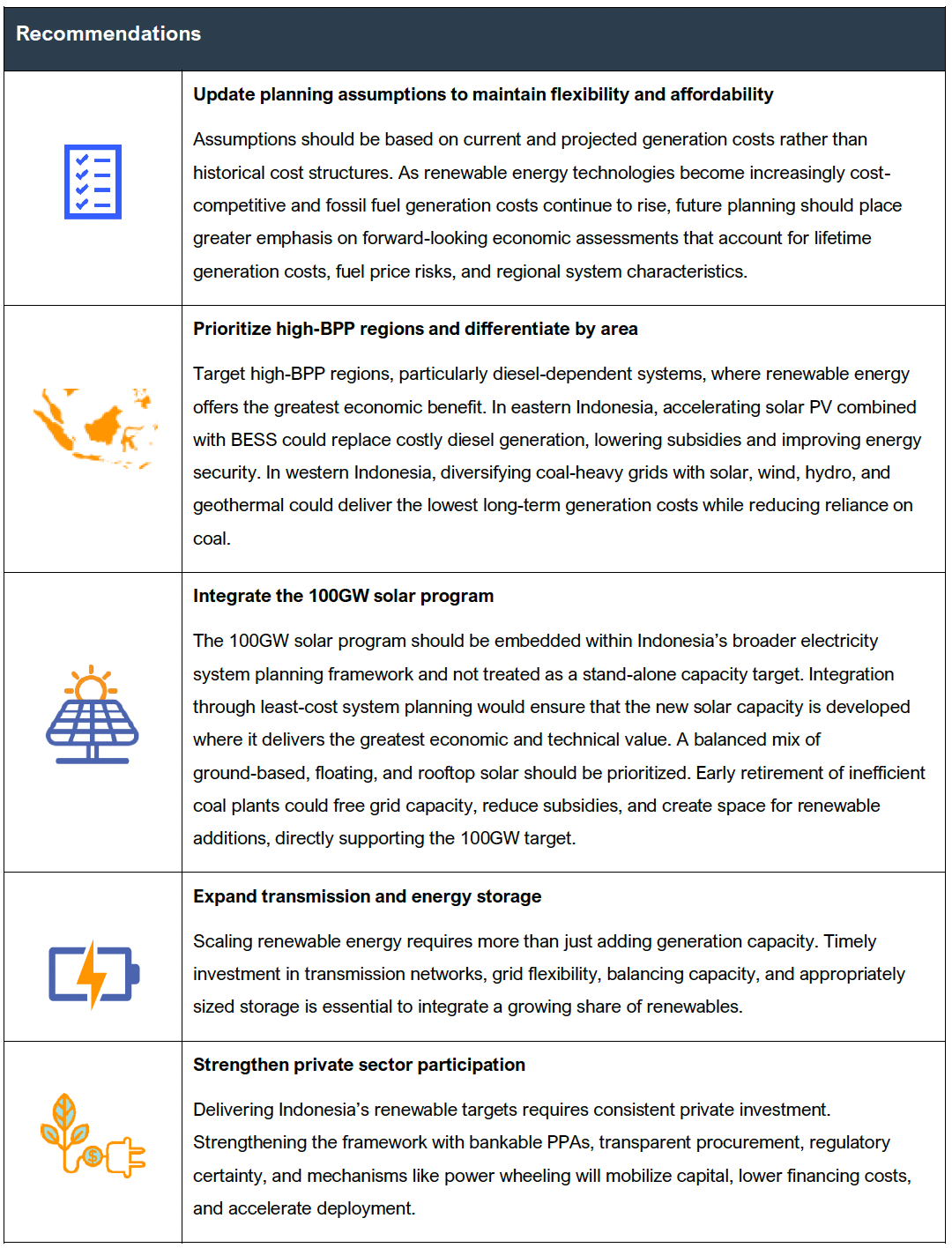
Future Electricity Supply Business Plan (RUPTL) revisions should adopt a dynamic least-cost planning approach reflecting current and projected generation costs, fuel price risks, financing conditions, and regional electricity economics. Embedding Indonesia’s 100GW solar program into the electricity planning framework could reduce electricity costs and strengthen energy security.
Executive Summary
Indonesia's Electricity Supply Business Plan (RUPTL) 2025–2034 targets 69.5 gigawatts (GW) of new generation capacity, including 42.6GW of renewable energy and 10.3GW of energy storage, supported by substantial investment in transmission infrastructure. In June 2025, the Government of Indonesia (GOI) announced an ambitious 100GW solar program1, which President Prabowo Subianto officially launched on 25 August 20262, signaling a greater role for renewable energy in the country's electricity supply. This program is expected to be incorporated into future revisions of RUPTL.3 Together, these plans will require unprecedented investment over the next decade, making cost-effective electricity planning more critical than ever. Developing new generation, transmission, and storage projects at the lowest long-term cost will be essential to maintaining affordability, ensuring the financial sustainability of Indonesia’s national electricity utility, PT Perusahaan Listrik Negara (PLN), and minimizing future subsidy requirements.
For decades, electricity planning in Indonesia has assumed that coal-fired generation is the cheapest electricity source. This premise underpins the use of PLN's Basic Cost of Providing Electricity (Biaya Pokok Penyediaan [BPP]) as the benchmark for electricity planning and renewable energy procurement. However, the economics of electricity have changed significantly. Rising fossil fuel costs, exchange-rate volatility, and aging thermal power plants have increased the cost of conventional generation, while renewable energy technologies have become steadily cheaper.
In 2025, coal-fired generation cost IDR930 per kilowatt-hour (kWh), compared with IDR313/kWh for hydropower and IDR906/kWh for wind. The Institute for Energy Economics and Financial Analysis (IEEFA) estimates that coal-fired generation costs could rise to approximately IDR1,060/kWh in 2026. As a result, some of the economic assumptions underlying Indonesia’s electricity planning no longer fully reflect current market realities. The distortion becomes even clearer when considering the impact of the Domestic Price Obligation (DPO) policy, which masks the true cost of coal generation. Without this policy, the actual cost is estimated to be around IDR1,455/kWh in 2025, highlighting the extent to which regulated pricing influences the apparent cost competitiveness of coal.
The historical cost advantage of fossil fuel generation in Indonesia has narrowed substantially and, in many cases, disappeared. Across the Association of Southeast Asian Nations (ASEAN), utility-scale solar and wind are increasingly cost-competitive with coal-fired generation, while solar photovoltaic (PV) combined with battery energy storage systems (BESS) can already deliver electricity at a lower cost than diesel generation in many remote power systems. Global projections indicate that the costs of solar PV, wind, and BESS are expected to continue declining, further strengthening the long-term competitiveness of renewable energy.
Using the levelized cost of electricity (LCOE) to compare generation technologies shows that coal is no longer the cheapest option in Indonesia’s power mix. Coal’s LCOE, ranging from USD10.0–15.1 cents per kilowatt-hour (¢/kWh), is higher than that of utility-scale solar PV (USD5.6–8.4¢/kWh) and onshore wind (USD6.8–10.3¢/kWh). Gas is the most expensive fossil fuel option, with an LCOE ranging from USD14.0–21.0¢/kWh. At the lower end of the estimates, utility-scale solar is approximately 44% cheaper than coal, while onshore wind is around 32% cheaper. Even at the upper end, solar remains about 16% cheaper than coal at its lowest estimated cost, while onshore wind is broadly comparable to coal at the lower end of coal’s range. Overall, the comparison points to a significant shift in the economics of new power generation, with renewable technologies increasingly offering lower-cost alternatives to coal and gas.
There are also significant regional differences in electricity generation costs, meaning the lowest-cost technology varies across Indonesia. Future investment decisions should therefore reflect regional resource availability and generation costs rather than applying uniform planning assumptions nationwide. While large interconnected systems in western Indonesia benefit from relatively low generation costs, many systems in eastern Indonesia remain heavily dependent on expensive diesel generation. These regions offer the greatest opportunity to reduce electricity costs by replacing diesel with renewable energy and battery storage. Diesel generation costs between IDR5,500/kWh and nearly IDR9,000/kWh in these systems, creating potential for significant savings from solar PV and BESS deployment.
Changing electricity economics also has important implications for PLN's financial sustainability. Under Indonesia's regulated tariff framework, higher electricity generation costs increase the government’s subsidies and compensation burden while placing additional pressure on PLN's finances. Renewable energy can provide a more predictable long-term cost structure by reducing exposure to fuel price volatility and exchange rate risks.
Future RUPTL revisions should adopt a more dynamic least-cost planning approach that incorporates updated generation costs, regional differences, and long-term financial sustainability. Integrating the proposed 100GW solar program into this framework could optimize investments in generation, transmission, and energy storage while attracting greater private sector participation. This approach would help ensure that the scale of investment required under the RUPTL is directed toward the most economically efficient technologies and regions.
Indonesia's challenge is no longer whether renewable energy can compete with fossil fuels, but whether its electricity planning framework can keep pace with rapidly evolving generation economics. Aligning future RUPTL revisions with current market realities could help reduce long-term electricity costs, strengthen PLN's financial sustainability, lower future subsidies, and support the country’s energy transition.
1 Sekretariat Kabinet Republik Indonesia. Pacu Program Energi Surya Nasional 100 Gigawatt, Presiden Prabowo Targetkan 17 Gigawatt PLTS Terbangun Tahun Ini. 21 April 2026.
2 Jakarta Globe. Prabowo Launches 100 GW Solar Power Program. 25 August 2026.
3 Listrik Indonesia. KESDM Tegaskan Target PLTS 100 GW Sudah Masuk Revisi RUPTL. 04 August 2026.



Related Content