South Korea's ESG disclosure framework: A welcome mandate, but lacking urgency

Key Findings
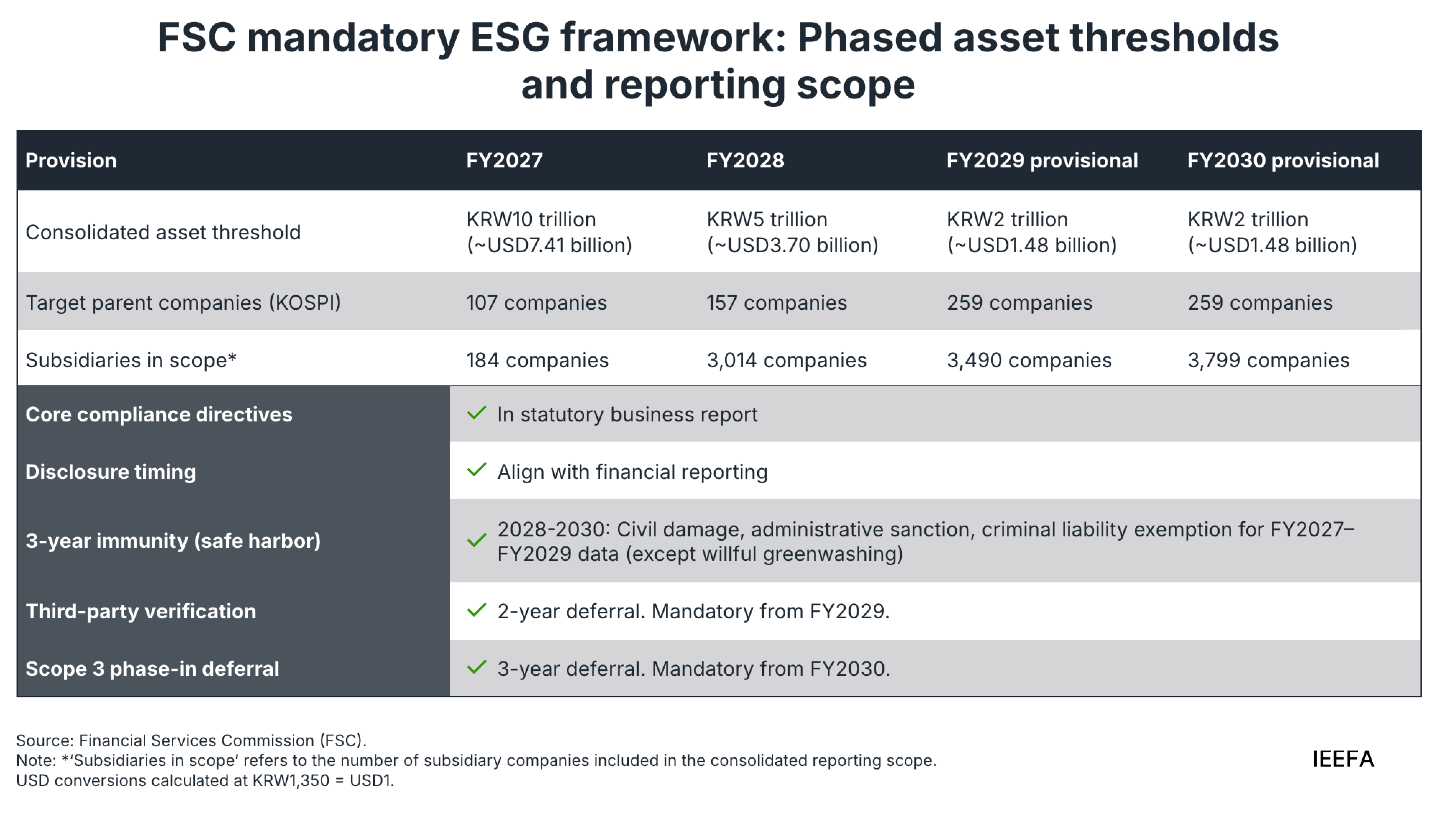
South Korea’s proposed mandatory environmental, social, and governance (ESG) disclosure framework provides a phased mandate beginning in the financial year (FY) 2027 for firms with consolidated assets exceeding KRW10 trillion (USD7.41 billion), with the threshold falling to KRW5 trillion in FY2028 and potentially KRW2 trillion in FY2029.
Current voluntary reporting in South Korea highlights gaps in reliability and comprehensiveness. In 2025, while 68% of reporting firms disclosed Scope 3 emissions, only 49% explained their calculation methodologies, and just 13% disclosed reporting boundaries or underlying assumptions. Consolidated Scope 1 and 2 reporting also remained limited.
South Korea’s three-year safe harbor provision is broader than Japan’s, shielding nearly all disclosed information, including historical data, from liability. Assurance requirements also begin a year later, suggesting a more cautious approach to sustainability reporting.
South Korea’s disclosure framework should be paired with measures to support sustainable finance. A robust measurement system, sector-specific Scope 3 guidelines, and an expanded Life Cycle Inventory (LCI) database can support high-quality disclosure, while incentives and a mandatory green taxonomy could facilitate financing for sustainable activities.
South Korea's Financial Services Commission (FSC) released its proposed framework for mandatory environmental, social, and governance (ESG) disclosures in July 2026, following prolonged consultation with industry, the financial sector, and other stakeholders. The framework establishes standard guidelines for disclosing sustainability-related financial risks and opportunities. It is modeled on the International Financial Reporting Standards General Requirements for Disclosure of Sustainability-related Financial Information (IFRS S1).
While the framework is a step in the right direction, it could do more to encourage sustainable finance. Designed as a standalone disclosure measure, it offers no new incentives to accelerate sustainable finance and leaves the existing, voluntary South Korean taxonomy (K-taxonomy) unchanged.
Gaps in the new ESG disclosure framework continue to constrain sustainable finance. The K-taxonomy remains voluntary, and there is a lack of stringent technical screening criteria for eligible activities. Additionally, clear guidelines on which activities can count toward the national climate finance investment target or the Korea Green Transformation (K-GX) plan are still needed. As long as activities with ambiguous sustainability benefits are included under the plan, investors in green-labeled instruments may question the credibility of K-GX issuances.
As the ESG disclosure framework has not yet been enacted into law, with amendments to the Capital Markets Act currently before the National Assembly, lawmakers still have an opportunity to strengthen it.
This commentary examines three aspects of the South Korean framework: the phased scope and timing, how its safe harbor and assurance provisions compare with Japan’s, and what is still needed to strengthen sustainable finance.
South Korea takes a phased approach to mandatory disclosure
South Korea’s ESG disclosure framework stands out in the region by establishing a firm, phased statutory disclosure mandate rather than relying on voluntary alignment. Companies must include sustainability disclosures in their business reports from the financial year (FY) 2027, beginning with Korea Composite Stock Price Index (KOSPI)-listed firms with consolidated assets exceeding KRW10 trillion (USD7.41 billion). The threshold falls to KRW5 trillion (USD3.70 billion) in FY2028 and potentially to KRW2 trillion (USD1.48 billion) in FY2029.
This approach is closer to the European Union’s (EU) Corporate Sustainability Reporting Directive (CSRD) than to many Asian frameworks. Both the South Korean framework and the CSRD embed disclosure in statutory corporate filings rather than exchange listing rules; phase in coverage by company size rather than requiring universal compliance from day one; and build toward mandatory third-party assurance instead of allowing voluntary verification. Mandatory climate disclosure will be established in the Korea Sustainability Standards Board (KSSB) framework, which is expected to align with the International Sustainability Standards Board (ISSB).
Mandatory disclosure will institutionalize corporate ESG and climate reporting. Companies will have to measure their climate impacts and assess how these could affect their business. This is a significant shift from the current voluntary system. According to a Korea Exchange (KRX) analysis of 2025 disclosure data, a record 225 companies published voluntary sustainability reports, a 10% increase from the previous year. Among the largest domestic issuers — those with market capitalizations exceeding KRW10 trillion (USD7.41 billion) — 86% (50 of 58 firms) were already reporting voluntarily.
However, voluntary reporting has not produced reliable, complete data. Of the 225 companies that published sustainability reports, only three disclosed Scope 1 and 2 emissions on a consolidated basis, including emissions from subsidiaries. Standalone Scope 1 and 2 coverage, meanwhile, was reported by nearly all companies (99%). Value-chain disclosures also lack methodological consistency. While 68% of reporting firms disclosed Scope 3 emissions, only 49% explained their calculation methodologies, and just 13% disclosed specific reporting boundaries or underlying assumptions.
Between 2021 and 2025, the number of reporting companies nearly tripled, but Scope 3 coverage rose only from 66% to 68%. Reporting of Scope 1 and 2 emissions on a consolidated basis remained limited, with only seven companies providing this data in 2024 and just three in 2025. This underscores the limitations of voluntary standards, which do not independently ensure audit-ready, consolidated emissions data.
In a March 2026 opinion letter to the FSC, the National Pension Service (NPS) called for an earlier and broader mandate. It proposed that mandatory reporting begin in FY2026 and apply to companies with assets of KRW2 trillion (USD1.48 billion), arguing that South Korea's timeline lagged behind Singapore and Japan by two to three years. The final framework adopts a lower threshold in later phases, while retaining the KRW10 trillion threshold for the first cohort and a later start date.
How South Korea’s safe harbor and assurance provisions compare with Japan’s
The Sustainability Standards Board of Japan (SSBJ) framework, cited by the NPS as a similar regional example, offers a useful comparison on two features: assurance and safe harbor provisions. Together, these aspects determine how quickly disclosed data becomes trustworthy. Assurance is independent, third-party verification that disclosed data is accurate and complete, similar to a financial audit, but for sustainability information. Safe harbor provisions limit companies' liability for specified disclosures, typically forward-looking statements or information that cannot be readily verified, while reporting practices and data systems mature.
South Korea's new ESG disclosure framework provides a generous three-year liability exemption covering forward-looking, estimated, and third-party-sourced emissions data, as well as historical emissions data disclosed during the initial window. While some legal protection may be justified for new disclosure types, the extent and duration of the provision give companies a relatively long period to strengthen their reporting processes. In contrast, Japan's safe harbor provision is narrower. It covers only Scope 3 emissions and other forward-looking estimates, subject to methodology and reasoning documentation.
Japan also requires assurance sooner: one year after mandatory disclosure begins, compared with two years in South Korea. Japan’s first cohort, companies with market capitalizations exceeding JPY3 trillion (USD19.2 billion), must begin reporting for the financial year ending March 2027 and obtain assurance from the following year. In South Korea, assurance applies from FY2029, with the first assured disclosures published in 2030.
This comparison demonstrates that South Korea has moved more cautiously than Japan in designing these standards. It shields a wider range of disclosed information for longer, while requiring independent verification a year later. As a result, investors and regulators must rely on largely unverified data for longer, just when the new framework is being established.
Using disclosure to support sustainable finance
The South Korean ESG disclosure framework should be paired with a robust measurement system capable of supporting high-quality disclosure. While Scope 3 disclosure has been deferred until FY2030, with exemptions for small and medium-sized enterprises (SMEs) in non-high-carbon sectors, sector-specific Scope 3 calculation guidelines are being developed for 15 export sectors. A 1,000-entry Life Cycle Inventory (LCI) database aligned with the Global Life Cycle Assessment Data Access network (GLAD) system is also being developed. These initiatives are important steps toward building the infrastructure needed to measure and track corporate emissions.
Consistent and comparable reporting can also provide a foundation for broader sustainable finance activity. The FSC could build on the disclosure regime by introducing incentives for sustainable finance and refining the K-taxonomy to facilitate funding for sustainable activities. These measures could, in turn, strengthen the credibility of issuances under the K-GX plan.
The ESG disclosure framework places a welcome emphasis on measurement, data infrastructure, and reporting systems. More comprehensive information can help companies identify and manage climate-related risks, improve their emissions performance, and advance their decarbonization and sustainability goals.
The next challenge for policymakers and South Korean companies is to ensure effective implementation. With the Capital Markets Act amendments still before the National Assembly, lawmakers have a timely opportunity to position South Korea as a regional sustainable finance leader by pairing the ESG disclosure framework with a mandatory K-taxonomy and clearer sustainable finance incentives.


Related Content