Role of distributed resources in energy transition: A multi-country perspective
Download Briefing Note
Key Findings
Despite the continued dominance of centralised electricity systems built around large power plants and transmission networks, distributed energy resources (DERs) are demonstrating their ability to deliver clean, affordable energy. Case studies of Australia, India and Bangladesh highlight the growing role of DERs, with rooftop solar emerging as the dominant source.
In Australia, solar panels are now installed on 40% of homes. Supported by early feed-in tariffs and government rebates, rooftop solar grew from near-zero to 13% of total electricity generation in the country’s largest electricity grid between 2014 and 2025, while coal’s share fell from 75% to 52%. Australia is now experiencing a residential battery boom, with nearly 10 gigawatt-hours (GWh) installed less than a year since federal rebates were introduced.
In Bangladesh, rooftop solar has grown faster than other DERs. While government data reports 418.1 megawatts (MW) of rooftop solar capacity till June 2026, IEEFA estimates it has reached 667MW in 239 establishments, including groups of companies. If the assessment were to include units below 0.15MW, Bangladesh’s rooftop solar capacity might already be around 1,000MW. This growth has contributed to a slight decline in daytime power demand, based on comparisons between 16 April–11 June 2024 and the same period in 2026.
Government-led schemes have driven India’s DER growth, particularly solar. Subsidies, concessional finance, and supportive policies have accelerated rooftop solar and agricultural solarisation, increasing distributed solar capacity from 1.8GW in financial year (FY) 2018 to 31.5GW in FY2026.
Background
Electricity systems have traditionally been built around large power plants and transmission networks. While these centralised systems continue to dominate, distributed energy resources (DERs) — such as rooftop solar, solar irrigation, biogas, and small-scale batteries — are increasingly demonstrating their ability to deliver affordable and clean energy.
As countries electrify their transport systems, electric vehicles (EVs) are also emerging as a potential form of DER through technologies such as vehicle-to-grid (V2G), allowing them to store and feed electricity back into the grid when needed.
Recent global energy supply disruptions, including those triggered by the West Asia crisis and the resulting spikes in fuel prices, have once again highlighted the urgency of accelerating energy transition. Supported by enabling policies, DERs could rapidly transform energy systems across the globe.
Different countries have achieved varying degrees of success in harnessing DERs and their experience could offer valuable lessons for others. For instance, both Australia and India have significantly scaled up DERs in recent years supported by favourable policy frameworks. Meanwhile, after a slow start, Bangladesh’s DER sector is gaining momentum for an accelerated expansion.
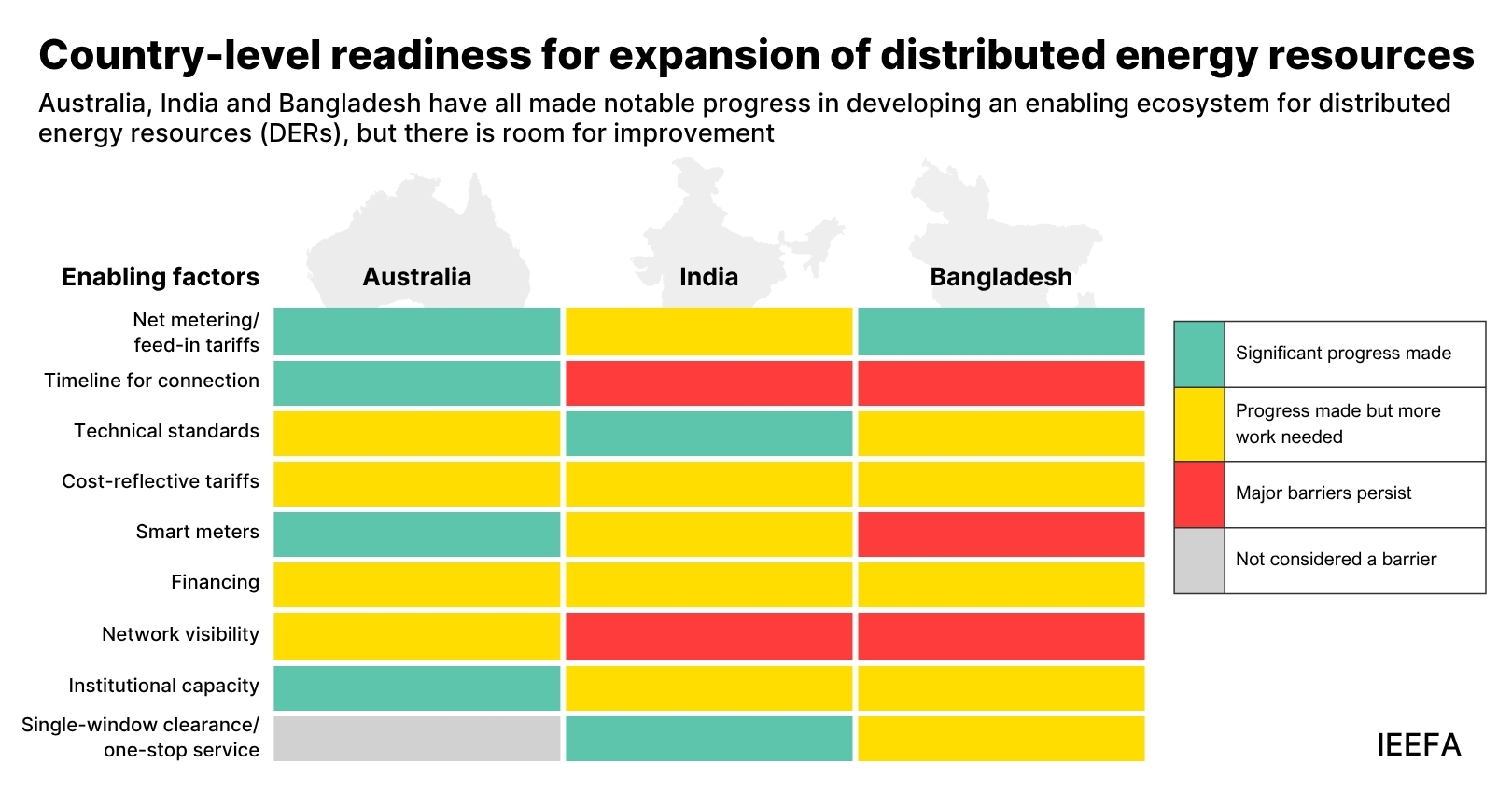
Through country-specific case studies, this briefing note reviews the status of DERs in Australia, India and Bangladesh, and how such technologies are shaping their power sectors. It also assesses the barriers each country faces in realising its DER potential and offers directions for future development.



Related Content