India's distributed renewables hold vast potential, with rooftop solar leading the way
Govt schemes like PM Surya Ghar and PM-KUSUM have helped expand India's distributed energy resource (DER) solar capacity.
Key Takeaways:
Despite the continued dominance of centralised electricity systems built around large power plants and transmission networks, distributed energy resources (DERs), such as rooftop solar, solar irrigation and vehicle-to-grid (V2G) technologies, are demonstrating their ability to deliver clean, affordable energy. Case studies of India, Australia and Bangladesh highlight the growing role of DERs, with rooftop solar emerging as the dominant source.
Government-led schemes have driven India's DER growth, particularly solar. Subsidies, concessional finance, and supportive policies have accelerated rooftop solar and agricultural solarisation, increasing distributed solar capacity from 1.8GW in financial year (FY) 2018 to 31.5GW in FY2026.
In Bangladesh, rooftop solar has grown faster than other DERs. While government data reports 418.1 megawatts (MW) of rooftop solar capacity till June 2026, IEEFA estimates it has reached 667MW in 239 establishments, including groups of companies. If the assessment were to include units below 0.15MW, Bangladesh’s rooftop solar capacity might already be around 1,000MW. This growth has contributed to a slight decline in daytime power demand, based on comparisons between 16 April–11 June 2024 and the same period in 2026.
In Australia, solar panels are now installed on 40% of homes. Supported by early feed-in tariffs and government rebates, rooftop solar grew from near-zero to 13% of total electricity generation in the country’s largest electricity grid between 2014 and 2025, while coal’s share declined from 75% to 52%. Australia is now experiencing a boom in residential batteries, with nearly 10 gigawatt-hour (GWh) capacity installed less than a year since federal rebates were introduced.
4 August 2026 (IEEFA): A new briefing note from the Institute for Energy Economics and Financial Analysis (IEEFA) examines how distributed energy resources (DERs) are increasingly demonstrating their ability to deliver affordable and clean energy. DERs are small-scale power generation and storage technologies, such as rooftop solar, solar irrigation pumps, biogas and batteries, located close to where electricity is used.
Drawing on a comparative analysis of India, Australia, and Bangladesh, the briefing note, titled “Role of distributed resources in energy transition: A multi-country perspective”, finds that rooftop solar has emerged as the single biggest driver of DER growth.
India has significant potential for distributed renewable energy, particularly solar. Government assessments indicate that rooftop solar alone has a technical potential of 637 gigawatts (GW), while the agriculture sector offers a major opportunity through more than 29 million irrigation pumps that can be solarised.
“In India, DER growth has been driven by two flagship schemes, PM Surya Ghar Muft Bijli Yojana and Pradhan Mantri Kisan Urja Suraksha evam Utthaan Mahabhiyan (PM-KUSUM). Backed by diverse business models, including capital expenditure (CAPEX), renewable energy service company (RESCO)/operating expenditure (OPEX), and utility-led implementation models, these schemes have broadened market participation and accelerated DER deployment across urban and rural areas,” says co-author Gaurav Upadhyay, Lead Analyst - Sustainable Finance at IEEFA - South Asia.
However, while India’s DER-solar capacity increased sharply from 1.8GW in FY2018 to 31.5GW in FY2026, its share within total renewable energy has remained largely stagnant at around 21–22% over the same period, as utility-scale solar has expanded even faster.
Meanwhile, Australia has been global leader in DER adoption, with solar panels now installed on around 40% of homes. Rooftop solar surged from near-zero to over 13% of generation in Australia's National Electricity Market between 2014 and 2025, as coal's share fell from 75% to 52%. This growth has also pushed wholesale electricity prices close to zero or negative in the middle of the day in most regions.
“Rooftop solar has reshaped Australia's grid, cutting deep into coal's share of generation. Now residential batteries are emerging as the next frontier, with the uptake seen since the launch of the Cheaper Home Batteries Program in July 2025 far exceeding what most forecasts expected,” says Jay Gordon, Energy Finance Analyst, Australian Electricity at IEEFA, and a co-author of the briefing note.
In Bangladesh, after a slow start, the DER sector is beginning to take shape, driven largely by industrial interest in rooftop solar. While government data puts installed rooftop solar capacity at 418.1 megawatts (MW), IEEFA analysis finds that combined capacity across just 239 establishments, including groups of companies, has already reached 667MW, and could be as high as 1,000MW if smaller units (of less than 0.15MW) are included. This growth appears to have contributed to the reduction in daytime power demand.
“The sector is expected to grow further, with engineering, procurement, and construction (EPCs) companies holding a project pipeline of more than 500MW. Bangladesh's diesel-dominated irrigation sector also offers vast opportunities for solar-powered irrigation, with a full transformation of the sector potentially adding 4,000MW of solar capacity and cutting the country's annual diesel import bill by around USD244 million (BDT30 billion),” says Shafiqul Alam, Lead Analyst, Bangladesh Energy, IEEFA - South Asia, and a co-author of the note.
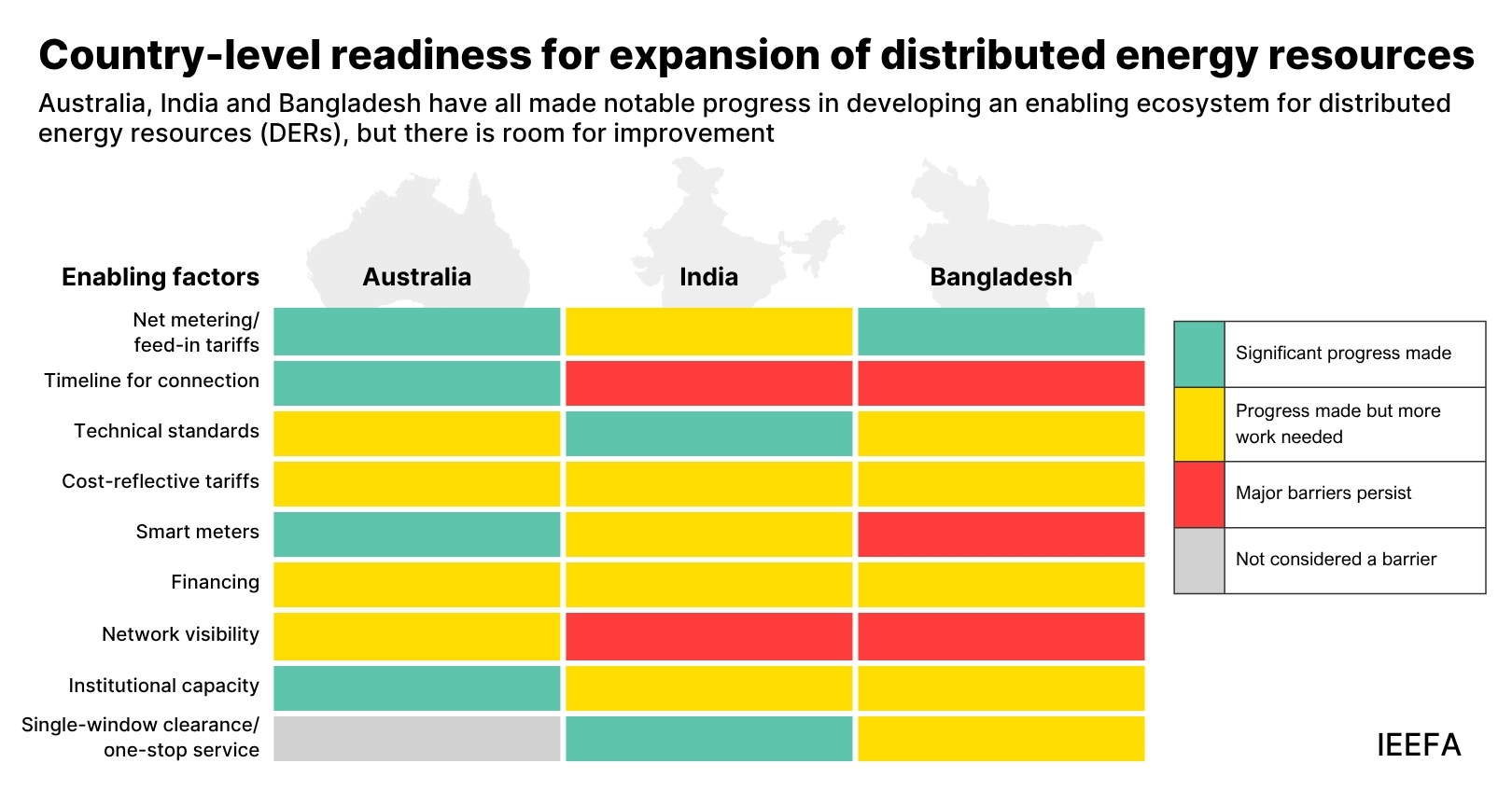
Beyond the individual case studies, the briefing note also looks at how the three countries differ meaningfully in areas such as approval timelines, smart meter rollout and access to financing. The authors call for equitable access to DERs, expanded battery storage alongside solar programmes, smart meter deployment and streamlined financing for households, farmers and small businesses for accelerated DER adoption.
Read the report: Role of distributed resources in energy transition: A multi-country perspective
Media contact: Prionka Jha ([email protected]); +91 9818884854
Author contact: Gaurav Upadhyay ([email protected]); Jay Gordon ([email protected]); Shafiqul Alam ([email protected])
About IEEFA: The Institute for Energy Economics and Financial Analysis (IEEFA) examines issues related to energy markets, trends, and policies. The Institute's mission is to accelerate the transition to a diverse, sustainable and profitable energy economy. (ieefa.org)