Billions of reasons Victoria can’t slow electrification

Key Takeaways:
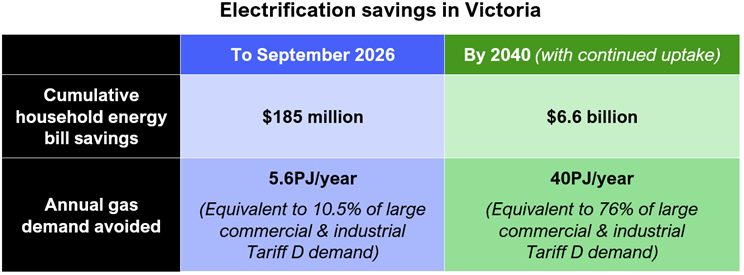
Residential electrification initiatives in Victoria have reduced household energy bills by AU$185 million since 2023. Savings are highest in outer suburban areas and the Latrobe Valley.
Residential electrification has reduced Victoria’s annual gas demand by an estimated
5.6PJ/year since 2023. This is equivalent to 10.5% of demand from large commercial and industrial (Tariff D) users.
Continued uptake of electrification at recent rates could increase household savings to AU$6.6 billion by 2040 alongside 40PJ/year in gas demand savings. This is more than the annual gas consumption from mining and power generation in Victoria combined.
New regulations from 2027 will likely accelerate residential electrification. This is important, as a slowdown in residential electrification could increase energy security risks for large gas users.
24 September 2026 (IEEFA Australia): Electrification policies in Victoria are helping to avert the risk of gas supply gaps while lowering household energy bills, but there is no room for complacency, according to a briefing note released today.
Victorian households consume more gas than in any other part of Australia, and have been hit hard by rising gas prices. Meanwhile, declining gas production in Bass Strait has raised the real risk of future gas supply shortfalls in the state.
These pressures have prompted the Victorian government to implement policies that encourage households to shift to efficient electric appliances.
“The savings on offer are big,” says Jay Gordon, IEEFA’s energy finance analyst, Australian electricity. “A gas ducted heater can cost $1,500–1,600 a year to run compared with $760 for a reverse-cycle air conditioner. A gas hot water system can cost $400–850 a year compared with less than $200 for an efficient heat pump hot water system. Households with rooftop solar can save even more.”
The note, Electrification saves Victorians $185m in three years, analyses the progress of Victoria’s electrification initiatives, and finds:
- More than 190,000 Victorians have switched their gas appliances to efficient electric options since electrification incentives were introduced in 2023, saving a cumulative $185 million on their energy bills.
- These households are saving enough gas each year to supply more than 40% of the state’s annual gas demand for power generation.
- If this rate of electrification continues, the savings could grow to $6.6 billion by 2040, saving enough gas to meet the state’s combined gas demand for power generation and mining.
For the first time, the analysis reveals where Victorians are saving the most from electrification. “Incentives for efficient electric appliances were most popular in the outer suburbs of Melbourne, as well as particular regional areas like the Latrobe Valley,” Mr Gordon says.
While the cost-saving benefits of efficient electric appliances are well established, these results also demonstrate the effect of electrification in reducing gas demand, when compared with the state’s limited options to increase gas supplies.
“By cutting gas demand through electrification, Victoria can mitigate against the risk of future gas supply gaps while lowering energy bills,” Mr Gordon says. “By contrast, importing more gas into Victoria carries significant infrastructure costs that would need to be added to consumer bills.”
While the savings are considerable, they come with a note of caution: Existing policies alone cannot fully mitigate the risk of future gas supply gaps. And if the momentum behind residential electrification momentum falters, this could increase energy security risks for large gas users.
“These results show that electrification policies in Victoria are working,” Mr Gordon says. “However, there’s no room for complacency. Victoria’s major gas users need certainty over the future security of their energy supply. Achieving this will require the successful rollout of further electrification policies, such as new regulations set to commence in 2027.”
These new regulations would require certain gas appliances to be switched to efficient electric alternatives when they reach the end of their useful life. This is likely to accelerate the uptake of residential electrification well above present rates, delivering even higher savings for households and, importantly, providing greater supply certainty for large gas users such as manufacturers.
“To grow the benefits even further, Victoria should consider broadening its electrification policies in future – particularly when it comes to electrifying gas heating, which is one of the biggest culprits behind high energy bills,” Mr Gordon says.