Water-intensive hydrogen and carbon capture buildout not included in Texas' 2027 State Water Plan
Key Takeaways:
The 2027 State Water Plan predicts Texas demand will outpace supply by 16% by 2030.
The five-year plan estimates Texas will need to spend $174 billion by 2080 to meet the future demand of a growing population and expanding economy.
The Texas plan, however, does not account for the increasing demand for water from growing hydrogen, carbon capture, and direct air capture industries.
Evidence suggests that water may be the weak link in Texas's efforts to promote the hydrogen, carbon capture, and direct air capture industries.
October 6, 2026 (IEEFA) – While Texas is promoting the development of hydrogen and CCS-based projects because of favorable federal credits and cheap natural gas, the latest Institute for Energy Economics and Financial Analysis (IEEFA) report finds that water resources may prove to be the weakest link in project viability.
Water availability for industrial and manufacturing purposes is a growing concern. In Texas, 78% of counties are considered to have extremely high water stress, and almost half of its counties have water demand projections that equal or surpass supply. The 2027 State Water Plan predicts that Texas demand will outpace supply by 16% by 2030 but does not include sources of significant water demand that have emerged in the last few years, including hydrogen production and carbon capture and storage (CCS) projects.
Hydrogen production operations and other industries dependent on CCS use enormous amounts of water. “To date, the water demands of these projects have gone largely undiscussed, but they will have very real consequences for other local users,” says Anika Juhn, IEEFA energy data analyst and author of the report.
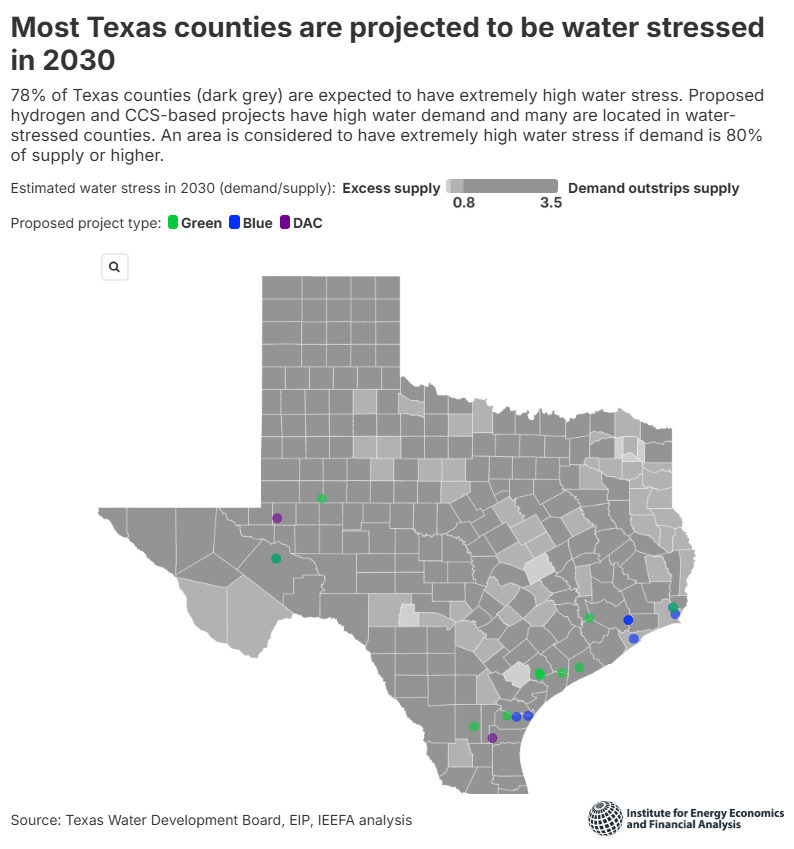
Statewide, the planned hydrogen and CCS-dependent projects most likely to be completed could require an additional 57,000 acre-feet (18.6 billion gallons) of water per year, putting significant new strain on the state’s already-stressed water supplies. Projects that are in early phases of development have an additional 49,000 acre-feet (15.9 billion gallons) of water associated with them. If all these projects are built out to their proposed levels by 2040, there would be about 106,000 acre-feet of demand that is not currently accounted for in the 2027 water plan.
As pressure to expand water-intensive industries increases, Texas will be hard-pressed to develop sufficient water resources to accommodate project plans. Investors should also factor increasing supply concerns into their decisions on proposed projects.