China has transformed from the world’s largest LNG buyer to a competing reseller

Chinese resales of surplus liquefied natural gas (LNG) volumes could exacerbate global oversupply in the coming years
September 24, 2026 (IEEFA Asia): A new report by the Institute for Energy Economics and Financial Analysis (IEEFA) finds that China is managing a growing surplus of liquefied natural gas (LNG) by reselling cargoes abroad.
Plateauing domestic demand, a ballooning portfolio of long-term contracts, and a structural pivot by state-owned enterprises into LNG shipping and trading are positioning Chinese companies as significant competitors to traditional suppliers as the market enters a period of historic oversupply.
China's LNG imports have fallen from a peak of 79 million tonnes (Mt) in 2021 to 66Mt in 2025 and are expected to decline further to 63Mt in 2026. Meanwhile, extensive contracting between 2021 and 2023, during which Chinese buyers signed nearly 60Mt of new supply agreements, has generated a growing surplus of contracted volumes.
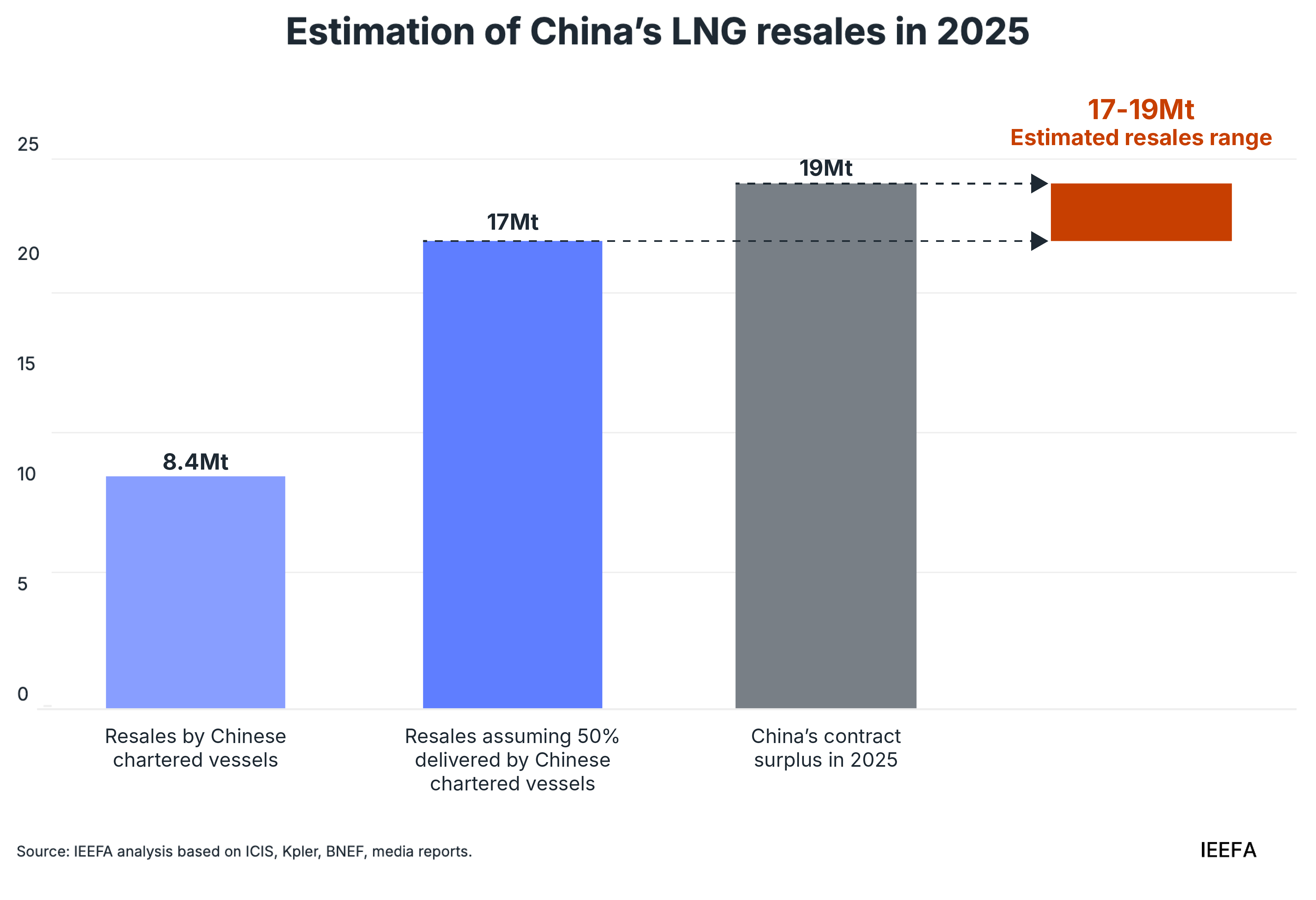
IEEFA estimates that China resold between 17Mt and 19Mt of LNG in 2025 alone, and these resales are set to grow further in 2026. In the first half of the year, China diverted 47% of its handled LNG to buyers in other countries.
Ship-tracking data show that resales by Chinese-chartered vessels reached 8.4Mt in 2025 — a third of China’s total chartered volumes that year. South Korea (19%), Japan (14%), and the Netherlands (9.9%) were the main destinations for these volumes.
Chinese buyers are reselling LNG from the US and Australia
The report estimates that Chinese companies earned USD4.6 billion in profit from reselling LNG sourced from the United States (US) and Australia between 2021 and June 2026.
“Fueling this trend is a surge in flexible long-term contracts, particularly from Australia and the US,” says report co-author Christopher Doleman, IEEFA Asia’s LNG/Gas Specialist. “Growing flexible volumes from Australia have enabled China to optimize its LNG portfolio across the Pacific region, while US supply has largely been leveraged to capitalize on arbitrage opportunities in the Atlantic region.”
Deteriorating US-China trade relations in early 2025 have accelerated these resales. While no US LNG landed in China for over a year, resales of US-based cargoes increased by almost 63% in 2025.
Australian LNG exports have also played an integral role in enabling Chinese resales. Australia’s strategic location, together with the high share of flexible free-on-board (FOB) contracts with Chinese buyers, allows portfolio optimization around the Pacific region. In 2025, a record 1.3Mt of LNG was resold to Japan, Singapore, South Korea, and Taiwan.
State-owned enterprises are expanding LNG trading infrastructure
“The availability of cheaper energy sources in China, including coal, domestic gas production, pipeline imports, and renewables, has relegated LNG to a residual role in the domestic market,” says Sam Reynolds, co-author of the report and IEEFA Asia’s LNG/Gas Research Lead. “Plateauing LNG demand this decade has created a surplus for Chinese LNG buyers, who are increasingly trading volumes that cannot be absorbed at home.”
The state-owned China National Offshore Oil Corporation (CNOOC) and PetroChina Company Limited (PetroChina) are two of the largest Chinese LNG resellers, together accounting for 64% of Chinese charterer resales in 2025.
Both companies are becoming more active in the shipping segment of the LNG supply chain, expanding their LNG carrier fleets, which could integrate LNG trading into operations over the long term. They are also among the world’s largest LNG bunkering suppliers — a growing use of the fuel that could serve as offtake for surplus contracted commitments.
The report notes that with more contracts scheduled for delivery, China is likely to remain oversupplied with LNG until at least the early 2030s, providing additional volumes to support trading activity.
Implications for global LNG markets
Global LNG markets are entering a period of record export growth that is likely to result in prolonged oversupply. More than 274Mt of LNG supply will enter the market between 2026 and 2031, growing capacity by 52% from 2025 levels of 525Mt.
At the same time, uncontracted capacity — stemming from contract rollovers at existing export facilities and new capacity yet to be contracted — could add more than 90Mt of uncommitted LNG supply. Portfolio players will need to find markets for their contracted volumes, and together these factors are likely to exert downward pressure on LNG prices.
As domestic demand stagnates, China’s LNG buyers are actively looking to expand their trading activity, putting Chinese LNG resellers in direct competition with existing suppliers and other aspiring traders.
“Limited demand growth in Asia this decade suggests that the latent growth expected by the gas industry is not guaranteed,” says Doleman. “Structural declines in mature markets such as Japan, and demand destruction in emerging Asian markets, could undermine this expectation.”
“China's emergence as a reseller of surplus LNG exposes the fragile assumptions underlying the current wave of LNG export investment. For those looking to offload LNG over the coming decade — from traditional exporters, marketers, and portfolio traders to emerging merchant buyers — China, the world’s largest LNG customer, could increasingly become one of their most significant competitors,” adds Reynolds.
Read the report: From buyer to broker: China’s emergence as a global LNG reseller
Author contacts:
Christopher Doleman ([email protected])
Sam Reynolds ([email protected])
Media contact: Alex Yu ([email protected])