Rising LNG costs strengthen the case for Vietnam to prioritize domestic renewables for energy security
New LNG-fired power would cost more than Vietnam’s average electricity tariff, while solar and wind can deliver power at less than half the government’s ceiling price for LNG-fired electricity
October 14, 2026 (IEEFA Asia): A new report by the Institute for Energy Economics and Financial Analysis (IEEFA) finds that domestic solar and wind could meet Vietnam’s rapidly growing electricity demand more quickly and economically than liquefied natural gas (LNG)-fired generation.
Vietnam's revised Power Development Plan VIII (PDP8) targets 22.5 gigawatts (GW) of LNG-fired capacity by 2030. If all of it were developed, IEEFA estimates the required LNG imports could cost USD15.5–23.6 billion annually, increasing the country’s energy import bill by around 66–106%.
Russia’s invasion of Ukraine in 2022 and the 2026 Middle East conflict have demonstrated how geopolitical events can rapidly affect global energy supplies and prices. Although Vietnam imports only a limited share of its LNG directly from the Persian Gulf, its reliance on the spot market leaves it critically exposed to global LNG price fluctuations.
“Vietnam cannot control geopolitical disruptions or global LNG prices, but it can control how exposed its power system is to them,” says report co-author Paige Nguyen, IEEFA’s Director, Asia. “Greater reliance on imported LNG risks exposing Vietnam to higher electricity costs and supply disruptions. Prioritizing domestic renewable energy would help the country meet growing demand while strengthening its energy security.”
Rising fuel and construction costs undermine the case for LNG
Higher LNG prices, rising construction costs and longer equipment lead times are weakening the economics of new gas-fired generation.
Since the outbreak of the Middle East conflict, the Japan-Korea Marker (JKM) spot LNG price has averaged USD18.74 per million British thermal units (MMBtu) through the end of August 2026, compared with just below USD12.00/MMBtu between January 2024 and the start of the conflict. For a 1,500 megawatt (MW) power plant, comparable in size to PetroVietnam Power’s recently commissioned Nhon Trach 3 and 4 complex, the country’s first to run exclusively on LNG, this price increase would raise annual fuel costs by around 50%, from approximately USD716 million to USD1.07 billion.
Rising construction costs compound these pressures. Observed capital costs for utility-scale combined-cycle gas turbine (CCGT) plants have increased from around USD700–1,000 per kilowatt (kW) in the early 2020s to around USD2,100–2,500/kW currently.
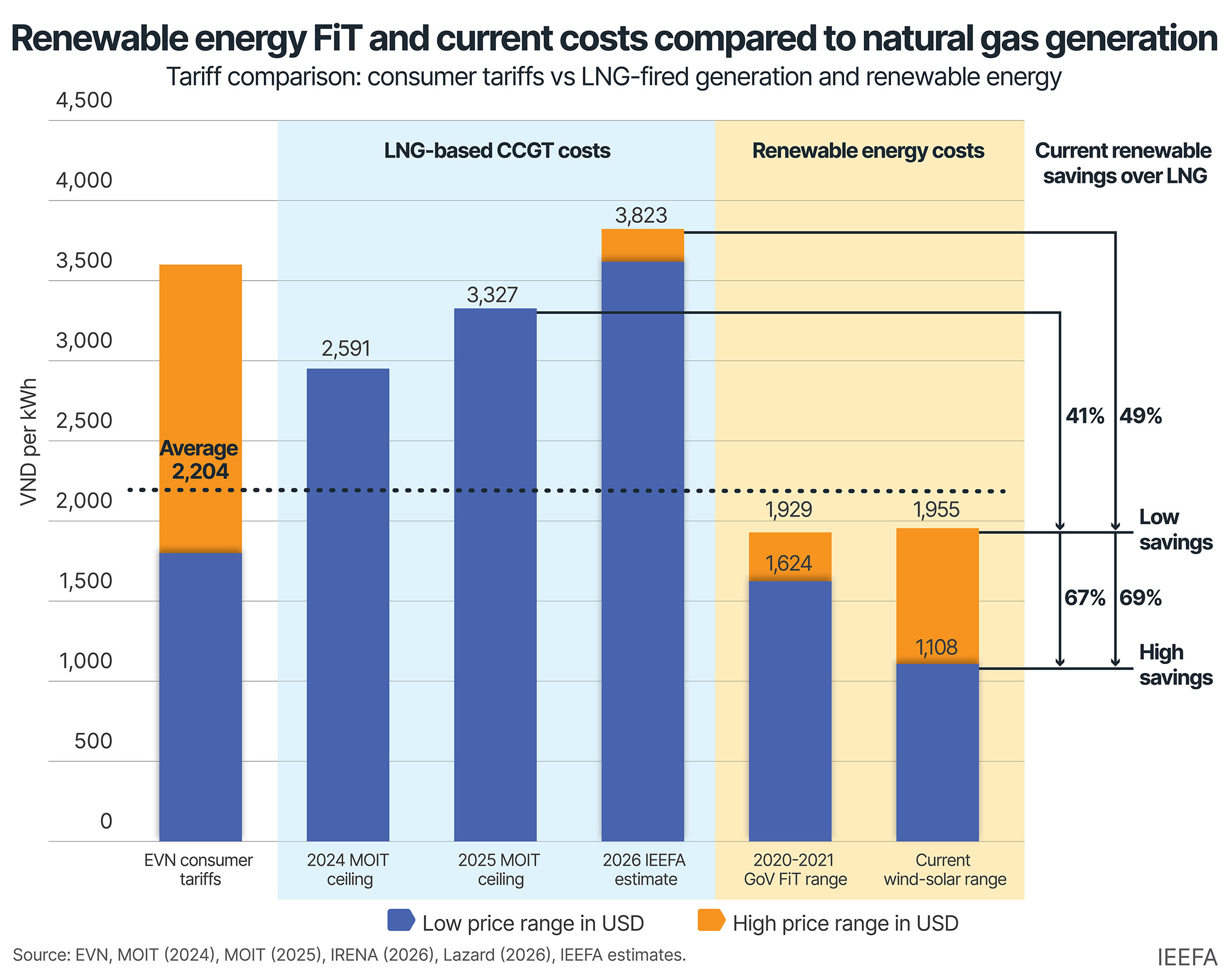
Taken together, IEEFA’s analysis estimates that current LNG-fired generation costs range from VND3,780 per kilowatt-hour (kWh) to VND4,860/kWh (USD140–180 per megawatt-hour [MWh]). This is 14–46% above Vietnam’s ceiling tariff for LNG-fired electricity of VND3,327/kWh (USD129.60/MWh). Even this ceiling is well above the national average retail electricity price of VND2,204/kWh (USD84/MWh).
“Vietnam has already seen the financial consequences of high fuel prices. When rising generation costs cannot be passed on to consumers, the financial burden falls on state utility Vietnam Electricity (EVN), which had accumulated losses of around USD1.7 billion by the end of 2024,” says report co-author Grant Hauber, IEEFA’s Strategic Energy Finance Advisor, Asia. “Expanding gas-fired generation risks adding to these financial pressures, particularly if global fuel prices remain elevated.”
The changing economics are already prompting some investors to reconsider LNG projects. In March 2026, Vingroup JSC, Vietnam’s largest private conglomerate, proposed replacing its planned 4.8GW LNG power project in Hai Phong with a portfolio of solar, wind, and battery storage, citing surging LNG prices.
Renewables offer a cheaper, faster route to new electricity supply
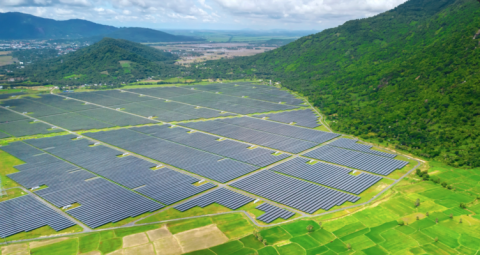
Domestic solar and wind offer a substantially lower-cost alternative to LNG-fired generation. IEEFA estimates the current levelized cost of utility-scale solar in Vietnam at VND1,328–1,625/kWh and onshore wind at VND1,026–1,412/kWh — around 51–60% and 58–69% below the VND3,327/kWh LNG electricity ceiling, respectively.
“Unlike gas-fired power, solar and wind require no ongoing fuel expenditure, giving Vietnam greater certainty over long-term electricity costs,” says Nguyen. “As renewable costs keep falling and gas-fired power becomes more expensive, that widening cost gap should be central to Vietnam’s future power investment decisions.”
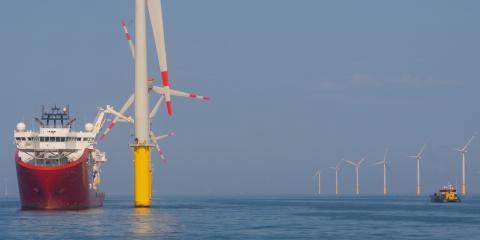
Beyond their cost advantage, renewables can be deployed more quickly and in stages, allowing new capacity to come online as demand grows. Solar projects can become operational in as little as six months, while wind farms can begin generating electricity around one year after construction begins. In contrast, shortages of gas turbines and transformers are extending equipment lead times for new gas-fired plants to 48–60 months, before accounting for construction periods of 30–36 months. These delays could push commissioning of proposed projects well into the 2030s.
Vietnam has already demonstrated its ability to scale up renewable energy rapidly. Between 2018 and 2023, generous 20-year feed-in tariffs (FiTs) helped increase Vietnam’s installed solar and wind capacity from virtually zero to more than 21GW.
“Vietnam enters the next phase of its power sector development with a significant renewable energy advantage. The country has already demonstrated that solar and wind can be deployed rapidly and at scale,” notes Hauber. “The current policy challenge is to capture the cost advantage of renewable energy while providing sufficient certainty to mobilize capital at the pace required.”
Redirecting Vietnam’s power plan toward domestic renewables
To capitalize on the cost and energy security advantages of domestic renewables, the report identifies four priorities for Vietnam’s power sector:
- Shift a greater proportion of near-term power supply development toward domestic renewable energy, which would reduce the additional LNG imports required. As renewable energy and storage capacity expand, some planned LNG projects may prove unnecessary.
- Reassess the scale and sequencing of LNG development by regularly reviewing the 22.5GW LNG target against changing fuel prices, construction costs, equipment availability, project timelines, and Vietnam's longer-term power needs.
- Accelerate investment in grid infrastructure, energy storage, and power system flexibility, which would help reduce congestion and curtailment and enable greater integration of renewable energy.
- Establish a stable and bankable framework for private investment through transparent procurement and pricing mechanisms, such as revised FiTs and competitive renewable energy auctions, and by expanding the existing Direct Power Purchase Agreement (DPPA) framework.
This IEEFA report forms part of the Clean Energy Perspectives on Security and Resilience project, led by Climate Strategies in partnership with the Stanley Center for Peace and Security.
Read the report: Vietnam’s energy security depends on accelerating its clean energy transition
Author contacts:
Paige Nguyen ([email protected])
Grant Hauber ([email protected])
Media contact:
Alex Yu ([email protected])