A market-aligned petrochemical strategy can strengthen IOCL’s returns, climate goals, and India’s energy security
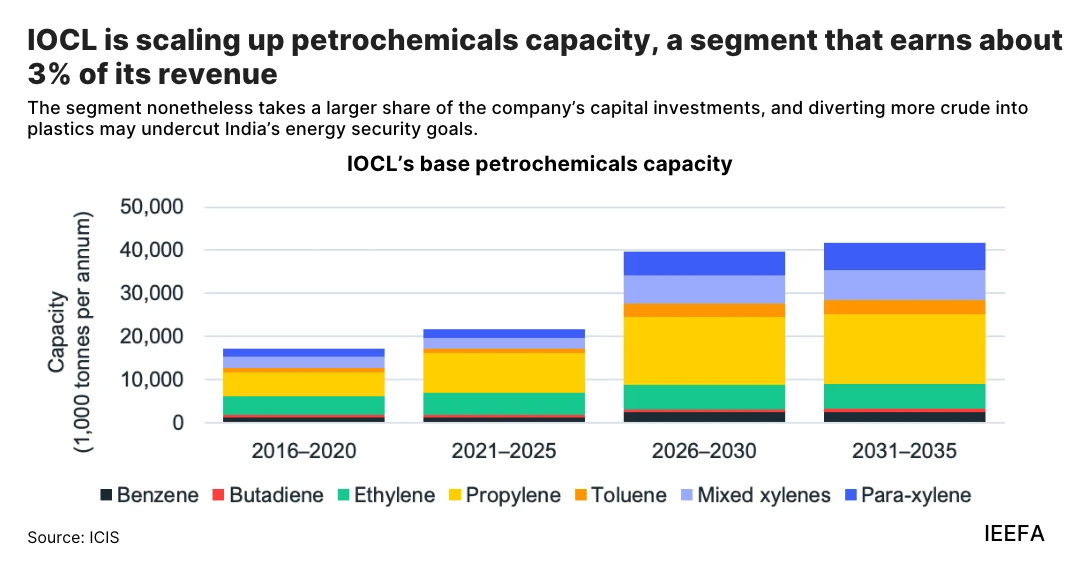
Petrochemicals make up 3% of IOCL’s revenue but attract a growing share of its capital, making the right market choices key to future returns.
Key Takeaways:
IOCL’s petrochemical expansion would benefit from closer consideration of market signals and evolving demand dynamics. The company is adding capacity while global markets face oversupply, slowing demand, and weak margins. IOCL’s profitability depends on growth in domestic consumption, which could be constrained by sustainability regulations.
The petrochemical segment accounts for only around 3% of IOCL’s revenue, while receiving a larger share of the company’s capital investments.
IOCL’s profitability is increasingly exposed to structural pressures in global markets. Oversupply from the US, China, and West Asia, weak downstream demand, and high crude and naphtha prices have narrowed the gap between feedstock costs and polymer selling prices. IOCL is producing more, but higher volumes have not translated into stronger earnings, raising questions about the segment’s returns in the near term.
Decarbonisation strategy of the IOCL focuses primarily on energy-related emissions rather than the core emissions challenges arising from continued fossil fuel and petrochemical expansion. Around 96% of its operational emissions are classified as Scope 1. However, its net-zero strategy relies heavily on renewable energy, green hydrogen, biofuels, and efficiency improvements. These target energy/combustion emissions, not process/feedstock emissions, and cannot offset expansion-driven growth. Scope 3 remains undisclosed.
India imports 88% of its crude oil, so the case for making petrochemical expansion a national priority warrants scrutiny. Directing growing quantities of crude into petrochemical production, particularly non-essential plastics, may run counter to the country’s energy security goals.
27 October 2026 (IEEFA): Indian Oil Corporation Limited (IOCL) — the second-largest petrochemical producer in the country, third largest in Asia, and sixth largest in the world — plans to triple its petrochemical capacity by 2030, even as global markets grapple with surplus supply, softening demand, and thin margins. A new report by IEEFA finds that IOCL’s growth plans could benefit from paying closer attention to market signals and shifting demand trends.
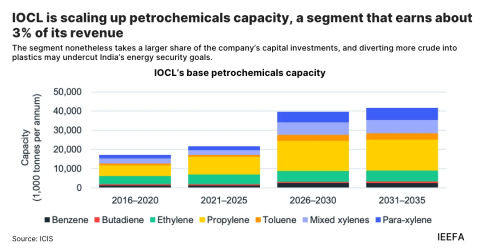
IOCL aims to raise its petrochemical capacity from 4.3 million metric tonnes per annum (MMTPA) to 13.2MMTPA by 2030 and lift its petrochemical intensity index (PII), the share of crude oil a refinery converts into chemical feedstocks, from 6.1% to 15%. The company is expanding across base petrochemicals, intermediates, and polymers to deepen integration and reduce its reliance on transportation fuels. These plans support the central government’s goal of lifting India’s PII from 5% to 15–20% and expanding national capacity from 29.62MMTPA to 46MMTPA by 2030.
Petrochemicals currently make up just 3% of IOCL’s revenue, yet the segment draws a far bigger slice of its capital spending — about 24% of the company’s INR1.04 lakh crore (USD10.86 billion) committed to major ongoing projects. At the same time, the report finds that global market conditions are putting growing pressure on the segment’s earnings. Oversupply from the US, China, and West Asia, weak downstream demand, and elevated crude and naphtha prices have squeezed the margin between what IOCL pays for feedstock and what it earns from selling polymers.
In financial year (FY) 2024-2025, petrochemical revenue climbed to nearly INR28,000 crore (USD2.92 billion), even as profitability deteriorated sharply. This weakness was evident early in the year with segment profit falling by 86.5% year-on-year to INR11.93 crore (USD1.24 million) in the April to June quarter.
“The market that IOCL is expanding into has changed significantly,” says Swathi Seshadri, Research Lead, Global Petrochemicals, IEEFA, and author of the report. “With global oversupply squeezing margins, a more measured expansion that focusses on chemicals for essential uses over commodity polymers could help the company generate more dependable returns.”
With India importing 88% of its crude oil and relying on crude for around 93% of its petrochemical output, the report argues that treating petrochemical expansion as a national priority deserves closer examination. Channelling more crude into petrochemicals, especially for non-essential plastics, could work against the country’s energy security objectives.
“Import substitution will not secure India’s energy needs if the feedstock used to make the petrochemicals is still imported,” adds Swathi Seshadri. “Rationalising demand for non-essential plastics and investing in renewable energy would better serve India’s long-term interests.”
On climate, the report notes that IOCL’s decarbonisation strategy focuses primarily on energy-related emissions. Around 96% of its operational emissions are Scope 1, yet its net-zero strategy relies largely on renewable energy, green hydrogen, biofuels, and efficiency improvements. These target energy or combustion emissions, not process or feedstock emissions, and cannot offset expansion-driven growth. Scope 3 emissions remain undisclosed.
The report recommends that IOCL review the scale of its petrochemical expansion, shift its focus towards chemicals for essential uses, address its Scope 1 emissions, and consider diversifying into alternative and renewable energy sources.
Read the report: Indian Oil's petrochemical push: Weighing the financial, climate, and energy security risks
Media contact: Prionka Jha ([email protected]); +91 9818884854
Author contact: Swathi Seshadri ([email protected])
About IEEFA: The Institute for Energy Economics and Financial Analysis (IEEFA) examines issues related to energy markets, trends, and policies. The Institute’s mission is to accelerate the transition to a diverse, sustainable and profitable energy economy. (ieefa.org)