Energy-efficient fans could cut Bangladesh’s peak power demand by up to 2,590MW: IEEFA
A national programme backed by bulk procurement and carbon revenue could make the switch to energy-efficient BLDC fans affordable for low-income households
Key Takeaways:
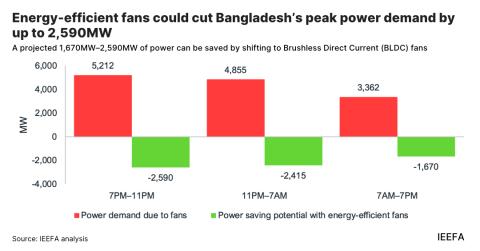
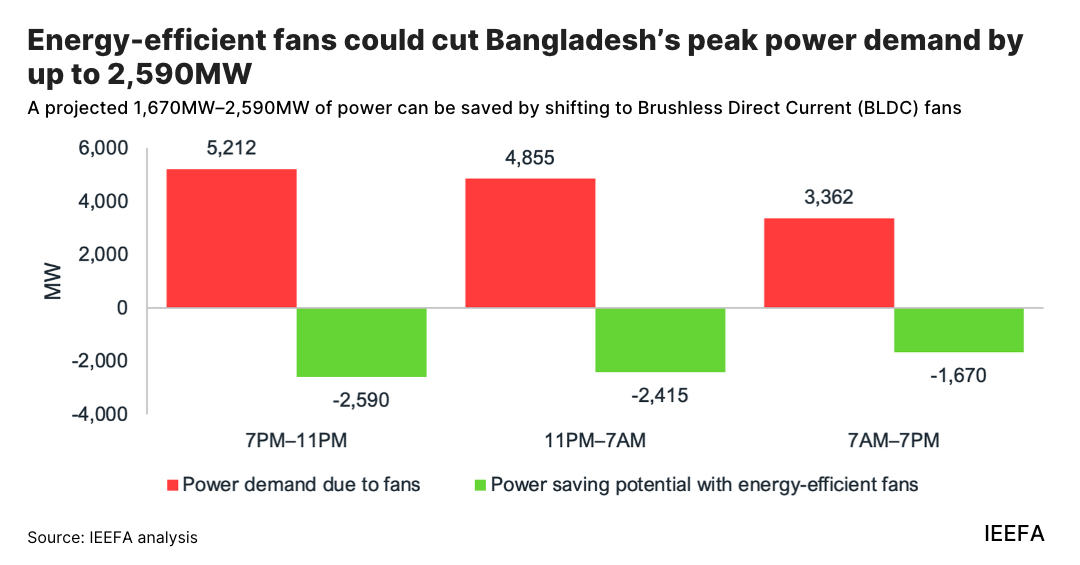
Household fans for space cooling alone account for up to 5,212 megawatts (MW) of Bangladesh’s summer power demand. Yet energy-efficient brushless direct current (BLDC) fans make up less than 2% of household fans.
Replacing energy-inefficient household fans with BLDC fans could cut summer power demand by up to 2,590MW and avoid over USD4 billion in future investment in coal-fired plants. It could also save 6,913 gigawatt-hours (GWh) of electricity a year, worth BDT89.87 billion (USD0.73 billion).
Households lack information on the availability of BLDC fans and their energy-saving potential. In addition to raising awareness, the Sustainable and Renewable Energy Development Authority (SREDA) should finalise standards and labels for fans to nudge consumers towards efficient models.
The government could design a national programme to cut the upfront cost of BLDC fans through bulk procurement and recycle the programme’s carbon revenue to make them affordable for low-income households.
2 November 2026 (IEEFA, South Asia): Household fans add up to 5,212 megawatts (MW) to Bangladesh’s summer power demand, with usage peaking around 9PM. On 27 August 2026, the country’s peak demand hit 19,027MW at 9PM. Replacing energy-inefficient fans with the energy-efficient brushless direct current (BLDC) models could cut peak demand by up to 2,590MW, according to a new report by the Institute for Energy Economics and Financial Analysis (IEEFA).
Drawing on a survey of 435 households, grouped by monthly income, across 26 districts, the report titled Household space cooling in Bangladesh: Role of energy-efficient fans, authored by Shafiqul Alam, Lead Energy Analyst-Bangladesh, IEEFA, explores the potential for energy savings from household fans. It finds that BLDC fans, which run at 35 watts (W) against 70W or more for energy-inefficient fans, make up only 1.4% of the fans in use.
Households account for the largest share of Bangladesh’s grid electricity demand, with fans and air conditioners contributing significantly. The study finds that even low-income households use up to two fans in summer, adding to peak demand. However, high power demand at times results in loadshedding exceeding 3,500MW.
“Global energy supply disruptions have compounded challenges, making it harder for the Bangladesh Power Development Board (BPDB) to meet power demand. Wider adoption of energy-efficient fans will reduce demand and ease the pressure on BPDB,” notes Shafiqul Alam.
Apart from cutting summer power demand, replacing energy-inefficient household fans with BLDC models could avoid over USD4 billion in future investment in coal-fired plants. This avoided upfront capital expenditure would be enough to replace all inefficient fans currently in use across the country.
“The use of BLDC fans would save up to 6,913 gigawatt-hours (GWh) of electricity a year, worth BDT89.87 billion (USD0.73 billion),” adds Shafiqul Alam.
Despite a desire to reduce their electricity bills, consumers’ awareness about efficient fans remains low. 75% of the surveyed households are unaware of the availability of these fans in the market.
When informed about the fans’ energy-saving potential, 96% of the respondents expressed willingness to switch. However, the high upfront cost is a deterrent. While an energy-inefficient fan costs around BDT2,000 (USD16.3), a BLDC fan costs between BDT5,000 (USD40.7) and BDT6,300 (USD51.3). Households earning up to BDT25,000 (USD203.42) a month, about 40% of the total (households), pay an average summer electricity bill of BDT663 (USD5.4) per month. Without financial support, the investment takes 7.7 to 9.6 years to pay back for them. A bulk procurement, combined with carbon revenue, will likely bring down payback period for income group to 4.8 years.
The study, therefore, calls on the government to adopt a structured approach for a smooth and effective transition to energy-efficient fans, including seven steps:
- Design a national programme for energy-efficient household fans and establish a super energy service company (ESCO) to lead its implementation.
- Raise awareness about energy-efficient fans and their cost-saving potential to encourage their adoption.
- Finalise standards and labelling for fans to help households differentiate between energy-efficient and inefficient fans.
- Design a cost-reduction strategy to make BLDC fans affordable for low-income households. This may include a bulk-purchase mechanism and the utilisation of future carbon revenue.
- Establish a financing mechanism for low-income households, for example, through on-bill financing supported by utilities.
- Implement the programme through the super ESCO established.
- Develop a robust framework for quality control and monitoring.
“As Bangladesh’s energy sector challenges mount, the country must prioritise measures that can provide quick relief by curbing demand growth. Energy-efficient fans are one such measure, cutting demand as soon as they are installed,” says Shafiqul Alam.
Read the report: Household space cooling in Bangladesh: Role of energy-efficient fans
Media contact: Prionka Jha ([email protected]); +91 9818884854
Author contact: Shafiqul Alam ([email protected])
About IEEFA: The Institute for Energy Economics and Financial Analysis (IEEFA) examines issues related to energy markets, trends, and policies. The Institute's mission is to accelerate the transition to a diverse, sustainable and profitable energy economy. (ieefa.org)