Household space cooling in Bangladesh: Role of energy-efficient fans
Download Full Report
Key Findings
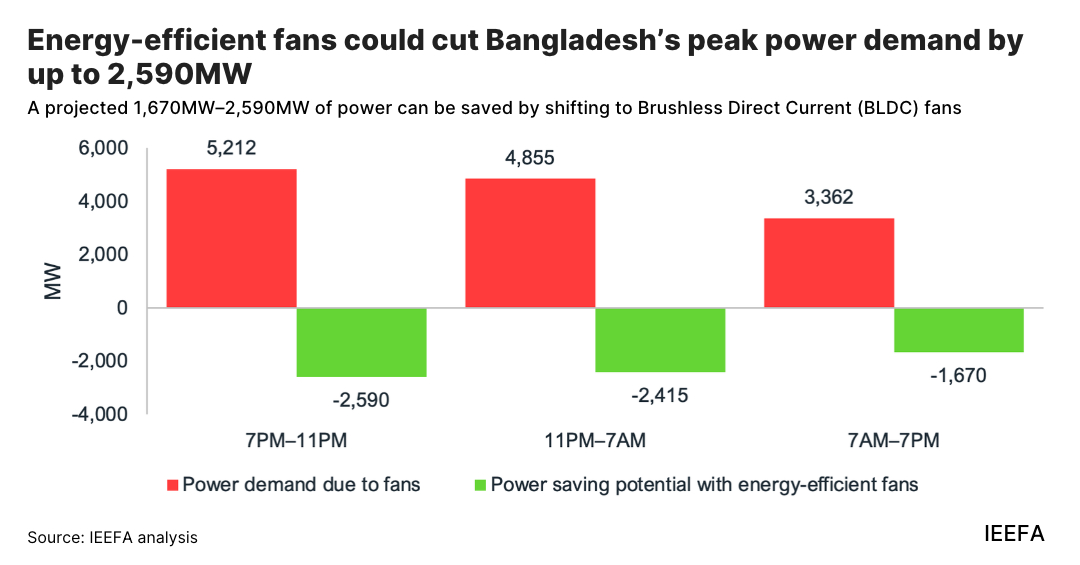
Household fans for space cooling alone account for up to 5,212 megawatts (MW) of Bangladesh’s summer power demand. Yet energy-efficient Brushless Direct Current (BLDC) fans make up less than 2% of household fans.
Replacing energy-inefficient household fans with BLDC fans could cut summer power demand by up to 2,590MW and avoid over USD4 billion in future investment in coal-fired plants. It could also save 6,913 gigawatt-hours (GWh) of electricity a year, worth BDT89.87 billion (USD0.73 billion).
Households lack information on the availability of BLDC fans and their energy-saving potential. In addition to raising awareness, the Sustainable and Renewable Energy Development Authority (SREDA) should finalise standards and labels for fans to nudge consumers towards efficient models.
The government could design a national programme to cut the upfront cost of BLDC fans through bulk procurement and recycle the programme’s carbon revenue to make them affordable for low-income households.
The household sector is the biggest driver of Bangladesh’s grid-based power demand, and space cooling through fans and air conditioners makes up a significant share of it. According to the country’s Energy Efficiency and Conservation Master Plan, daily power demand for household fans accounted for around 1,000 megawatts (MW) against the peak demand of over 6,000MW in May 2014. Further, fan-led energy consumption stood at 6,181 gigawatt-hours (GWh) in fiscal year (FY) 2013-14 against 17,570GWh consumed by all household appliances.
As the country stepped up efforts for 100% electrification and global mean temperature increased, household space cooling demand surged too, adding to utilities’ stress to ramp up power generation. Despite the current installed capacity of 29,143MW, the country finds it challenging to meet power demand when it crosses 16,000MW, resulting in loadshedding of more than 3,000MW.
Against this background, this study surveys 435 households in 26 of the country’s 64 districts, selected through predefined income levels. It identifies fan-usage patterns among different income groups. The survey reveals that less than 2% of the households use energy-efficient Brushless Direct Current (BLDC) fans that are of 35 watts (W), as opposed to energy-inefficient fans of 70W.
The study estimates that the power demand from household space cooling, led by fans, ranges from 3,362MW to 5,212MW, with maximum demand occurring in the evening. Further, it quantifies the annual energy consumption from fans at 13,916GWh, consistent with the draft Bangladesh National Cooling Plan’s projection of 22,174GWh in 2035.
Replacing the vast stock of Bangladesh’s energy-inefficient fans with BLDC fans could reduce power demand by up to 2,590MW, avoiding over USD4 billion (BDT491.6 billion) of investment in new coal-fired plants. The energy-efficient BLDC fans are also likely to reduce 6,913GWh in annual energy consumption, saving the country BDT89.87 billion (USD0.73 billion) per annum.
More than two-thirds of the households covered in the survey were either unfamiliar with BLDC fans or unaware of their availability in the market. When the surveyors informed the respondents about the fans’ energy-saving potential, 96% of the respondents expressed willingness to switch to the energy-efficient models. However, analysis of the survey data by the Institute for Energy Economics and Financial Analysis (IEEFA) shows that the high upfront cost of BLDC fans, combined with low electricity bills among households earning less than BDT25,000 (USD203.42) per month, makes them financially less compelling to this group. For comparison, as opposed to the BDT2,000 (USD16.3) cost of an energy-inefficient fan, BLDC fans cost between BDT5,000 (USD40.7) and BDT6,300 (USD51.3).
Without any financial support, the payback period of investment in a BLDC fan for low-income households ranges from 7.7 to 9.6 years, depending on average operating hours. Payback periods fall below six years for households in other income groups due to their higher electricity bills. This report, therefore, recommends designing measures to reduce costs of BLDC fans for low-income households, supported by bulk procurement. The Indian example shows the potential of bulk procurement, which reduced the upfront cost of light-emitting diode (LED) bulbs by 87%. Further, Bangladesh can earn carbon revenue by selling part of the 86 million tonnes of carbon dioxide (CO2) to be reduced by replacing inefficient fans. This revenue can potentially bring down the price of BLDC fans.
While replacing energy-inefficient fans with BLDC fans is both technically and financially desirable, the government should design a clear implementation plan to ensure a smooth and effective transition. The plan should consider establishing a super Energy Service Company (ESCO) to coordinate the replacement of energy-inefficient fans in around 41 million households. Moreover, it should include an awareness-raising component to inform households about the financial benefits of using BLDC fans. In tandem, the government should develop a costreduction strategy through bulk procurement and the use of future carbon revenue. An on-bill financing mechanism could enable households to pay for the BLDC fans in instalments, eliminating the need for high upfront payment. The plan’s success will significantly hinge on robust quality control and monitoring to restrict the proliferation of sub-standard fans.
As Bangladesh’s energy sector challenges mount, the country must prioritise measures that can provide quick relief by curbing demand growth. Energy-efficient fans are one such measure, cutting demand as soon as they are installed.

Related Content