Mobilising domestic institutional capital in India’s clean energy transition
Download Briefing Note
View Press Release
Key Findings
Domestic institutional investors (DIIs) invest in renewable energy mainly through listed companies and operating assets. Their participation in unlisted clean energy equity remains limited, in both operational and under-construction projects.
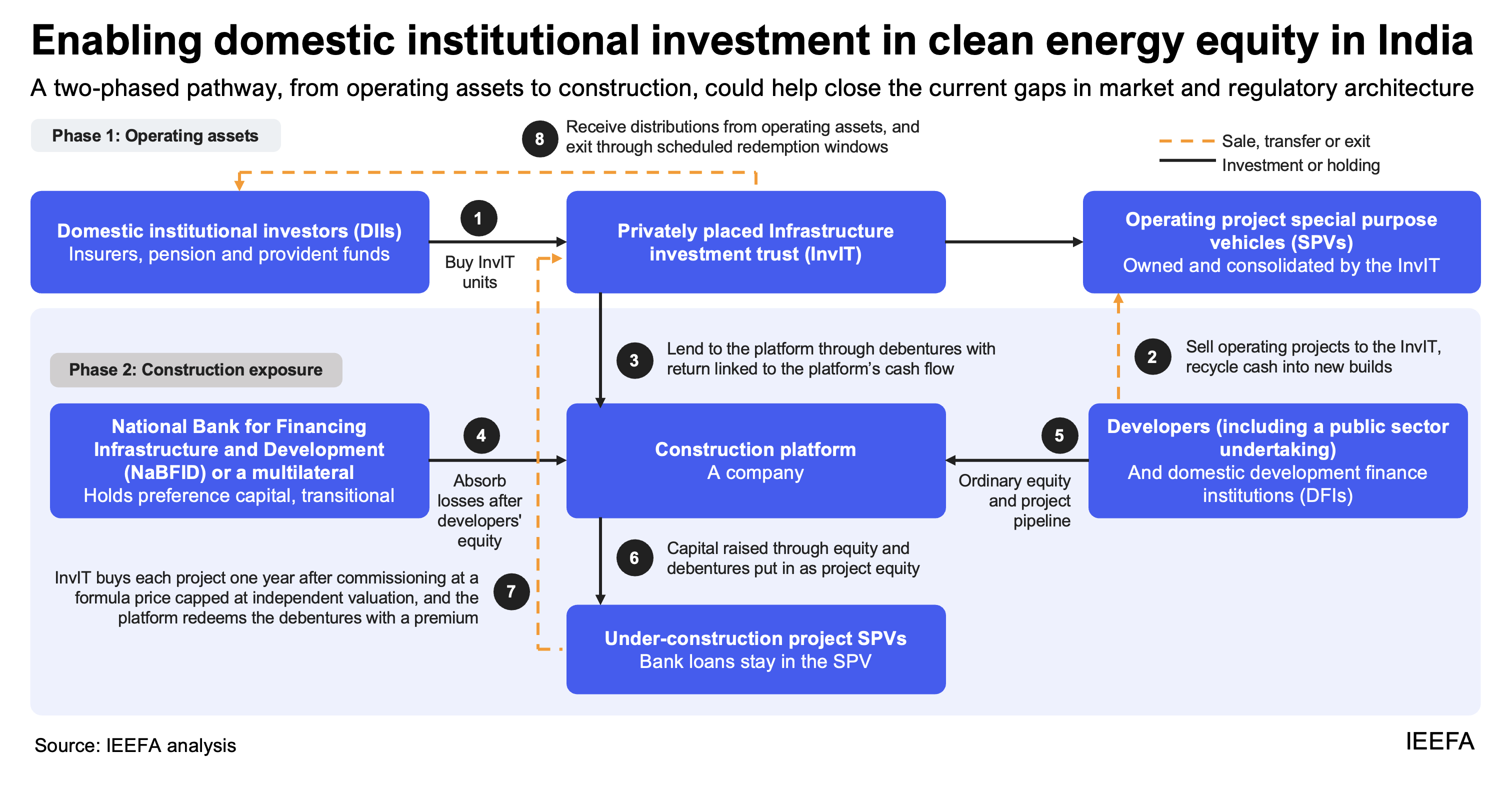
For operational projects, this gap is largely structural, and pooled vehicles such as infrastructure investment trusts (InvITs) already fit DII mandates. Construction-stage equity carries an added layer of perceived risk that a transitional first-loss layer can address.
DIIs can invest in unlisted clean-energy equity through diversified pooled funds, provided the investment structure addresses liquidity, steady cash flows, rating and investment eligibility requirements, and exit options. This requires suitable regulated instruments, credible risk-sharing arrangements, independent valuation, and workable exit options.
A phased approach can broaden participation, starting with investment in operational projects through InvITs, which also helps developers recycle capital, followed by measured construction-stage exposure backed by transitional public first-loss support.
India will require an estimated INR2,143 lakh crore (USD22.7 trillion) in cumulative investment to achieve its net-zero target by 2070, according to NITI Aayog’s report "Scenarios Towards Viksit Bharat and Net Zero". However, an estimated INR765 lakh crore (USD8.1 trillion) investment gap remains, with the power sector accounting for the largest share of the investment requirement. Domestic finance is expected to provide about 58% of this investment [USD1 = INR94.4087 (As on 6 November 2026)].
While discussions on India’s transition financing often focus on the scale of investment required, the structure and source of the capital are equally important. Renewable energy projects are financed through debt and equity, and India’s financing ecosystem has evolved differently across these two segments.
This note focuses on understanding this distinction in domestic finance as India’s next financing challenge is not just mobilising more capital but broadening the domestic sources of equity financing for renewable energy developers. In the near term, the most direct route is demand from domestic institutional investors (DII) for operating assets, which frees up funds for developers to channel into new projects. Over time, DIIs can also help fund under-construction projects through regulated investment platforms where a public institution helps reduce perceived risks through a transitional first-loss support layer.


Related Content