India’s draft steel policy bets on coal it may not have access to
Key Findings
India’s met coal needs are set to soar. The draft National Steel Policy: Vision 2047 projects demand for metallurgical (met) coal will reach 284 million tonnes (Mt) by 2047. With India importing most of its met coal, it faces a critical question as steel output grows: Where will the supply come from?
Exports from Australia, Russia, and Canada are expected to be lower in 2035 than in 2025. Australia, the largest exporter, is repeatedly revising its met coal export forecasts downward.
Uncertain met coal supply poses energy security and price risks for India. Steelmaking routes that do not use coal, such as scrap steel recycling and hydrogen-based production, as proposed in the draft policy, offer a way to reduce that exposure.
India’s new draft National Steel Policy: Vision 2047, released by the central government in October this year, includes several positive proposals. However, it also raises important questions about where the country will source its metallurgical (met) coal from as steel production continues to rise.
Decarbonisation is named as one of the key pillars of the policy, which includes proposals for the development of a domestic scrap steel ecosystem, improved energy efficiency, and increased steel production for electric arc furnaces (EAFs). These would certainly be positive developments.
However, the draft policy notes that the share of steel produced via the blast furnace-basic oxygen furnace (BF-BOF) technology route will increase from the current 42% to over 50% by 2047. This, along with the substantial increase in overall steel production over this time period, will increase reliance on met coal.
The draft policy also highlights that the requirement for coking coal will increase from 72 million tonnes (Mt) in 2025 to 236Mt by 2047. The demand for the other type of met coal — pulverised coal injection (PCI) — will rise from 17Mt to 48Mt, taking the total met coal requirement to 284Mt in 2047.
The vast majority of India’s met coal requirement is imported. The draft policy notes that 92% of its coking coal comes from overseas and that PCI coal demand is “largely met through imports from Russia and Australia”.
Global supply falling short
India’s forecast met coal demand of 284Mt needs to be put into the global context. According to the latest government forecasts from Australia, the world’s largest met coal exporter, total world trade in met coal was 340Mt in 2025. However, this figure includes 61Mt exported from Mongolia to China, which is likely to remain unavailable to India.
In September, Steel Authority of India Limited (SAIL) imported one tonne of Mongolian met coal by air to test the country’s potential as a new supply source. However, larger volumes would have to be transported by rail from the landlocked nation to ports in Russia before being shipped to India. This is a major logistical hurdle that is unlikely to ever become financially viable. In 2025, JSW Steel had put its plans to import Mongolian met coal on hold citing these very logistical difficulties.
Excluding Mongolia’s exports, global met coal trade totalled 279Mt in 2025, less than the amount the draft policy forecasts India’s steel industry will need by 2047.
The draft policy does include plans to increase domestic sources of met coal, including more coal washeries, optimised coal blends to increase domestic coal use, and fewer transportation bottlenecks. However, there are significant doubts about the effectiveness of these measures and India is likely to remain highly dependent on met coal imports in 2047. India’s steel sector would, therefore, be counting on a significant increase in global seaborne met coal trade by then. The chances of this happening, though, do not seem high.
The latest forecast from S&P Global expects met coal exports from Australia, Russia, and Canada — three of the five biggest exporters, excluding Mongolia — to be lower in 2035 than they were in 2025. The only significant opportunity for increased imports into India would come from China’s declining demand. Over the coming decade, coal previously heading to China could find new destinations in India. However, beyond 2035, this opportunity is likely to dry up too. By then, almost all of China’s remaining met coal imports would come from Mongolia, according to S&P Global. That coal will likely never be available to Indian steelmakers.
Australia’s inability to increase volumes is particularly concerning as the country’s government has been repeatedly revising its forecasts of met coal exports downwards.
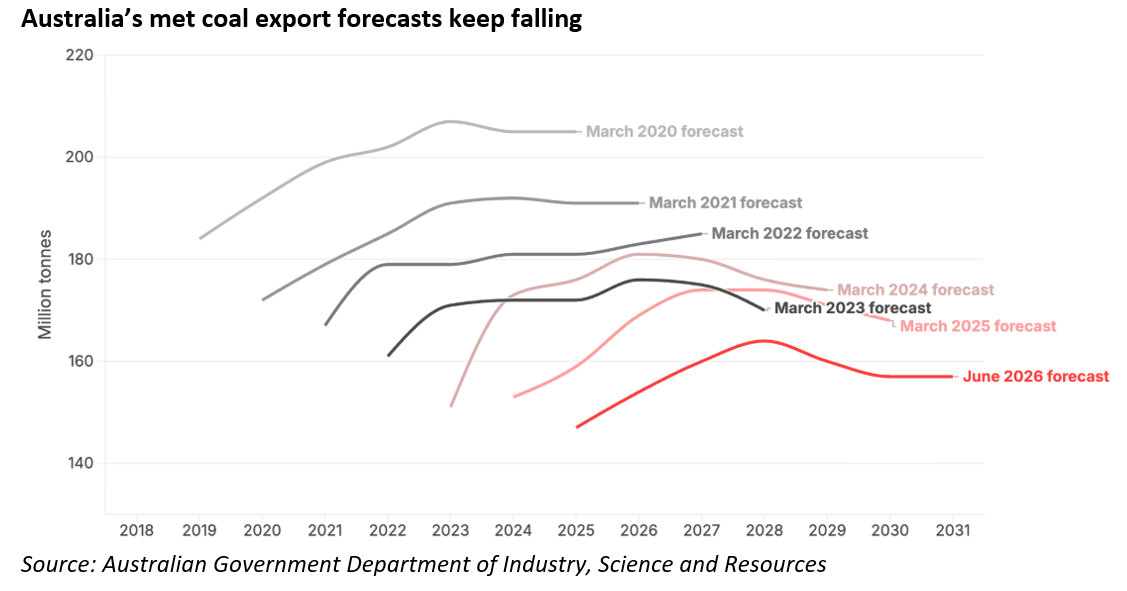
Australian met coal mining faces depletion, higher costs, and growing local resistance to opening new capacity. Moreover, a recent ruling by the High Court of Australia on mine approvals and the emissions from burning coal could make matters more difficult.
Why India needs non-coal routes for steelmaking
Uncertain long-term met coal supply is a significant energy security concern for India. Where supply does not meet demand, there will be cost implications. Met coal prices have been high recently, as supply has struggled to meet demand following a major mining accident in China and the subsequent temporary closure of mines for safety checks.
S&P Global is forecasting much bigger supply shortfalls by the mid-2030s, which would likely push met coal prices higher. Meanwhile, Australia’s ability to respond to high prices with more supply is increasingly eroding.
India has already taken steps to address met coal supply and cost concerns. But most of these — such as diversifying import sources and targeting more domestic production — remain coal-based.
The new draft National Steel Policy highlights opportunities in steelmaking routes that do not use coal, such as scrap steel recycling and hydrogen-based production. India needs to put greater emphasis on non-coal solutions to address the growing met coal supply concerns.
This article was first published in ETEnergyworld.

Related Content