Safeguard Mechanism review submission: Appendix B
DCCEEW 2026-27 Safeguard Mechanism review submission:
Appendix B. Additional information on Australia's coalmining sector
*Note: IEEFA’s briefing note Not so hard to abate was included as Appendix A to this submission.
Coalmining is unlike other industrial sectors, where emissions arise from two key sources. For underground coalmines, most emissions come from fugitive methane. Methane abatement technology is available and cheap, relative to ACCU prices. CSIRO’s techno-economic assessment finds about 6MtCO₂e a year are abatable for less than A$11/t (over the life of the project)— 3.1 Mt from ventilation air methane (VAM) oxidation at underground mines and 2.8Mt from flaring or generating power from gas already drained for safety — against an ACCU price of ~A$38. This becomes even more compelling if ACCU prices trend toward a cost containment price of A$82.68. Approximately 10 underground coalmine methane abatement projects have been developed in Australia, and some of these will be nearing major equipment replacement schedules, requiring reinvestment to continue. VAM projects, which are more widespread overseas, are proceeding locally at the Kestrel and Appin mines.
Readiness is not the barrier. The barriers for underground mining are:
- Capital allocation: High upfront cost against a delayed and uncertain abatement benefit. Co-ordinating the supply of captured methane with the demand for its use can be challenging. The timing of gas availability does not always match up with when it can be used. For instance, if a mine is considering whether to use methane for a power station, the decision can contain considerable uncertainty in sizing, timing and life span of the mine-site power generation.
- Competition for capital: Projects have stalled where decarbonisation capital loses out to returning funds to shareholders.
- Not core business: Miners consider their core business to be coalmining, including the preparation and management of gas for safety hazards — such as to prepare coal seams for mining, reducing risk of coal outbursts, and installation of sufficient mine ventilation capacity. But this does not typically extend to managing the remaining methane unaccounted for, nor does it compel the destruction and/or utilisation of the methane gas.
- Loss of the crediting pathway: The Coal Mine Waste Gas ACCU method closed to new projects in March 2025 (the government confirmed in April 2026 it will not be remade), removing a key crediting pathway for methane utilisation. A record number of projects registered in 2025 in anticipation of its closure.
- Methane concentration: Some mine operators argue VAM oxidation on dilute vent air is not yet proven at commercial scale in Australia, and is not suitable for their mine conditions.
- Uncertain or short remaining mine lives: IEEFA estimates half of the high-emitting active mines could be amenable to VAM abatement, while others have insufficient remaining mine lives to achieve returns on capital investment.
- Critical skills shortages: Recent mine outages due to methane incidents attract increasing attention from the safety regulator and the public. Shortages of qualified operators and engineers — as loss of experienced staff through retirement, retrenchment or mine closures outstrips the pipeline of new or retrained workers. This provides a challenge to design and implement new abatement projects, over and above the base core business.
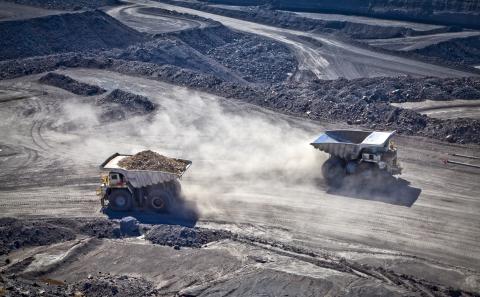
For open-cut coalmines, emissions are typically split 50:50 between fugitive emissions and diesel combustion. Each emissions source must be separately abated. Methane abatement at open-cut mines is also challenged by lower gas content in the coal than in underground mines. This raises the extraction costs and complexity for each tonne of methane abated. BHP reports it is trialling a new drilling technology at its Saraji mine, to capture and treat methane from coal seams closer to the timing of coal extraction than traditional gas drainage methods. The practice is not widespread but has been trialled in some Australian open-cut settings, including the Curragh and South Walker Creek mines.
Readiness is a barrier. This has been driven partly by mixed incentive signals, and partly through industry under-investment in research and development. Industry-funded Australian Coal Association Research Program (ACARP) projects have investigated the issue and opportunity on an ad-hoc basis, culminating in a research paper at best.
For diesel decarbonisation, there is an issue of selection among competing alternatives amid tech change, which are expected to evolve in the future. For example, Whitehaven calls out the decarbonisation conundrum in its Maules creek open cut mine expansion application: “it would not be fiscally responsible to select a more expensive on-site abatement alternative” (than buying offsets) and, “attempting to pick ‘winner’ emission abatement technologies or emission reduction pathways at the Project approvals stage for the next 20 years of mining at the MCCM [mine] would be conjecture”.
Collectively, mines are not yet ready to embrace the challenges of bringing on sufficient levels of on-site methane abatement or implementing diesel decarbonisation. Other barriers for open-cut mining include:
- Weak Safeguard signal: IEEFA confirmed a weak price signal exists for open-cut mines; the Safeguard cost of exceeding the baseline was 14¢ per tonne for the average large open-cut mine in FY2024–25, on coal worth hundreds of dollars a tonne.
- Mine scheduling: Methane pre-drainage needs sufficient lead time to allow gas to flow out from underground sufficiently before mining operations can commence. The lead time for pre-drainage varies across mines so site planning and gas reservoir geologists and engineers need to design a mine schedule that meets all stakeholder needs so as not to delay coal production.
- Impact on mining productivity: Operational impacts also need to be considered, such as the impact of changes to mine haulage equipment — be it diesel, biofuel, CNG, battery-electric or catenary charging — the refuelling or recharging operations need to be assessed for their impact on productivity. For example, BHP has disclosed in its 2026 ESG roundtable presentation, that unless fast-charging or dynamic charging systems are developed, the BEV haul trucks suffer a 1,000 hour loss of productivity per year.
- Awareness gaps: Mine decarbonisation does not typically feature on mine management KPIs. While annual life-of-mine planning provides the opportunity for mines to consider alternative pathways, it is generally about achieving coal flow continuity and the best financial outcomes. At some mines, particularly open-cut coalmines, managers may not be aware of the opportunities if abatement studies have not been advanced. As the IEA has stated, “leadership may perceive methane abatement as more costly than it is ... or may not have identified an effective pathway or business case for bringing captured gas to productive use”.
- Unspent funding support: IEEFA identified more than A$1 billion in government decarbonisation funding that could support coalmine abatement but remains largely unspent, none of it on diesel.
- Scale of the decarbonisation bill: The scale of decarbonisation spend required is massive — hundreds of millions of dollars for a relatively modest fleet electrification and support infrastructure. Notwithstanding the above funding support is aimed at first movers rather than broad-based subsidies, unless the investment is made at the outset of a typical 20-year mine life, it will be less viable for miners as a subsequent fleet upgrade/replacement strategy.