IEEFA launches Australian Renewable Energy Scorecard

New interactive tool offers visual snapshot of renewables rollout across Australia
Key Takeaways:
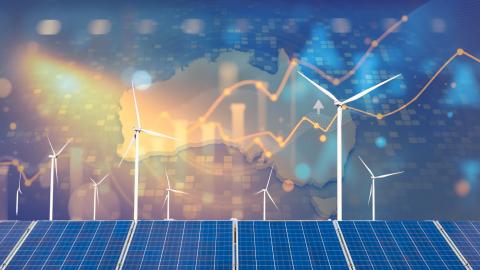
IEEFA has launched its Australian Renewable Energy Scorecard, an interactive, visual tool, updated quarterly to provide an ongoing overview of the progress of renewable energy projects across Australia.
The Scorecard shows that in aggregate, there are sufficient renewable energy and battery storage projects in development to meet Australia’s 2030 target, but too few have reached the construction phase.
A key barrier to getting renewable energy projects to construction is the lack of long-term power purchase agreements.
Large-scale renewable and battery projects already under construction are delivering around $6 billion in domestic construction investment and about 15,600 job-years of work. Moving the remaining fully approved projects into construction could unlock employment totalling around 127,000 job-years, and around $44 billion in investment.
16 September 2026 (IEEFA Australia): The Institute for Energy Economics and Financial Analysis (IEEFA) has launched its Australian Renewable Energy Scorecard, an interactive data tool that provides a visual snapshot of the progress of renewable energy projects across Australia.
The Australian Renewable Energy Scorecard has been developed as a collaboration between IEEFA Australia and Green Energy Markets. It primarily uses data from Green Energy Markets’ Power Generation Database, covering the number, size and status of large-scale renewable energy and battery storage projects across the country, as well as the growth of distributed energy resources.
This data is compiled and presented as an interactive online scorecard, showing how each jurisdiction is performing in progressing the growth of renewable energy. Analysts from IEEFA Australia’s electricity team and Green Energy Markets will be updating the Scorecard on a quarterly basis.
“The Scorecard shows that, in aggregate across Australia’s main grids, developers are pursuing far more renewable and battery capacity than is needed to meet the 82% target, and a large share has already been fully approved.” says Johanna Bowyer, Lead Analyst, Australian Electricity at IEEFA.
“Yet projects under construction still fall far short of what must be built by 2030 – in several states less than one tenth of the required new wind and solar capacity is currently being built, and even the strongest states have at most around one third of new capacity required currently under construction. Renewables projects can take roughly two to four years to move from construction start to operation, so we need significantly more projects to move to construction phase.”
The Scorecard covers all Australian states and territories, with the exception of the Northern Territory (NT), and areas of Western Australia (WA) outside the South West Interconnected System (SWIS). The Australian Capital Territory (ACT) is covered as part of New South Wales (NSW).
“Our analysis shows a key roadblock to getting projects to construction is the lack of long-term power purchase agreements. Only a small share of fully approved projects have secured contracts,” says Tristan Edis, Director – Analysis and Advisory at Green Energy Markets.
“Government underwriting schemes are helping, but on their own they don’t guarantee enough revenue certainty to get projects to financial close. Without more contracts from large energy users, too many fully approved projects will stay stuck.”
Bowyer notes: “This Scorecard does not analyse grid connection or transmission constraints, due to insufficient data. These steps may also be causing delays in getting projects to construction, but they are outside the scope of this analysis.”
Key findings from IEEFA’s Australian Renewable Energy Scorecard include:
- The capacity of renewable energy and battery projects that developers are already pursuing is far greater than the amount of capacity required to meet the federal government’s 2030 target of 82% of electricity generated from renewable energy.
- However, the amount of renewable energy and battery capacity currently under construction is significantly lower than the new capacity that needs to be operational by 2030 to meet the target.
- There is a significant lack of renewable energy projects with power purchase agreements – which is a key impediment to renewables projects progressing to construction.
- Installations of rooftop solar and household batteries, meanwhile, have experienced record high levels over the second quarter of 2026.
- Large-scale renewable and battery projects already in construction are providing around $6 billion in direct construction investment. If the remaining fully approved projects were to proceed to construction, the resulting investment would be around $44 billion.
- Projects currently in construction in Australia’s main grids will provide 15,600 job-years of employment over the full construction period. Converting the projects that already have development and environmental approvals into construction would deliver 127,000 job-years of construction work.
“While large-scale renewables construction is lagging where it needs to be, households have been moving quickly,” says Edis. “The Scorecard shows record highs of rooftop solar and small-scale battery capacity added in the June quarter of 2026, with system sizes steadily increasing since 2016. Policies like the Cheaper Home Battery Program have helped drive this surge, even though recent rebate cuts have started to slow monthly capacity installation numbers.”
Bowyer says: “We estimate that large-scale renewable and battery projects already under construction are delivering around $6 billion in domestic construction investment and about 15,600 job-years of work. If the remaining fully approved projects were to move into construction, that would unlock roughly $44 billion in additional investment, and around 127,000 job-years – a huge economic opportunity.”
Bowyer concludes: “Australia has more than enough renewable and battery capacity on the drawing board to meet the 82% target in aggregate, but not nearly enough in construction. The Scorecard is designed to track that gap and help governments, the energy industry and communities see where action is most urgently needed. We will be updating the Scorecard every quarter, to build an ongoing progress report on Australia’s energy transition.”
To visit IEEFA’s Australian Renewables Investment Scorecard, click here
Media contact: William Poole, ph +61 408 030 524, [email protected]
Author contact: Johanna Bowyer, [email protected]