European banks fail to unleash potential of green bonds
Key Takeaways:
Among Europe’s 47 largest banks, outstanding green bonds account for less than 1% of assets on average.
European banks’ green bond programmes are held back by business-as-usual lending to high-emitting assets and a limited pipeline of green projects.
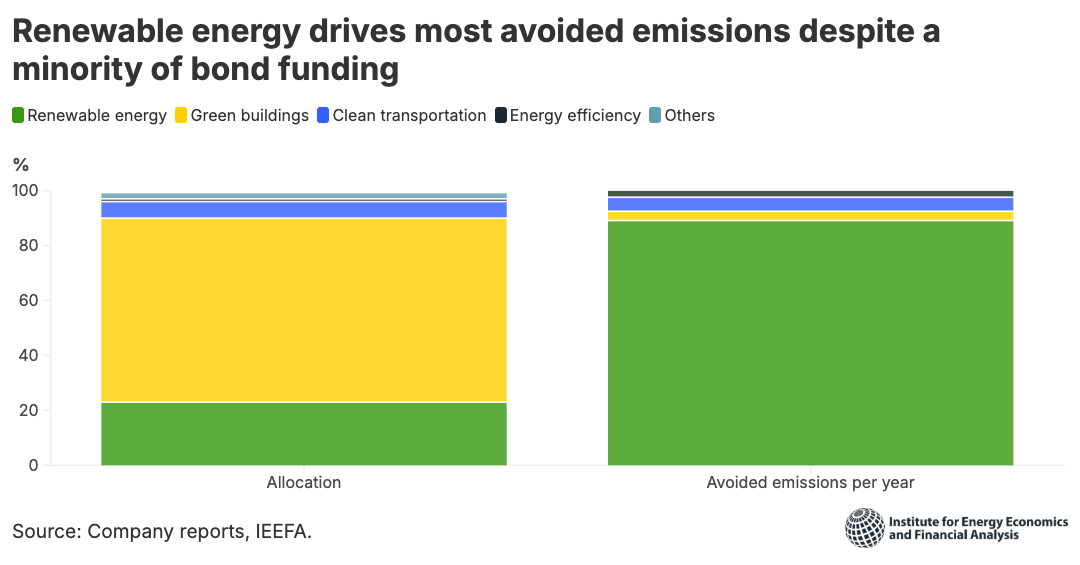
European banks allocate only a minority of green bond proceeds to the activities that most directly advance decarbonisation, energy security and industrial resilience.
The green bond market has significant room to grow if banks expand the pool of eligible assets aligned with Europe’s energy and industrial policy objectives.
2 September 2026 (IEEFA) | European banks have yet to capitalise on the potential of green bonds to fund the projects most critical to the energy transition.
New research from the Institute for Energy Economics and Financial Analysis (IEEFA) finds that, among Europe’s 47 largest banks, outstanding green bonds account for less than 1% of assets on average. This is despite most banks having established green bond frameworks.
“Green bond issuance remains too small to materially shift European banks' asset allocation. Green bond programmes are held back by banks’ business-as-usual lending to high-emitting assets and a limited pipeline of green projects,” said Kevin Leung, author of the report and a sustainable finance analyst at IEEFA.
European banks allocate only a minority of green bond proceeds to the activities that most directly advance decarbonisation, energy security and industrial resilience.
Although renewable energy accounts for only around 20% of proceeds allocated by European banks’ green bonds, it accounts for 90% of the reported avoided emissions delivered by those green bonds.
In contrast, green buildings receive around 70% of allocated proceeds but contribute only 3% of the reported avoided emissions.
“This composition of allocations does not squarely address Europe’s clean transition and resilience needs,” said Leung. “More credible green bond programmes should therefore actively align funding with a well-represented set of transition-critical assets, which have low climate risk exposure.”
Banks already represent a substantial subset of the green bond market. IEEFA finds that the market has significant room to grow because many banks have a large pool of eligible assets that they have not allocated to green bonds, and green bonds account for only a small share of banks' market-based funding.
The report recommends that banks integrate green funding more explicitly with sustainable finance targets, transition planning and risk management. This would strengthen the role of green funding in directing capital towards Europe’s transition and resilience agenda.
“Unlocking the full value of bank green bonds is particularly important given banks’ role in financing the real economy,” said Leung.
“European banks have the opportunity to move from issuing green bonds as a mature market practice to using them as a strategic instrument for financing the assets Europe needs for its climate and energy security agenda.”
Press contact
Jules Scully | [email protected] | +447594 920255
About IEEFA
The Institute for Energy Economics and Financial Analysis (IEEFA) examines issues related to energy markets, trends and policies. The Institute’s mission is to accelerate the transition to a diverse, sustainable and profitable energy economy. www.ieefa.org