Key Findings
Promises of boosted economic conditions and new jobs have failed to materialize for the Texas cities hosting the wave of petrochemical expansion the industry experienced over the last 15 years.
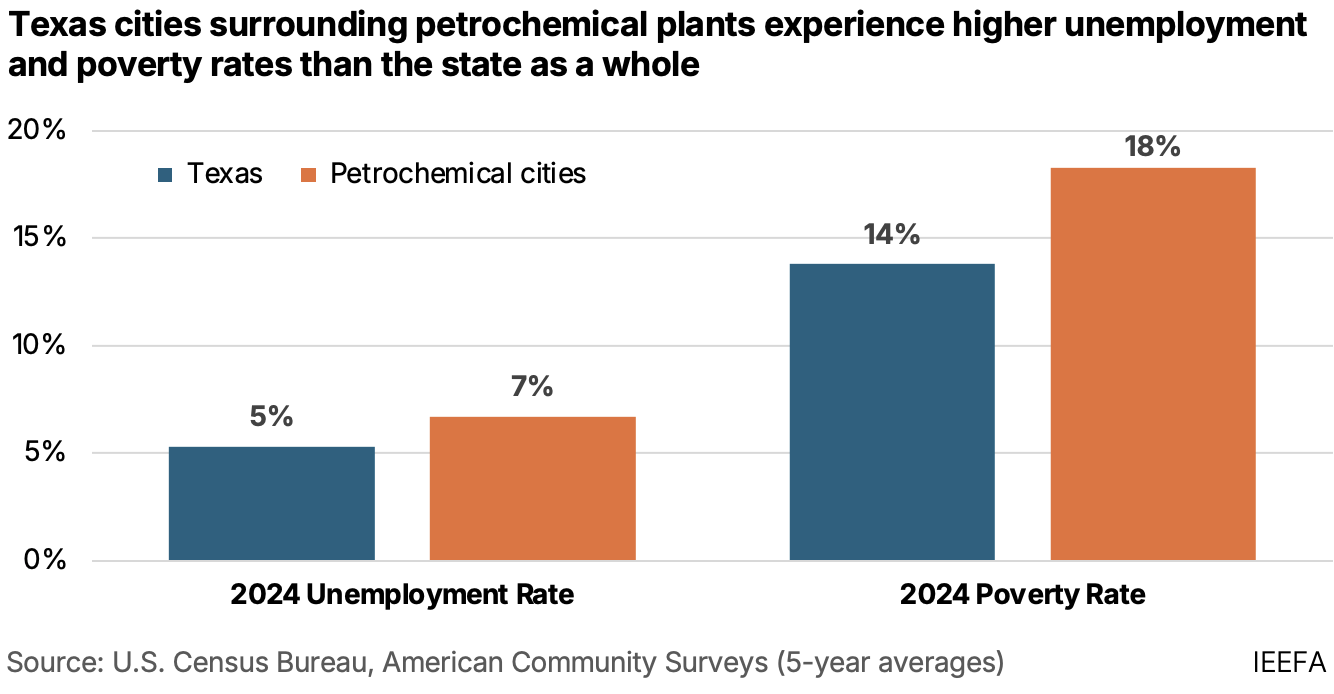
Lower median incomes, slower population growth, and less job growth coupled with higher city debt levels per person, higher unemployment, and higher poverty levels are characteristics of petrochemical cities during this time of industry expansion—contrary to industry claims of economic improvement.
Besides a lack of long-term economic gains, the Texas buildout has resulted in additional health costs associated with elevated levels of toxic pollutants affecting communities closest to petrochemical plants.
Petrochemical host cities were expecting prosperity but are getting blight, health issues, and devalued property in return for the industrial development they support.
Executive Summary
Promises of boosted economic conditions and new jobs have failed to materialize for the Texas cities hosting the wave of petrochemical expansion the industry experienced over the last 15 years. This report will delve into the demographic, employment, and financial trends of cities along the Texas Gulf Coast where much of the state’s petrochemical activity occurs. Benchmarking performance against statewide metrics casts the effects of the petrochemical industry in these towns in an unfavorable light.
The focus of this report is on the relative economic underperformance occurring in the cities Port Arthur, Orange, Beaumont, Mont Belvieu, Channelview, Baytown, Deer Park, Pasadena, La Port, Freeport, Ingleside, Corpus Christi, and Gregory, compared to statewide measurements. Our conclusion is not one of causation—we are not suggesting these cities underperformed because they hosted petrochemical complexes. Instead, we observe no data supporting claims made by developers that these communities are better off economically because they hosted the petrochemical capacity expansion that has occurred since the shale revolution.
We specifically identify companies operating ethane crackers within the listed cities because ethylene is a key petrochemical building block. Ethane, first cracked into ethylene, is then transformed into derivative chemicals that are used to produce a wide array of plastics, resins, and synthetic materials. Also, the capital intensity of building ethane steam crackers, in combination with how few permanent jobs are necessary once plants are operational, underscores the disconnect. Developers tend to ignore how few permanent jobs are created, and instead herald, with some liberty, the resulting temporary, indirect, and induced jobs involved. This causes a disconnect in the data—large project expenditures within a community don’t necessarily translate into better economic conditions for communities near petrochemical expansions.
Executives have claimed that every one job at a petrochemical plant results in another seven jobs in the community, and the National Energy Technology Laboratory has suggested that $1 million in petrochemical investment leads to 13 jobs., But any prosperity derived from the concentration of petrochemical complexes in the three key host regions—known as the Coastal Bend, the Houston Ship Channel, and the Golden Triangle—is not evident in the economic indicators for the communities where most of the buildout occurred, whether before or after the shale revolution.

Related Content