Key Findings
The injection and geologic storage components of CCS pose numerous risks, which are
either being underestimated or completely ignored by the industry as it looks to sell the
technology.
Industry and CCS advocates see offshore storage as offering favorable geologic
conditions, proximity to carbon dioxide emitters, and simplified pathways to obtaining
pipeline and well permits.
Without real-world, commercial-scale examples of geologic carbon storage operating
over long periods, it is difficult to properly assess either the likelihood or severity of
potential problems.
The likelihood of leaks and the lack of effective mitigation options call into question the
climate-sparing argument made by CCS advocates, and also raises important questions
about the financial implications of CO2 containment failure.
Executive Summary
Oil and gas companies, led by ExxonMobil, Repsol, and Chevron, have leased large tracts in the Gulf of Mexico for carbon capture and storage (CCS). Industry and CCS advocates see offshore storage as offering favorable geologic conditions, proximity to carbon dioxide (CO2) emitters, and simplified pathways to obtaining pipeline and well permits. The comparative ease of working with state and federal landowners rather than a complex quilt of property owners and communities is an especially attractive proposition. Even with higher offshore costs, companies expect to realize savings as projects can be implemented more quickly.
CO2 injection and geologic storage are technologically complex processes that require highly specialized materials and operations. Those differ significantly from the oil and gas industry’s touting of success in onshore enhanced oil recovery (EOR), which has centered on transporting CO2 from natural sources and natural gas processing for injection into existing wells to force more oil out of the ground.
Our detailed review of the injection and geologic storage components of CCS highlights numerous risks. These are either being underestimated or completely ignored by the industry as it looks to sell the technology. For example:
- The regulatory environment around offshore geologic carbon storage is under development, untested, or undergoing significant changes in the U.S. It is subject to uncertainty that can impair access to financing and increase exposure to liability;
- The lack of long-term storage data for commercial-scale projects operating under real-world conditions;
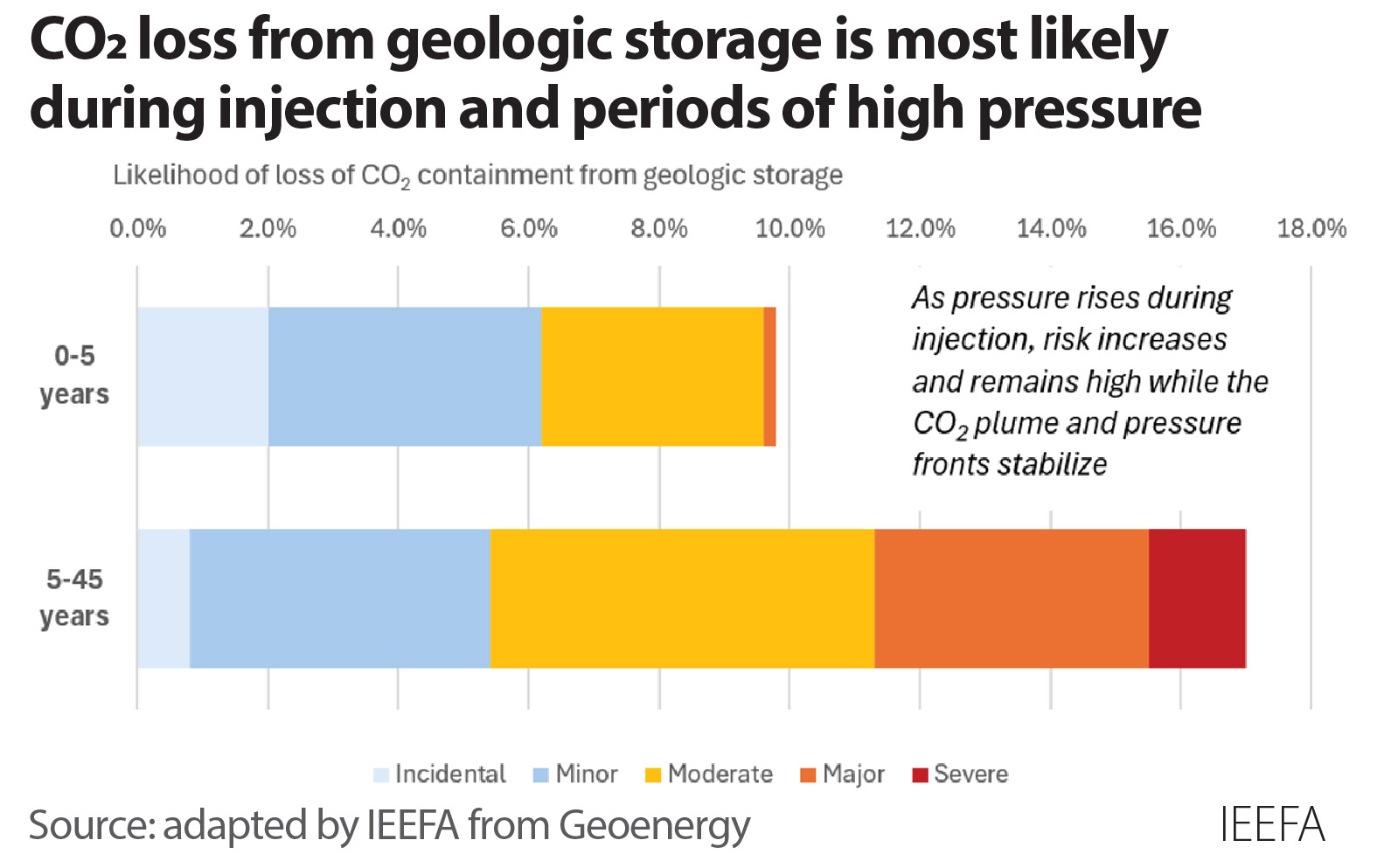
- Operational challenges, particularly during the CO2 injection and plume stabilization periods, could result in leaks that are more difficult to detect, manage, and mitigate in an offshore project; and
Potential for leakage higher than anticipated from the storage reservoir calls into question the logic of CCS as a climate solution and presents a risk of long-term liability.