Assessing overcapacity risk in India’s solar PV manufacturing market
Download Full Report
View Press Release
Key Findings
India’s solar PV module manufacturing capacity reached approximately 233 gigawatts (GW) by June 2026, placing it among the world’s largest module manufacturing bases. However, this capacity is heavily concentrated in modules, at nearly 7x cell capacity and 116x ingot-wafer capacity, signalling a structural gap in upstream manufacturing.
India’s module manufacturing base is operating at 35–40% utilisation, well below the 50–65% level required for sustainable operations. With manufacturing capacity already exceeding domestic demand, further capacity additions risk widening the supply-demand gap in modules.
Data centres, green hydrogen, and export markets could be the largest sources of incremental module demand by 2030, offering 17–22GW of annual additional opportunity beyond conventional solar deployment. Their ability to scale up will depend on supportive policy, project execution, and evolving procurement dynamics.
Vertically integrated manufacturers with scale and technology depth are positioned to define the industry’s next growth phase. Small-scale assemblers, legacy Passive Emitter and Rear Cell (PERC)-based lines, and manufacturers without an upstream integration roadmap will be at risk of consolidation, acquisitions, or exit.
India has moved from near-total import dependence in solar photovoltaics (PVs) to becoming one of the world’s largest manufacturers of solar PVs. This rapid expansion has strengthened domestic manufacturing capabilities, but most new capacity has been added at the module stage, with domestic nameplate capacity (maximum annual production capacity) reaching approximately 233 gigawatts (GW) by June 2026. This concentration has established India as a major manufacturing destination while leaving upstream segments such as cells, wafers, and polysilicon underdeveloped, creating an imbalance that now shapes the central challenge in the PV manufacturing sector.
This challenge is most acute at the module level, where capacity has expanded well ahead of demand. With approximately 135GW of such future capacity additions underpinned by firm investment commitments and near-certain commissioning schedules, the sector faces a clear risk of overcapacity at this stage. This is already evident in utilisation, with Indian manufacturers operating at an estimated 35–40% utilisation, below the 50–65% range that industry stakeholders identify as generally required for sustainable operations. As demand grows gradually, manufacturers are likely to face increasing pressure on utilisation, margins, and investment returns, raising stranded asset risk for standalone manufacturers.
This pressure is unlikely to ease by 2030, according to JMK Research’s analysis. India’s solar deployment is expected to grow strongly on utility scale, commercial and industrial, rooftop, and hybrid demand, but that growth alone is unlikely to absorb the capacity already commissioned or announced. JMK Research models two pathways to 2030. One is based on capacity backed by confirmed investment, and the other on all capacity announced by manufacturers. Module capacity remains ahead of demand under both, with polysilicon the hardest upstream gap to close. The supply-demand gap therefore persists through the decade at the module stage, and partly at the cell stage.
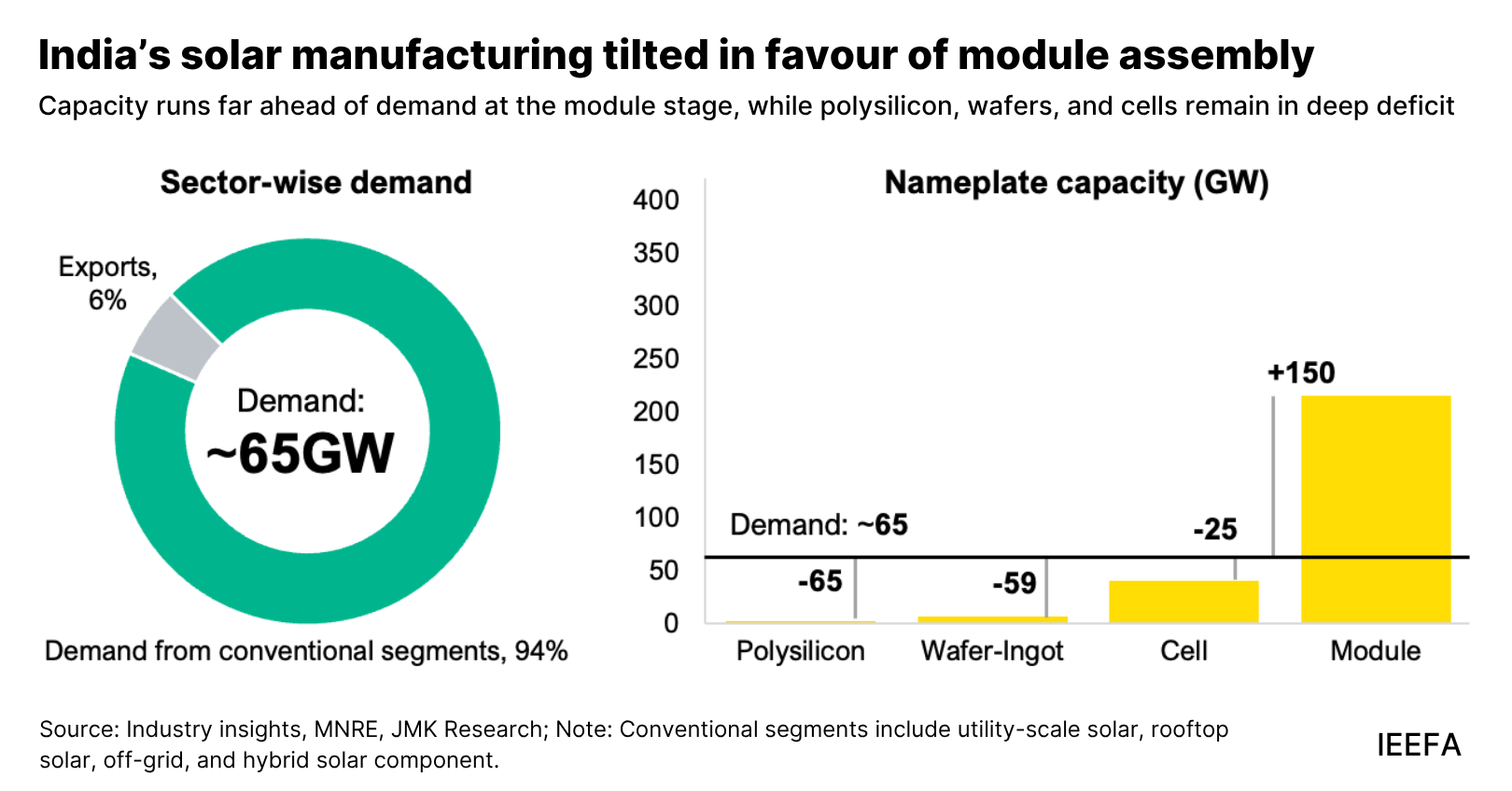
The imbalance stems from two key factors. Module assembly is the easiest segment to enter, requiring modest capital, short commissioning timelines, and limited process complexity. On the other hand, cell and wafer manufacturing demand larger capital, longer build-outs, and specialised expertise. Compounding this, the Approved List of Models and Manufacturers (ALMM) sequencing concentrated the early demand pull at the module stage, with List I for modules binding for nearly five years before cell and wafer requirements followed. Investment therefore flowed to the one segment offering assured offtake and the lowest entry barrier.
Narrowing this gap will increasingly depend on demand emerging beyond conventional solar deployment. Data centres, green hydrogen/ammonia, and exports are segments that offer the most credible upside by 2030. Green hydrogen is the largest single avenue, given the dedicated renewable capacity needed for its production. While meaningful, this incremental demand is unlikely to fully offset the planned scale of expansion, keeping competitiveness and market access central to absorbing the surplus.
Exports will be pivotal to utilising India’s expanding base. High dependence on US, which absorbs the bulk of current shipments, has exposed manufacturers to rising trade-policy risk and emphasised the urgent need for diversification. Europe offers the most structured medium-term opportunity, as its policy frameworks increasingly reward supply-chain resilience and sourcing diversification. Market access alone, however, will be insufficient. Sustained export growth will depend on India’s ability to narrow its cost and technology gap with China through scale, integration, and operational efficiency. The timing favours such investment, as leading Chinese producers are absorbing losses from oversupply while Indian manufacturers have stayed profitable, creating room to invest in upstream integration, efficiency, and research and development (R&D).
On the supply side, a gap between demand and available manufacturing capacity could change the industry structure. Smaller, non-integrated manufacturers may face greater pressure, while larger, vertically integrated companies could gain an advantage. Domestic manufacturing is also likely to expand beyond modules to cells, wafers, and eventually polysilicon, reducing dependence on imported inputs. India’s membership of the Pax Silica coalition supports this shift, creating opportunities to diversify silicon-based solar manufacturing inputs and reduce reliance on China.
The sector’s challenge is, therefore, no longer one of capacity creation, but of utilisation, competitiveness, and value-chain depth. Policy support remains critical, with a growing focus toward strengthening competitiveness and addressing the gaps that constrain it, alongside continued capacity expansion. This will require incentives that promote upstream specialisation, stronger industry-research collaboration, targeted export support, and faster power transmission and right-ofway (RoW) clearances to accelerate the installation of power generation capacity.
In the near term, however, the lack of availability of ALMM List II-compliant domestic cells has emerged as a key constraint for module manufacturers without in house cell production. The subsequent introduction of an exemption for net-metering and open-access renewable energy projects until the end of 2026 provides additional time for domestic cell-manufacturing capacity to scale while mitigating immediate utilisation pressure on standalone module manufacturers. Ultimately, the pace of upstream integration, export diversification, and technology advancement could determine whether India can translate its manufacturing scale into lasting global competitiveness.





Related Content