India’s solar module output is outpacing demand, leading to reduced factory utilisation at 35–40%
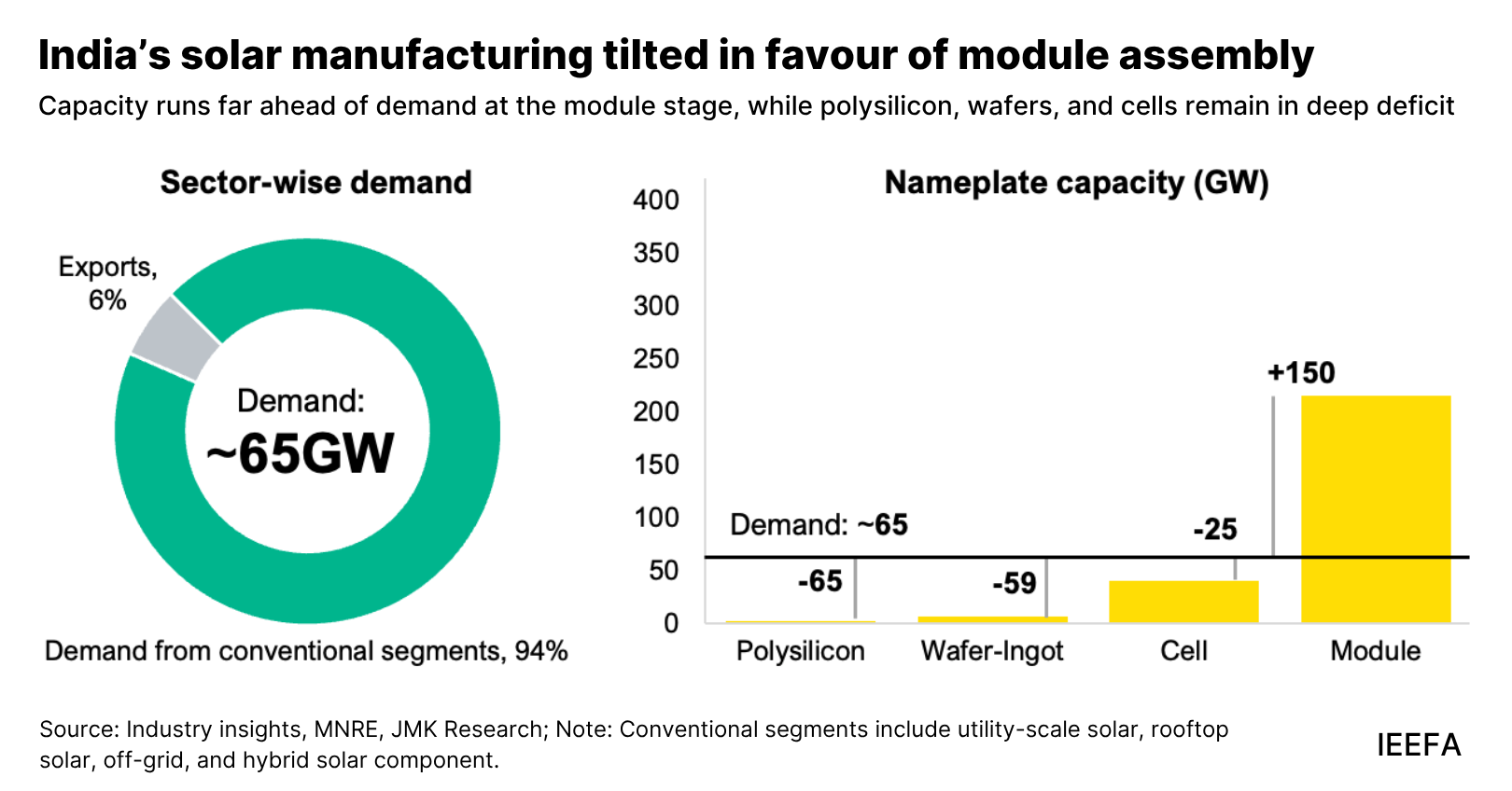
At 233GW, India is now the world’s second-largest solar module manufacturer, but capacity is heavily concentrated downstream and is set to outstrip demand through 2030.
Key Takeaways:
India reached 233 gigawatts (GW) of solar photovoltaic (PV) manufacturing capacity in June 2026 but the build-out is overwhelmingly concentrated in modules.
Module capacity is nearly 7x cell capacity and 116x ingot-wafer capacity, exposing a deep structural gap upstream.
Module factories are running at an estimated 35–40% utilisation, well below the 50–65% needed for sustainable operations, with roughly 135GW of further capacity planned or under construction.
Data centres, green hydrogen, and exports offer the most credible new demand, an incremental 17–22GW by 2030, but not enough on their own to absorb the surplus.
September 1, 2026, IEEFA: India has built solar module capacity faster than its market can use it. Having moved from over 90% import dependence to become the world’s second-largest solar photovoltaic (PV) module manufacturer, the country now holds 233 gigawatts (GW) of capacity as of June 2026. However, its module factories are running at just 35–40% utilisation, well short of the 50–65% needed to operate sustainably.
A new report by the Institute for Energy Economics and Financial Analysis (IEEFA) and JMK Research, ‘Assessing overcapacity risk in India’s solar PV manufacturing market’, finds that this expansion has been overwhelmingly concentrated at the module stage. Module capacity now stands at nearly 7x cell capacity and 116x ingot-wafer capacity, leaving upstream segments such as cells, wafers, and polysilicon underdeveloped and the supply chain dependent on imported inputs, predominantly from China.
“India has added module capacity faster than the market can absorb it,” says Prabhakar Sharma, Senior Consultant at JMK Research and lead author of the report. “With around 135GW more already planned or under construction and factories running at 35–40%, the pressure on utilisation, margins, and returns will only intensify. Standalone module manufacturers face a real risk of stranded assets.”
The report finds this imbalance is unlikely to ease by 2030. India’s solar deployment is expected to grow strongly, but not fast enough to absorb the capacity already committed. New demand from data centres, green hydrogen and ammonia, and exports offers the most credible upside, an incremental 17–22GW by 2030, with green hydrogen the single largest avenue given the dedicated renewable capacity it requires. Even so, this is unlikely to fully offset the planned scale of expansion.
Exports will therefore be pivotal, and here the picture is shifting fast. India’s export base is heavily exposed to a single market: the US absorbed around 97% of module export volume in financial year (FY) 2026. That channel has since been disrupted by combined US duties exceeding 200% on most Indian manufacturers, which have cut exports to the US by 44–47% from their FY2024 peak. The European Union, whose recent supply-chain and sourcing rules increasingly reward diversification, now offers the most structured medium-term alternative.
“India may have the opportunity to unlock new export markets, provided Indian solar PV manufacturers can effectively compete with Chinese manufacturers by investing in R&D and the manufacturing of polysilicon, ingots, wafers, and cells,” says Charith Konda, Lead Energy Specialist at IEEFA, and contributing author of the report along with Vibhuti Garg, Director, South Asia, IEEFA. “But market access alone will not be enough. Sustained export growth depends on closing the cost and technology gap with China through scale, integration, and operational efficiency.”
On the supply side, the report expects the gap between capacity and demand to reshape the industry. Smaller, non-integrated manufacturers will come under greater pressure, while larger, vertically integrated players are positioned to gain. Domestic manufacturing is also likely to move upstream, from modules into cells, wafers, and eventually polysilicon, reducing reliance on imported inputs.
“The challenge is no longer building capacity; it is using it well and deepening the value chain. That means spreading incentives evenly across cells, wafers, and polysilicon rather than rewarding modules alone, strengthening industry-research collaboration, and giving exporters targeted, time-bound support,” says Chirag H. Tewani, Senior Research Associate, JMK Research, and report co-author. “India’s entry into the Pax Silica coalition is a real opportunity to diversify silicon inputs and cut its reliance on China,” says Pulkit Moudgil, Senior Research Associate, JMK Research, and co-author of the report.
Alongside these measures, the report calls for faster power transmission and right-of-way (RoW) clearances to sustain domestic deployment, and a framework to repower ageing solar assets. It concludes that today’s module overcapacity is best viewed as a transitional feature of a fast-expanding industry, one that can be resolved through demand absorption, consolidation, and disciplined upstream investment over the coming decade.
Read the full report here: Assessing overcapacity risk in India’s solar PV manufacturing market
Media contact: Prionka Jha ([email protected]); +91 9818884854
Author contact: Prabhakar Sharma ([email protected]); Chirag H. Tewani ([email protected]), Pulkit Moudgil ([email protected]), Charith Konda ([email protected]), Vibhuti Garg ([email protected])
About IEEFA: The Institute for Energy Economics and Financial Analysis (IEEFA) examines issues related to energy markets, trends, and policies. The Institute’s mission is to accelerate the transition to a diverse, sustainable and profitable energy economy. (ieefa.org)
About JMK Research: JMK Research & Analytics provides research and advisory services to Indian and international clients across renewables, electric mobility, and the battery storage market. (www.jmkresearch.com)