PJM lags badly in renewable, battery buildout, consumers pay the price
Key Findings
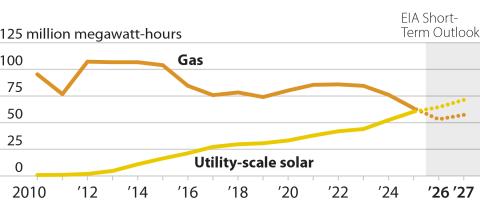
The federal government estimates that wind and solar will supply 93.7% of the increase in electricity generation through 2027.
The growth in renewables and battery storage helped Texas lights remain on and prices stay low during record July electricity demand.
Meanwhile, PJM, which is heavily dependent on natural gas- and oil-fired plants, posted prices that were 70 times more than Texas customers paid.
Regulators and PJM officials need to learn from Texas and California: Renewables are reliable, readily deployable, and keep prices stable.
The prevailing public narrative is that U.S. electricity demand is soaring and gas is the only option to meet that growth. The data tells a much different story.
In its August short-term energy outlook, the Energy Information Administration (EIA) projects that total electric power sector generation will climb 4.6% from the beginning of 2026 through the end of 2027. Strong growth, certainly, and a break from the past decade, but not unprecedented.
What is most interesting in EIA’s data is the composition of the new generation. The agency projects that wind and solar will supply 93.7% of the projected increase through 2027—186.4 million megawatt-hours (MWh) of the forecasted 198.8 million MWh rise. Adding expected hydropower generation pushes the renewable share to 98.5%, or 195.9 million MWh. By contrast, EIA expects coal and gas generation to climb just 1.3 million MWh through 2027, supplying less than 1% of the projected national increase in electricity output.
Importantly, the projected increase in utility-scale wind and solar generation is a national trend. As the graphic shows, EIA expects output from the two renewable resources to climb significantly in almost every major U.S. power market.
Figure 1- EIA projects strong growth in solar, wind generation through 2027
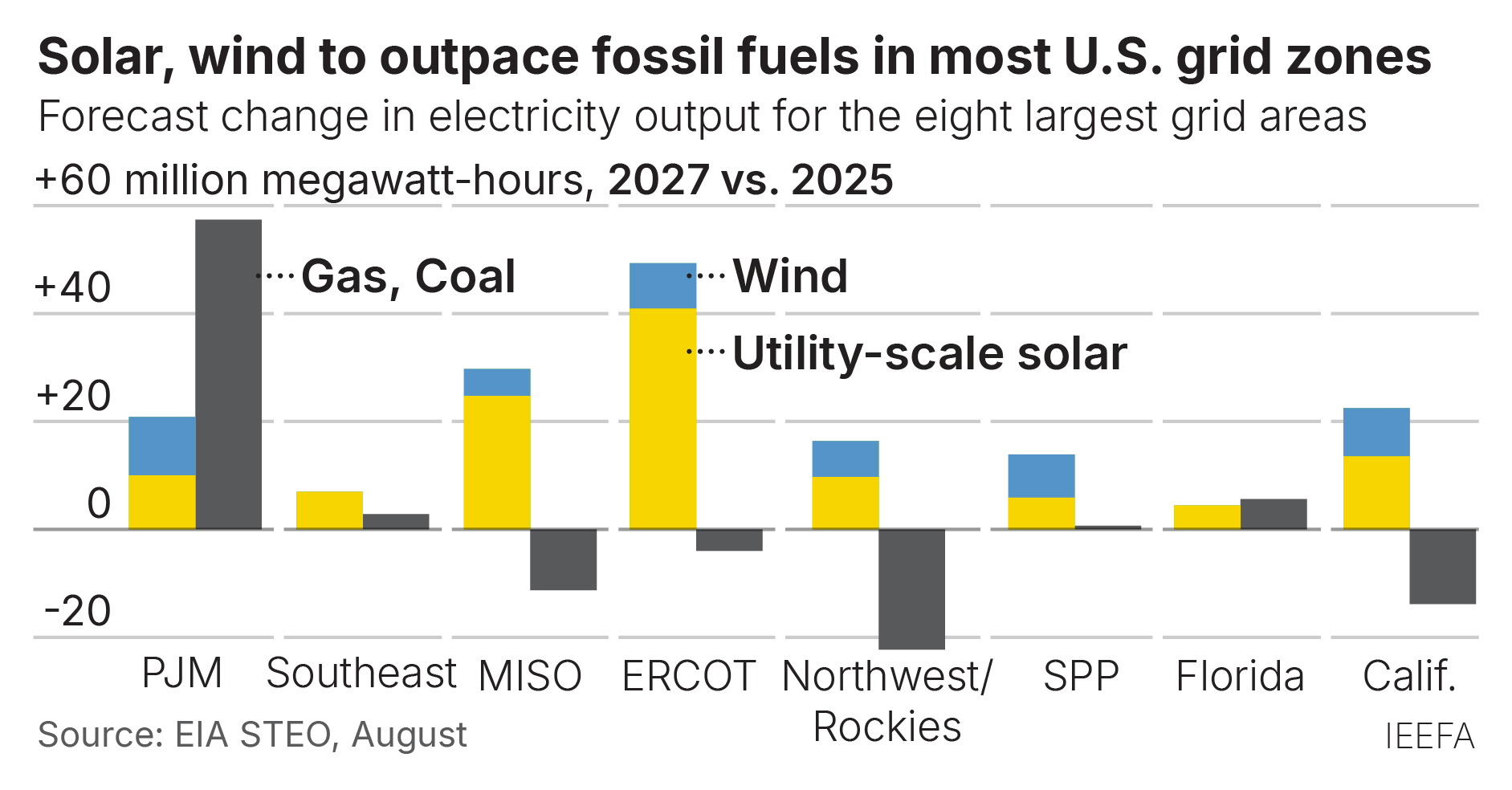
IEEFA has written extensively about the renewable (and dispatchable battery storage) transition underway in the Electric Reliability Council of Texas (ERCOT), which operates the market serving about 90% of the state’s electricity demand. Texas has the highest power demand of any individual state in the country, by far. Not only is that transition continuing as the state rushes to meet the burgeoning electricity needs of new data centers and other industrial sources, but the buildout of large-scale solar and wind will be the largest of any power market in the country. Through 2027, EIA projects total ERCOT generation will increase 42.4 million MWh— all of which will be supplied by wind and solar.
The ability of renewables and dispatchable battery storage to meet rapidly rising demand was on full display in ERCOT in July. The system smashed its previous generation record July 22, hitting a peak of 91,089 megawatts (MW) at 6 p.m. local time. This was 3,692 MW above the July 21 mark and 5,508 MW above the system’s previous peak record of 85,508 MW set Aug. 10, 2023. The market barely noticed. At the peak hour, real-time ERCOT prices averaged just $29.11/MWh. In contrast, in 2023 prices climbed to $4,477.12/MWh during the peak hour, and were well over $1,000/MWh for most of the afternoon and early evening.
The reason for the significant price differential is straightforward: Solar and battery storage have changed the ERCOT market, making it both more flexible and reliable while keeping prices in check. Solar generation topped out at 12,993 MW in 2023 and hit 10,435 MW at the peak hour, just over 12% of total demand. On July 22, solar generation climbed to a high of 33,634 MW early in the day and was at 28,712 MW during the peak hour, providing 31.5% of total demand. This solar generation reduced the need for more costly gas and coal, which were both lower at the peak hour in 2026 than in 2023, even though demand was much higher.
Then, as solar generation began to decline, batteries flooded into the market. For more than an hour beginning at 7:45 p.m. July 22, batteries injected more than 10,000 MW into the ERCOT system, providing between 10% and 14% of total demand, negating the need for expensive gas peakers or additional coal generation.
Texas is clearly one of the energy transition leaders, but it is no longer alone. EIA expects wind and solar to grow faster than gas and coal generation in nine of the 11 U.S. power markets through 2027. In those nine areas, EIA projects that wind and solar generation will rise by 161 million MWh while gas and coal output will fall 63 million MWh.
Table 1- EIA projects sharp growth in wind and solar output, flat gas and coal generation
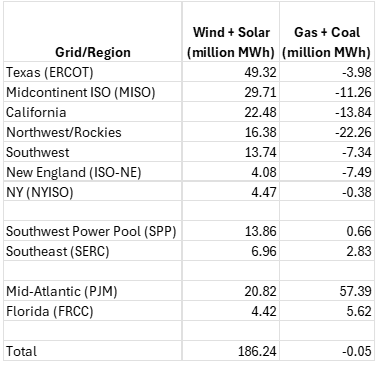
Source: EIA STEO data, IEEFA calculations
The outlier in the ongoing U.S. transition is PJM, the nation’s largest power market, serving all or parts of 13 Midwestern and mid-Atlantic states and the District of Columbia. Its long-troubled process for connecting new generation has led to the delay and/or cancellation of thousands of megawatts of planned solar and wind projects. System rules have also discouraged the construction of battery storage capacity, further undercutting renewables. As a result, while EIA expects wind and solar output to climb in PJM through 2027, almost three-quarters of the region’s generation growth will come from gas and coal.
Perhaps most telling, some 44% of PJM’s projected increase in generation through 2027 is expected to come from the region’s aging coal-fired power plants. These facilities have faced serious economic problems in the past decade, with many being unable to compete profitably and seeing their output decline as a result.
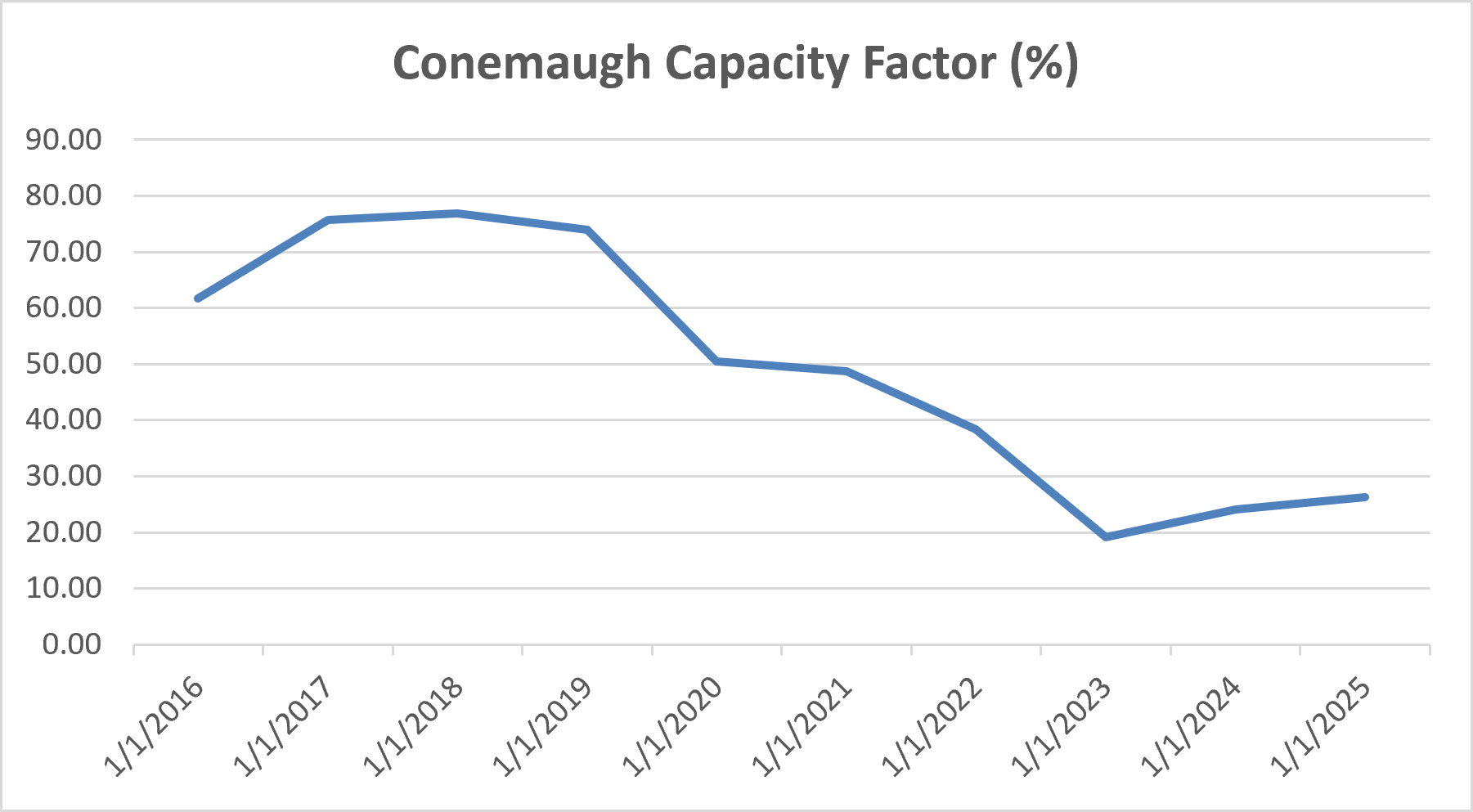
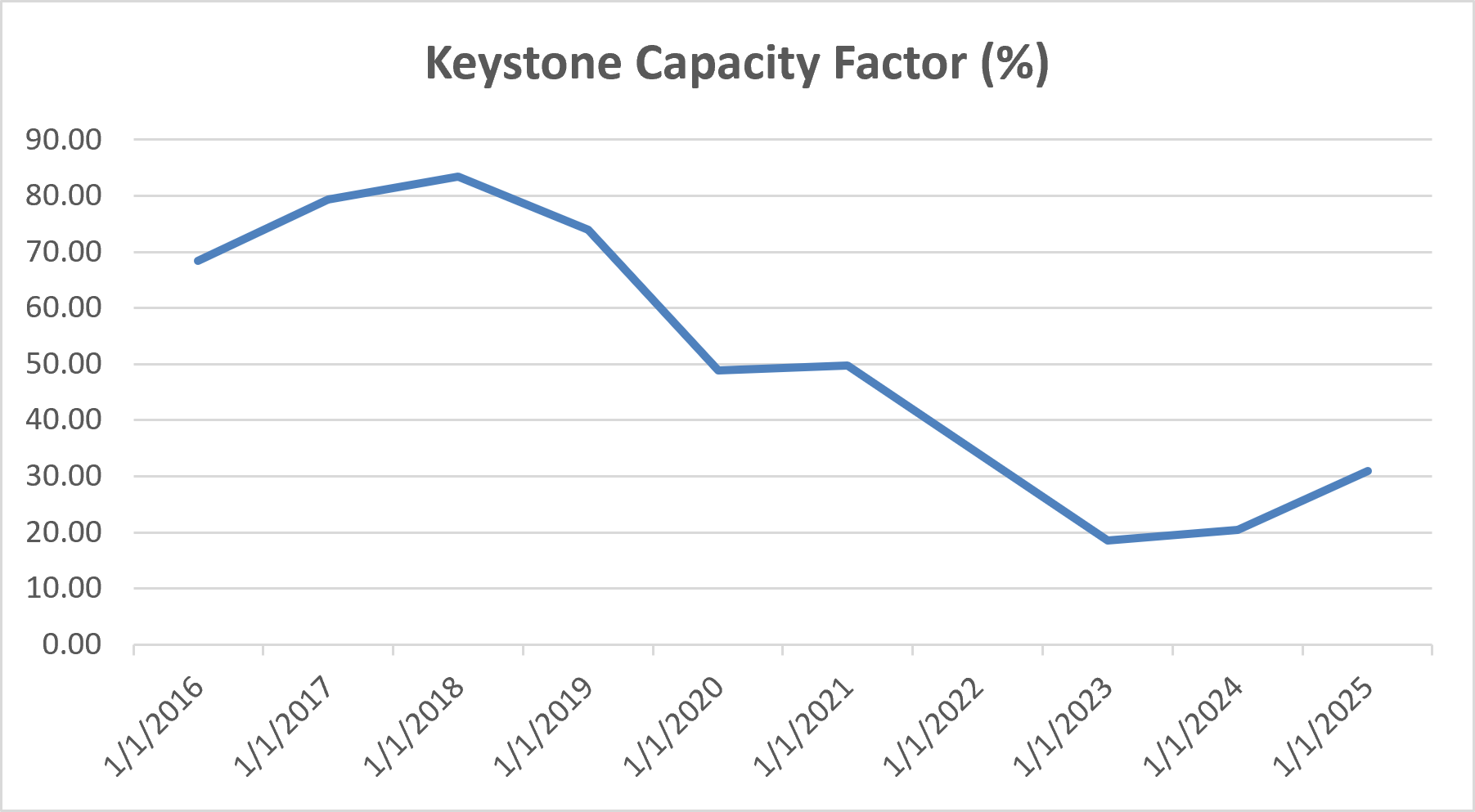
The Keystone and Conemaugh plants in Pennsylvania, essentially twin facilities with two 850-MW units each that came online between 1967 and 1971, are emblematic of these market issues.
Generation at these plants has fallen sharply over the past decade, dropping from an annual capacity factor of roughly 80% in the late 2010s to the 20%-30% level over the past three years. However, the continuing uncertainty around the region’s new project queue and PJM’s sky-high capacity payments, driven by projections of sharply higher regional electricity demand, have given all of PJM’s coal plants a temporary reprieve.
Figure 2 – Electricity generation falls at two large PJM coal plants
Source: S&P
PJM’s operating power plants benefit handsomely from the system’s sharply higher capacity payments, at consumers’ expense. All told, customers across PJM will pay almost $50 billion over the next three years due to the recent surge in capacity costs. In theory, these higher prices will encourage the construction of new generation, ultimately lowering costs. However, whether the theory becomes a reality will not be known for years; meanwhile, existing generators profit while customer costs rise.
The economic impact of PJM’s reliance on gas and aging coal plants also was evident in the early July heatwave that pushed regional demand to a new record. On July 2, PJM demand climbed to 168,158 MW, beating the system’s previous peak (set back in 2006) of 165,563 MW. In contrast to the relatively ho-hum price reaction in ERCOT discussed above, PJM prices soared. GridStatus data show that real-time prices during the peak hour on July 2 (from 5 p.m. – 6 p.m.) climbed to almost $2,000/MWh, and were over $200/MWh from 11:10 a.m. until 9:30 p.m.
More solar generation, which provides extremely reliable, low-cost power during summer peaks (again, see the example of Texas) would likely have dampened the region’s high prices on July 2. In addition, battery storage—of which PJM has virtually none—almost certainly would have lowered the region’s peak prices, as has occurred frequently in both ERCOT and CAISO, which are both smaller regional markets that have embraced battery storage. ERCOT currently has 21,864 MW of installed battery storage capacity, with roughly another 16,000 MW expected online by the end of 2027. Installed battery storage in CAISO totaled 17,125 MW as of Aug. 1, with more under construction.
Regulators, politicians, and market participants in PJM need to take a hard look at the measures being implemented in other regions. The data shows that renewables work, particularly when coupled with dispatchable battery storage. They are reliable, readily deployable, and keep prices stable.
Related Research