California’s gas use for power falls to record low
Natural gas’ share of electricity generation in the market run by the California Independent System Operator (CAISO) fell to a record low on May 16, dropping to just 3.1% of total generation. That day was not an outlier either; from May 13-17, gas’ share of daily CAISO output was less than 10%.
May is a relatively low-demand period in CAISO, which accounts for about 80% of the California electricity market. But comparing 2026 generation data through May 15 with previous years (2021and 2025) shows that the state’s long-running efforts to cut its reliance on gas-fired generation are paying off. California eliminated in-state coal generation more than a decade ago; a power plant in Utah supplying Los Angeles ended its coal use late last year.
In 2021, gas’ generation share never fell below 20% and was 40% or higher on 99 of those 135 days. In 2025, the number of high-market-share days (more than 40%) dropped sharply, to 56, but gas’ minimum daily share still never fell below 20%. This year has been a different story. There have been 68 days already when gas’ market share fell below 20%, and there has not been a single day when gas accounted for more than 50% of CAISO generation.
Solar, Wind, and Battery Storage Push Gas Generation to Record Low In CAISO
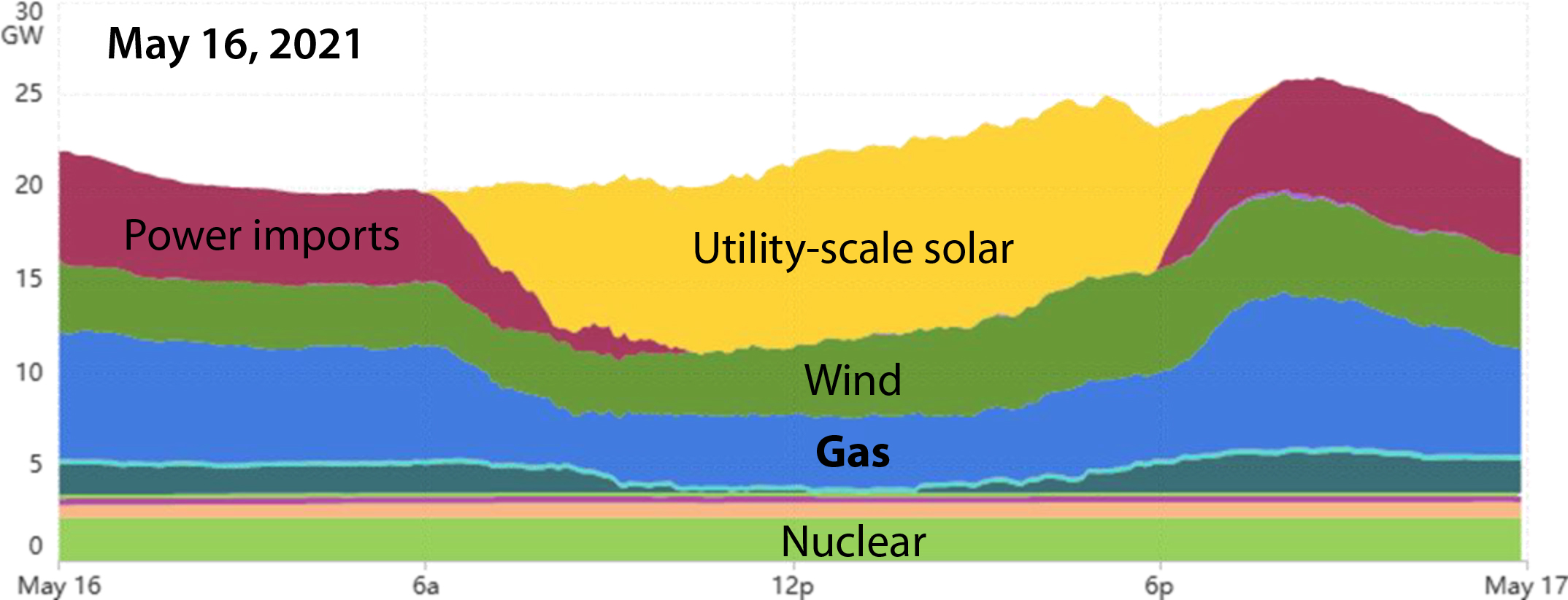
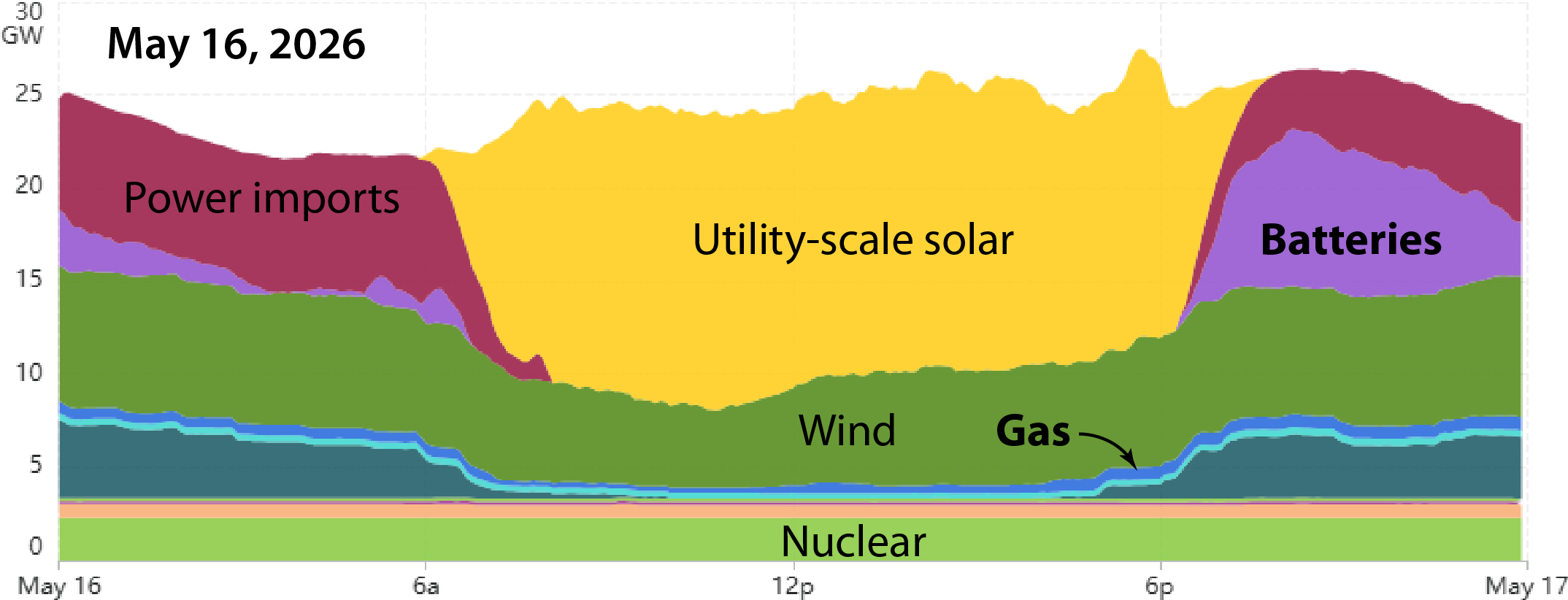
Source: GridStaus.io
Less gas-fired generation means less need for gas. The amount of gas used for power generation in California has fallen to its lowest level in at least 25 years. For the 12 months ending in March, the state used an average of 35.7 billion cubic feet (bcf) of gas each month, a 34% decline from the average just three years ago in March 2023 and less than half the record high of 76.7 bcf recorded in December 2001.
California’s average monthly gas use for electricity is at the lowest level in decades
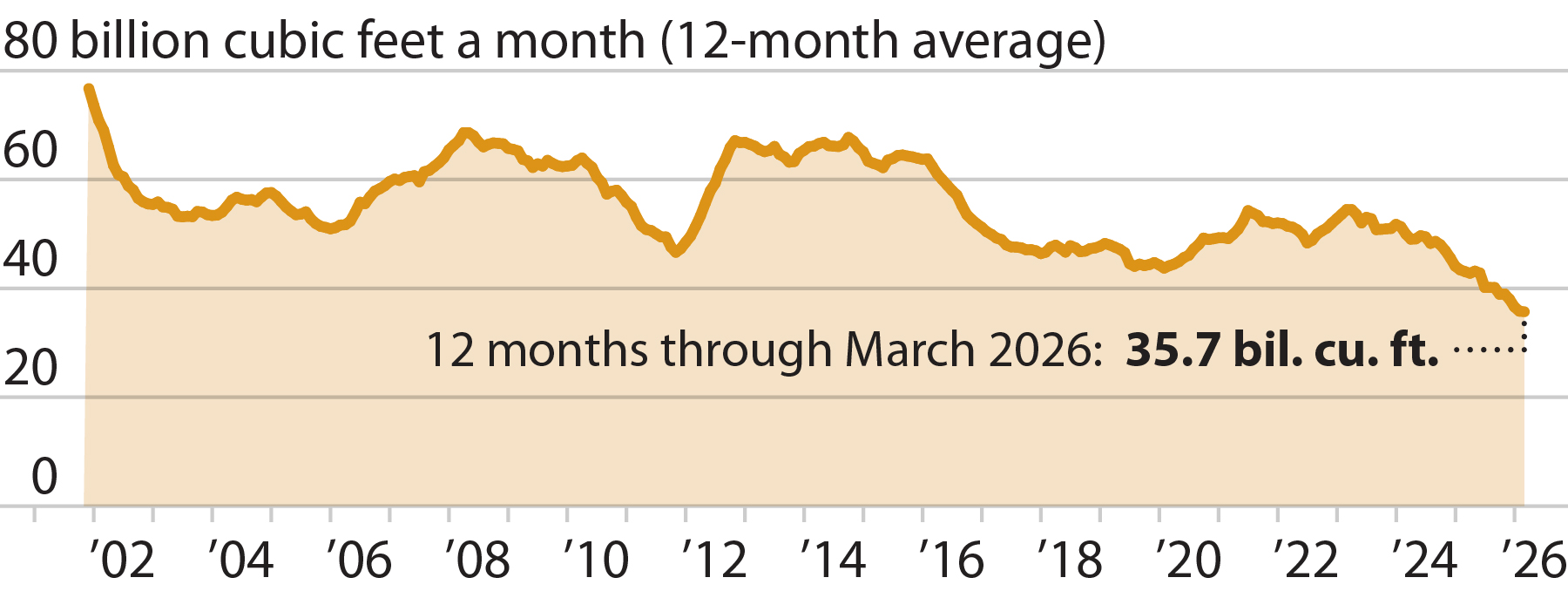
Source: Energy Information Administration
The transition from gas can be traced to several developments.
The massive build-out of battery storage in the California market has played a key role in reducing gas generation. CAISO releases a monthly statistical report about installed capacity and generation totals for the prior month. Battery storage was not included in that analysis until August 2021, when CAISO reported that 1,500 megawatts (MW) of storage capacity were installed across the system. In its April 2026 analysis, CAISO reported 16,251 MW of installed battery storage capacity.
That capacity has changed system operations. Battery storage now routinely supplies 20% or more of system-wide demand in the evening, beginning to send power into the grid around sunset and continuing to discharge until late in the evening.
On May 16, for example, battery storage supplied 20% of demand from 7:05 p.m. to 11:10 p.m., time-shifting low-cost solar from earlier in the day to the evening. During that same period, gas-fired generation never supplied more than 3% of demand, a low unheard of even a year ago.
While not as evident on May 16, batteries also are increasingly being used in the early morning hours. This generation, which has topped 7,500 MW and averaged a high of 3,600 MW in the previous 31 days, reduces the need to ramp up gas generation as demand climbs just before sunrise.
For May 16 as a whole, gas generation totaled just 12,477 megawatt-hours (MWh), a level that would have been unthinkably low in 2021 when the lowest daily generation total for the whole year was 104,174 MWh. Even last year, the lowest daily generation total was 50,199 MWh. Already this year, there have been 36 days (through May 16) when gas-fired generation failed to top 50,000 MWh.
Another reason for gas’ decline is a rise in wind generation sent to California. In early May, power began flowing from the 3,650 MW SunZia project in New Mexico. The project is connected to the CAISO grid through a 550-mile-long, high-voltage direct current line running from the wind farm to south-central Arizona. There, the power is converted to alternating current and fed into transmission lines running to California. CAISO has purchased 3,167 MW of the project’s capacity, although imports will initially be limited by transmission constraints; it currently holds only 2,131 MW of transmission rights on the Palo Verde line into the state.
Still, the project’s start-up can already be seen on the CAISO grid. The system has set five new wind generation records since April 13, the latest on May 15, when output hit 8,294 MW, almost 1,600 MW higher than the record before SunZia power began flowing into the state. Importantly, the SunZia generation is likely to be strongest at night, sending power into the grid when gas demand has traditionally picked up. Looking again at May 16, gas generation in the 12 a.m. – 6 a.m. period averaged about 3,600 MW in 2025. During the same period this year, gas generation was roughly 560 MW—the equivalent of just one gas plant running across the entire system.
The difference was wind. This year, wind generation averaged about 7,000 MW during the overnight period on May 16, compared to just about 4,000 MW a year ago. That is bad news for gas.
Even more wind is on the way. CAISO is currently working on two transmission projects designed to bring up to 5,000 MW of new capacity into the system. The Southwest Intertie Project will have 2,000 MW of capacity and expand links between CAISO, Nevada, and Idaho; it is expected to begin commercial operation in 2028. The second, Transwest Express, is expected to go online in 2031. Designed specifically to bring wind generation from Wyoming into California, this project is a 732-mile-long, combined high-voltage direct and alternating current line.
The third factor behind gas’ decline is the continued growth of utility-scale solar in the CAISO system. This clearly has been the underpinning for the growth of the system’s battery storage resources. But it is a valuable resource in and of itself. In 2021, there were 14,116 MW of installed utility-scale solar in the CASIO; as of April 2026, that total was 22,702 MW.
That capacity growth is evident in the generation totals for utility-scale solar. Through May 12, solar output in CAISO totaled 16.6 million MWh, up 48% from 2021, and its market share was 33.2%. Gas is going in the other direction. Its generation to May 12 totaled 10.9 million MWh, down 53% from 2021 and cutting its share of CAISO demand to 21.8%.
The result? Data from the Energy Information Administration’s (EIA) short-term energy outlook projects that solar generation in California will top gas generation for the first time this year, with the gap widening in 2027.
Utility-scale solar generation is set to surpass gas in California this year
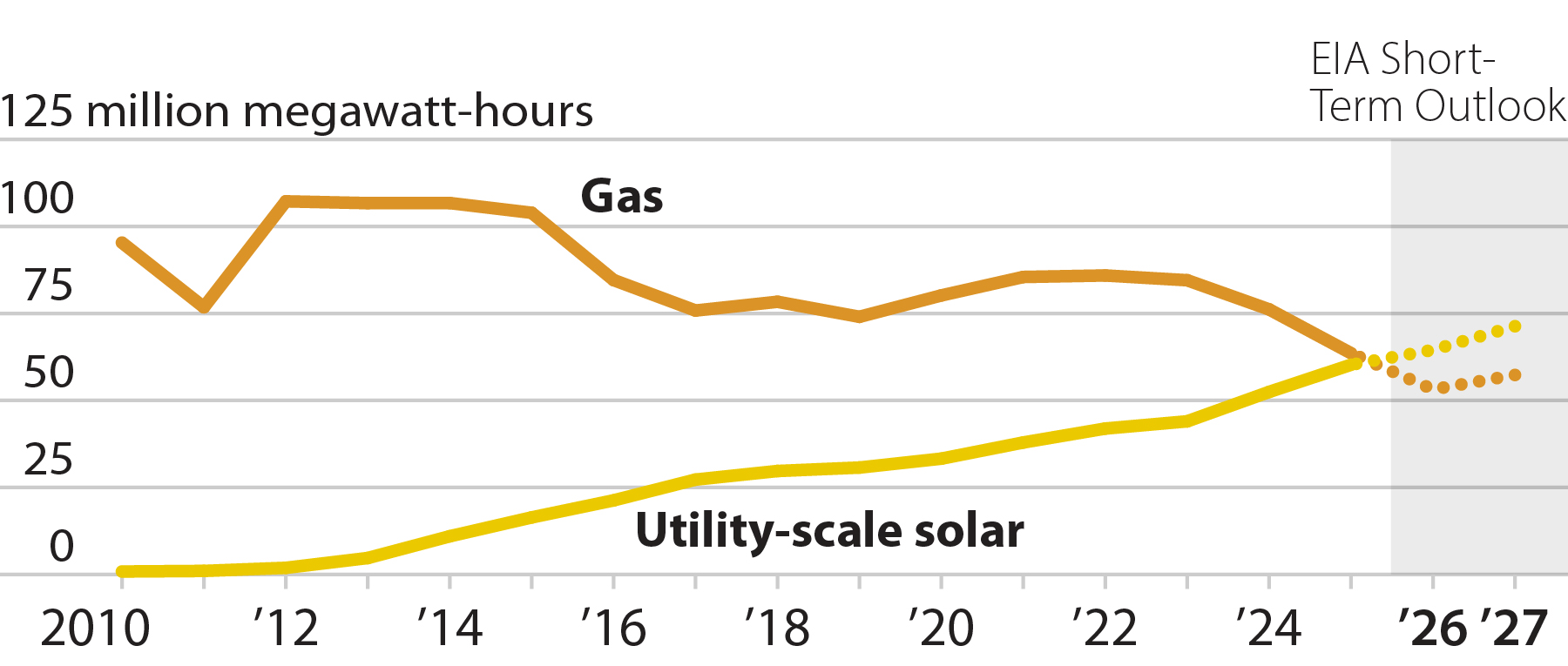
Source: EIA Short-Term Energy Outlook (May 2026)
California’s decades-long history of supporting renewable energy growth to wean its grid from fossil fuels is paying off. But the biggest changes have occurred in CAISO in just the last five years. In 2021, as shown in the first chart above, there were no dispatchable battery storage resources, solar and wind contributed less to grid demand, and gas was still a significant generation resource throughout the day. All that has changed. The investments in solar, battery storage, and transmission for out-of-state wind are now cutting sharply into demand for gas, and the state’s long-term goal of exiting fossil fuels appears closer than ever.


Related Content