Digging in: Why BHP wants approvals for mines it says it won’t build
Key Findings
BHP has secured approval for its Saraji East coal mine in Queensland, despite a challenging economic outlook and a royalties regime it claims deters investment.
The approval follows the decision by BHP joint venture BMA to close the neighbouring Saraji South mine in late 2025 on the grounds it was uneconomic – casting doubt over the viability of new mines such as Saraji East.
The approval does not necessarily mean Saraji East will be developed – merely securing permission for the project adds to its balance sheet value as BHP faces a range of mounting liabilities.
BHP has said it will no longer invest in Queensland coal. Whether it does or not, the Saraji East approval raises questions about the rules governing Queensland’s largest coal mines.
This analysis is for information and educational purposes only and is not intended to be read as investment advice. Please click here to read our full disclaimer.
Despite facing a challenging economic outlook, as well as new coal royalties it claims are prohibitive, BHP has won approval for its proposed Saraji East mine in Queensland.
BHP recently posted its FY2026 operational review for its BHP Mitsubishi Alliance (BMA) joint venture, Queensland’s largest coal producer. BMA continues to face cost-inflation pressures, largely in line with last year, and at the top end of guidance range, despite recent cost reductions.
Meanwhile, BHP has opposed Queensland’s new coal royalty regime since the state government introduced it in 2022. The company has told investors and government that the new royalties have killed the investment case for new mines. In an email to employees it explained that royalties have added to its already-high cost structure, rendering it uncompetitive with other coal-producing regions. CEO Brandon Craig has told employees he’s not selling the coal business.
In November 2025, BHP placed the southern extent of its Sariji complex, Saraji South, into care and maintenance, claiming that it was no longer economic due to the new royalties. Reference coking coal prices have now recovered by about 20% since then, and yet the mine remains idle. In 2024, BHP placed its Western Australia nickel operations into care and maintenance due to low prices, and wrote down their value by US$3.5 billion.
In such an adverse context, it is curious that BHP has successfully secured approval to build a new underground coal mine at the Saraji complex, Saraji East.
The application passed through the environmental impact statement (EIS) process despite including an out-of-date economic impact report based on 2019-era data. As the Queensland government is seeking to fast-track mining approvals - 'cutting unnecessary delays'- it did not refer to its own guidelines, which require it to “use the best current data available”. Since then, BMA’s unit cost rate has more than doubled, and the new royalty regime was not even assessed – the very royalties BHP says it won’t invest under.
If not expanding and not selling, what is the reason for continuing to pursue new mine approvals? There is value in holding an undeveloped asset on its books, even if it never plans to mine the coal. Saraji South retains its mine value on the balance sheet – despite not being economic enough to mine, it is economic enough to avoid a write-down on reserves.
Look at the carrying value, not the coal
In its 2025 Annual Report, BHP disclosed that its steelmaking coal assets would face an indicative write-down of approximately US$2 billion (around AU$3 billion) in a climate change sensitivity scenario of 1.5°C by 2100.
Under the accounting standard IAS 36, an asset that cannot earn its keep must be written down to what it can recover. BHP’s auditors have noted the issue as a Key Audit Matter (KAM), the highest tier of audit scrutiny.
Notes on page 149 of the Annual Report explain BHP’s stance: the company regards that scenario as unlikely, so no write-down is required. The base capital value survives – but only for as long as BHP’s own coal-price scenarios are accepted.
Nonetheless, a permitted mine delivers carrying value on its owner’s balance sheet, whether it is active, parked or unlikely to proceed. It can also push out any rehabilitation liabilities further into the future – making the eventual remediation a distant prospect.
The liability the approval defers is bigger than the asset it adds
Currently, the most valuable aspect of the Saraji East approval is not what it adds – but what it defers.
Across Queensland, mine rehabilitation liabilities have grown by about 3,000 hectares a year for five years to reach a AU$14.3 billion Estimated Rehabilitation Cost (ERC) in 2025, according to the Queensland Mine Rehabilitation Commissioner. BMA’s share of those costs is estimated to be AU$2.4 billion across its asset permits. It has the lowest rehabilitation rate among its peers, and has not completed any progressive rehabilitation in the past six years since the scheme was introduced. It did, however, reduce its ERC liability by more than $1 billion through selling coal mines over that period.
An approved mine extension or a mine parked in care and maintenance potentially enables a deferred closure. BHP has quantified the value impact of changes to closure dates. In its 2022 Annual Report, a review of its coking coal mines concluded that the end of their operations “may be earlier than previously anticipated”.
That single change in timing raised its rehabilitation provision by around US$750 million. The 2025 Annual Report stated that “a one-year change in the mine life of the Group’s steelmaking coal assets would, in isolation, change the closure and rehabilitation provisions for those assets by approximately US$40 million.”
BHP is also seeking permission to extend its Peak Downs mine by 93 years to 2116, and it has applied to extend Saraji mine’s Grevillea pit into a neighbouring mining lease, effectively deferring closure of the existing pit – otherwise scheduled for imminent closure – by 30 years. Approval would prevent immediate rehabilitation of the existing pit, as the Queensland government deems land must be “rehabilitated progressively as it becomes available”.
Propping up port and rail assets
The value of the approval does not stop at the mine gate. Coal export infrastructure is almost all fixed cost, which is why it runs on take-or-pay contracts – you pay for the capacity whether or not you use it. BHP does not merely use the Hay Point terminal; through BMA, it owns it. Therefore BHP, not a third party, wears the volume risk. Hay Point throughput has fallen roughly 25% over six years, to 37 million tonnes in FY2026.
The same logic runs down the rail line. BMA contracts with Aurizon under a take-or-pay arrangement for access to the Central Queensland coal rail network, and since 2014 it has operated its own rolling stock, capable of hauling around half of its coal directly from pit to port.
Hence the additional potential tonnage from the approval adds value to the port and rail’s tonnage-based value.
A decade of underinvestment – not a royalty-induced retreat
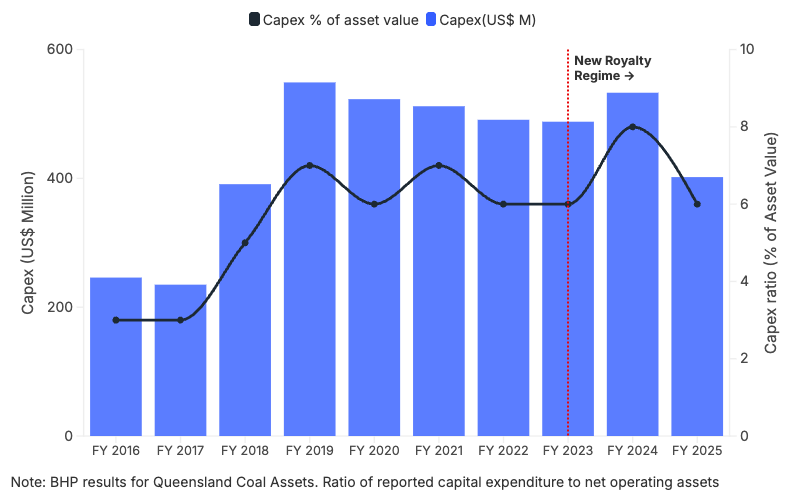
Over the past decade, BHP’s investments in its coal business have consisted of de-bottlenecking and sustaining capital expenditures, not major project expansions. Over the same time, it has progressively divested coal mines. The capex spent on the business has remained largely unchanged for the decade (Figure 1).
Figure 1: A decade of benign investment by BHP in Queensland coal
Source: BHP annual reports.
This virtually dates back to the 2015 decision to demerge South32 from BHP Billiton. Since then, BHP’s coal focus has been almost entirely on extracting productivity rather than growth. Although BHP criticises the royalty increase from FY2023, it merely extends a period of dormant investment in new coal capacity in Queensland.
So the full picture is broader than the grant of a mining approval. It is one approval propping up a stack of liabilities: the mine’s carrying value, the deferred rehabilitation provision, and the port’s value. This is why a company that insists it will not invest – or sell – will spend years securing the rights.
Transferring coal industry risk to the state
Despite these mounting liabilities – and some may argue they are merely accounting adjustments – BHP is the best placed of any miner to manage them. BHP remains one of the few diversified and best-capitalised majors in Australian coal – meaning it is most capable of managing the liabilities.
BHP will announce financial results later in August, and perhaps the outcome of its strategic review. It sits among other Queensland metallurgical (met) coal producers potentially posting marginal returns on capital. Australia’s share of the global export met coal export market declined in 2023 as other exporters expanded (Figure 2), notably Russia and Mongolia. This decline had already been in progress for some years before the new royalty rates were introduced for FY2023.
Figure 2: Australia’s share of world exports falls below 50% in 2023
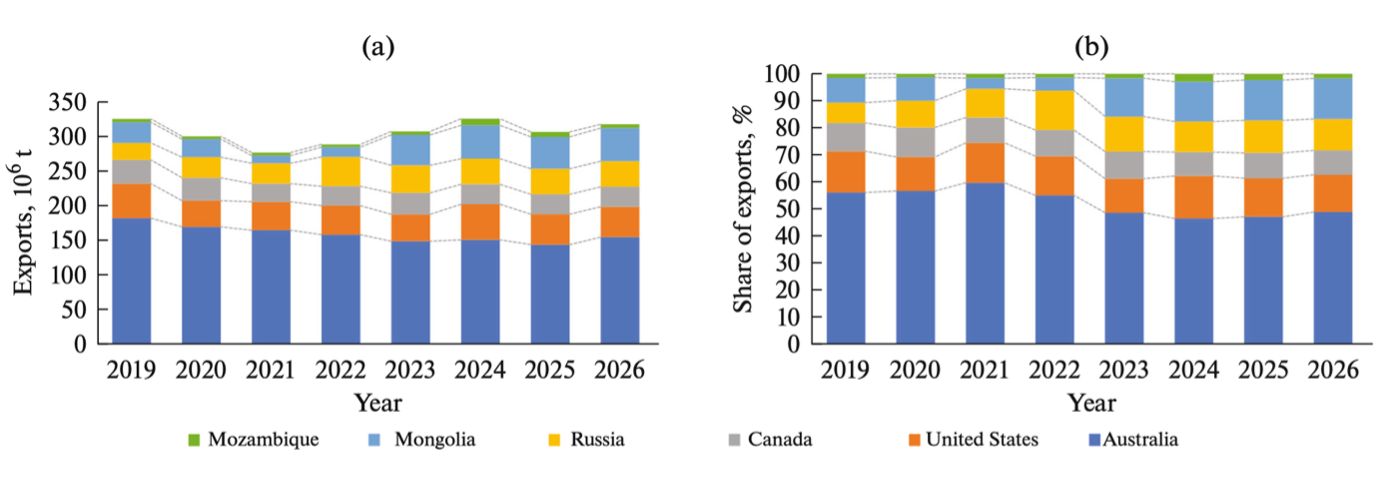
Source: World Market for Metallurgical Coal: 2025 Data and 2026 Prospects. Note: Graph shows leading exporters of met coal by: (a) export volume in millions of tonnes; and (b) distribution among leading exporters. Data for 2026 are predictions.
Meanwhile, the federal government has revised its outlook for Australian met coal peak exports downwards, from a forecast of 190 million tonnes made in 2021, to 164 million tonnes – lower export volumes than prior to 2021. In addition, another potential cost pressure is looming, as amid rising strip ratios, coal miners – including BHP – have increased their dependency on diesel over the past four years.
Queensland’s approvals process is not designed to ask who will be left carrying the can if an undercapitalised investor inherits a marginal mine. Neither is the process that oversees the state’s growing mine rehabilitation liability. In fact, Queensland is currently reviewing its $530 million financial provisioning scheme – a backstop fund if the state needs to take over remediation – and transferring the purse strings from Treasury to the Department of Natural Resources and Mines.
If the government is looking to unlock more growth and adjust its risk appetite, does that leave investors exposed? With a government eager to fast-track new coal projects, investors are left to determine whether mines will be developed, are saleable assets, or are just doing balance sheet work.
Whatever BHP’s plans are for Saraji East, the project’s approval raises questions about how the state government applies the rules governing Queensland’s largest coal mines.

Related Content