
IEEFA Issue Hub: Middle East Crisis
IEEFA Issue Hub: Impact of Middle East Crisis on Global Energy Markets - Updated: August 2026
Global energy markets that depend on imported fossil fuels are again exposed to volatile commodity prices and geopolitical risk. Although countries face different levels of direct exposure to the Middle East crisis, all could be affected by tighter fossil fuel markets, higher costs and elevated risk premiums.
Key uncertainties include the duration of the conflict, potential disruptions in the Strait of Hormuz and outages at major energy infrastructure in the Persian Gulf. Prolonged escalation could cause energy price increases to affect inflation, interest rates, trade balances and GDP growth, complicating fiscal and monetary policy.
The crisis could also pull the energy transition in two directions: accelerating renewable energy deployment to strengthen energy security, while prompting short-term measures that increase reliance on fossil fuels.
This issue hub brings together IEEFA’s global and regional research, data and expert commentary on how the crisis is affecting oil and gas markets, energy security and investment decisions.
Latest Research on Middle East Crisis
See more >





FAQs: The Crisis & Global Energy Markets
The following are responses to questions IEEFA analysts have been receiving from media and other stakeholders, with links to related resources. Quotes or references drawn from this material should be attributed to IEEFA and, where relevant, to original linked sources. For further comment, contact the media team below. Updated: July 6, 2026.
Global
How could the crisis affect the energy transition?
- The crisis is strengthening the longer-term push for renewables, even as some governments fall back on short-term fossil fuel measures.
- On one hand, the fragility of fossil fuel reliance is on display and renewables are increasingly seen as providing energy security while insulating consumers from price shocks. The Philippines is racing ahead with solar deployments, India is accelerating permitting for wind and batteries, and stock prices are soaring for Chinese solar and battery companies. Meanwhile, LNG executives warn that volatility is bad for business, with Vietnam, China and New Zealand already rethinking LNG import projects.
- On the other hand, many short-term responses still favor fossil fuels, including subsidies, reversion to coal-fired power, and efforts to secure new oil and gas supplies outside the Persian Gulf. These measures may shape near-term policy and market behavior, even as the broader case for renewables and electrification strengthens.
- Much will depend on the evolving viewpoints of decision-makers, investors, and the public. But there is now evidence that renewables can act as a solution to energy insecurity and affordability issues. The conflict is making the case against doubling down on fossil fuels.
Sources & Resources: New York Times on solar; IEEFA in AP on China; Reuters on Vietnam; Reuters on India; New Zealand Herald; IEEFA slideshow; IEA’s 2026 Energy Crisis Policy Response Tracker. IEEFA Commentary on European electricity prices; IEEFA Commentary on LNG in Asia.
Why are LNG markets under such intense pressure right now?
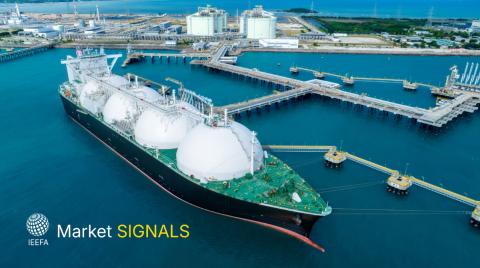
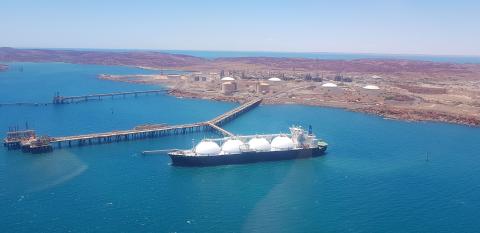
- Global LNG is already under stress. One-quarter of global LNG export capacity is offline as of early April.
- Ras Laffan, which accounts for nearly 20% of global output, is closed, with two of 14 trains damaged. Australian LNG output has been compromised by Cyclone Narelle, while Russian LNG output has been constrained by Ukraine attacks.
- Recent U.S. threats to Europe’s LNG have created new tensions and fault lines, impacting the reputation of LNG as “reliable”.
Sources & Resources: Center on Global Energy Policy; Reuters on Wheatstone LNG; Reuters on Qatar LNG; IEEFA slideshow.
What other commodity markets could be affected by disruption in the Persian Gulf?
- Commodity shocks could go far beyond oil and gas.
- The Strait of Hormuz accounts for one-third of global seaborne trade in fertilizer and 7–8% of global fertilizer supply.
- About 40% of the world’s helium, which is critical to computer chip manufacturing, comes from the Persian Gulf. The region accounts for about 15% of global polyethylene capacity, 9% of polypropylene capacity, and about 9% of the world’s aluminum.
Sources & Resources: UN Trade & Development.
How long could it take to repair damaged Middle East energy infrastructure?
- Damage has affected more than 40 major energy infrastructure assets. Even if attacks stop today, “normal” is years away.
- Restoring Qatar’s Ras Laffan LNG facility could take 3–5 years. The secret’s out: global fossil fuel infrastructure is fragile.
Sources & Resources: Energy Mix; IEEFA in New York Times.
Why does an emerging market fossil fuel crisis matter for global investors?
- The latest crisis shows that fossil fuel shocks are never just isolated events. From COVID-19 to Ukraine to the West-Asia crisis, energy disruptions have repeatedly moved from oil and gas markets into inflation, interest rate expectations, tighter public finances and deteriorating growth outlooks. For investors, this is not regional or sector-specific risk, but a recurring systemic risk to global portfolio values.
- Emerging Markets often take the brunt during supply shocks because many are exposed to imported fossil fuels, currency stress and high borrowing costs. Investors retreating to safe havens during periods of stress only exacerbates the problem, making clean energy investment harder to finance, precisely when it is most needed.
- Much of the future energy demand growth will come from fast-growing economies. If that demand is met through fossil fuels, it will increase pressure on an already volatile and disruption-prone supply base, keeping risks to global portfolios high. Keeping capital available to clean energy projects in emerging markets should be seen not just as a climate or developmental issue, but as a global portfolio risk-management tool.
Sources & Resources: IEEFA analysis in The Economic Times.

Asia
How vulnerable is Asia in this energy crisis?
- As IEA Executive Director Fatih Birol has said, this is likely the biggest global shock to energy security in history. Asia, especially, is going to bear the brunt, particularly for price-sensitive countries that lack the necessary storage infrastructure and economic tools to mitigate the economic impacts.
- In the short-term, Asian governments may introduce defensive measures such as fuel rationing and price caps. Just as after the invasion of Ukraine, there are early signs of an accelerated shift to domestic renewable energy generation, which is cheaper and helps mitigate geopolitical risks compared to imported fossil fuels.
- As this crisis continues, we are likely to see a bidding war for the limited supply available. And often, what that means is when prices are skyrocketing, it's the emerging countries that get forced out.
Sources & Resources: IEEFA Commentary by IEEFA’s Sam Reynolds and Ramnath Iyer; Reynolds on BBC, ABC-CBN, and National Public Radio.
Which countries in Asia stand out in terms of vulnerability?
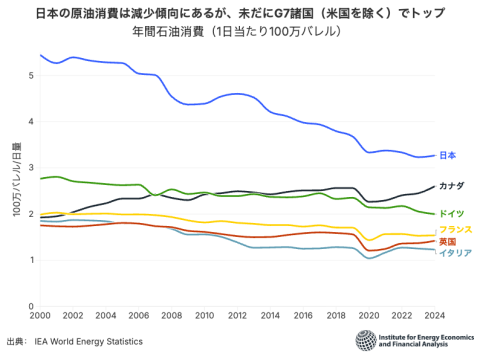
- In the case of liquefied natural gas (LNG), the lack of supply and storage can pose a real threat to Asian countries. IEEFA calculated that Pakistan, Japan, and the Philippines each sourced over 90% of their crude oil supplies from the Persian Gulf, and may also face the immediate risk of physical supply disruptions in the crude market.
- As the world's sixth-largest solar market, Pakistan has become less vulnerable to energy shocks, thanks to its massive solar capacity, particularly in households and businesses.
- Pakistan’s government had also announced that it was no longer going to build any more LNG power plants in the wake of the Russian invasion of Ukraine because energy prices had skyrocketed.
- Even in richer Asian countries, Japan is not insulated from the direct impacts of the Strait of Hormuz closure.
- Short-term fiscal measures such as subsidies and tax cuts tend to send the wrong market signals that encourage continued demand for fossil fuels.
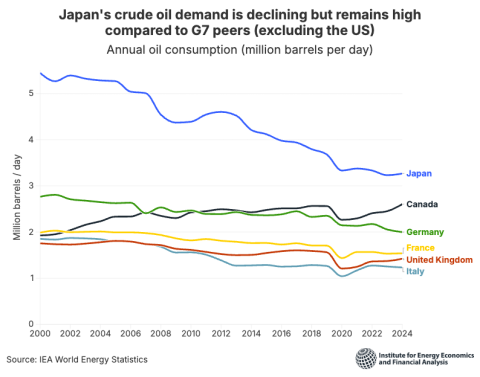
- Japan has spent over USD 77 billion on fuel subsidies between 2022 and 2024, but this level of fiscal support may not be sustainable for other price-sensitive Asian countries.
- Countries need to take coherent, intentional policy action to build energy and economic security and avoid reliance on imported fuels.
- In the near term, steps to minimize the fallout's effects on vulnerable and poorer sections of society will likely be needed. However, subsidizing inefficient and expensive fuel use in general is not the long-term answer.
- The necessary structural reform must be centered on higher reliance on freely available renewables. A second medium- to long-term priority should be to establish a modern, interconnected regional grid.
Sources & Resources: IEEFA’s Ramnath Iyer in Bernama; IEEFA briefing note on US-Indonesia trade; IEEFA briefing note on Japan LNG.
What are the emerging patterns in Asia because of the conflict?
- Overall, there are early signs of a long-term policy trajectory shift to renewables:
- Very early on, President Lee Jae Myung of South Korea said that this Iran conflict is a great opportunity to rapidly and comprehensively transition to renewables.
- The Philippines’ national energy emergency stated plans to accelerate the deployment of renewable energy and electric vehicles.
- EV sales in the Philippines and Vietnam have boomed in March as buyers seek to insulate themselves from fuel price shocks.
- Commodity market shocks completely undermine the case for LNG as an affordable, reliable ‘transition fuel’, particularly for emerging markets.
- Following Russia’s war in Ukraine, many Asian countries had already begun reevaluating the build-out of LNG import infrastructure, including Pakistan, which had instead begun importing large amounts of solar panels. The current conflict, if not deescalated quickly, could once again cause countries in Asia to reconsider LNG plans, potentially hindering the long-term growth of demand that the industry is counting on.
- Emerging markets in Asia are widely expected to be the largest growth markets for LNG demand globally, but — depending on the duration of the Iran conflict — they could once again find themselves at the mercy of global commodity markets and geopolitical uncertainty.
- Asia's surge in coal use is a short-term stopgap amid the Iran war, given that LNG power supplies remain limited and countries are unable to afford or procure available LNG cargoes. Coal may not be directly affected by the Iran crisis. But as demand rises, coal prices are rebounding to historical levels. The more expensive this crisis becomes, the more likely we are to see shifts away from imported fuels towards domestic renewables.
Sources & Resources: IEEFA’s Sam Reynolds in the Associated Press, on CNN and in The Financial Times.
Australia
How is Australia affected by the latest global energy crisis?
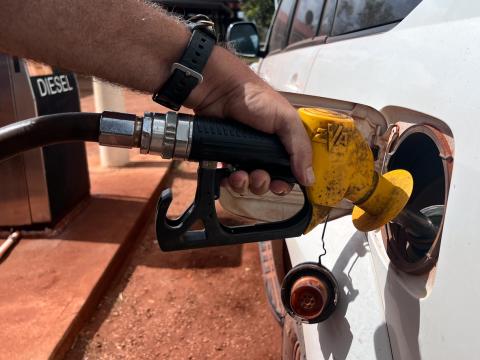
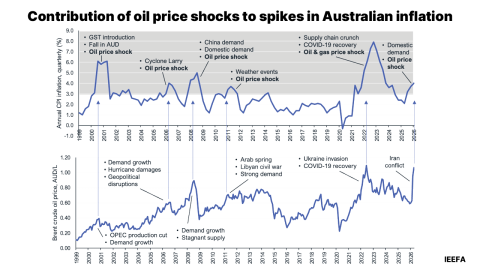
- Australia’s exposure to global oil shocks has dramatically increased in the past 25 years as our domestic oil production has dwindled. The situation is even more precarious because Australia has the smallest oil and petroleum stockpiles of all International Energy Agency (IEA) members.
- While the Iran crisis remains unresolved, Australia’s exposure presents significant economic risks. Oil is essential to many key economic sectors, such as mining and agriculture, and critical to the transport sector. It is the country’s largest energy source, accounting for 40% of total energy consumed. Oil imports also have material influence on Australia’s trade balance and inflation.
- Despite being a major producer of gas, eastern Australia faces high gas prices because much of the product is exported as LNG. This leaves Australian households and businesses exposed to international price volatility amid disruption of exports from Qatar, the world’s largest LNG producer.
Sources & Resources: DCCEEW: Australian Petroleum Statistics; Australian Energy Statistics.
How dependent is Australia on fossil fuel imports?
- The Middle East conflict presented Australia facing the prospect of a serious energy crisis, though so far it has managed the risks reasonably well. The country’s reliance on imported fossil fuels means that international crises frequently trigger high local petrol prices and threaten fuel security.
- Australia has very low stockpiles of key petroleum products, with reserves of petrol, diesel and jet fuel each equating to between one and two months of supply.
- Domestic oil production has slumped since its 2000-01 peak, amounting to just 5.6% of Australia’s demand today.
- Australia’s oil refining capacity has also fallen, with only two remaining domestic refineries, leaving the country reliant on regional suppliers for over 80% of its total petrol, diesel, and jet fuel needs.
- About 90% of Australia’s imports are sourced from Asia. Singapore accounted for 55% of petrol imports in 2025. South Korea supplies roughly 20–30% of refined products. Malaysia provides over 13%, and China, India and Taiwan are also key contributors to the overall import mix.
- This reliance on Asian refineries, which in turn import 60–70% of their crude from the Middle East, creates a significant supply chain risk for Australia.
Sources & Resources: Seven charts in The Guardian; IEEFA Briefing Note: The perfect storm to boost energy security; Wood Mackenzie Report.
How can Australia protect its energy security going forward?
- Australia has a limited range of options to reduce its exposure to a renewed intensification of the Iran crisis, or to future oil shocks. IEEFA believes boosting Australia’s dwindling petrol supplies should be the government’s first priority, along with building more storage capacity.
- Other potential short-term measures could include rapid, low-impact steps to reduce oil consumption, which would make Australia’s stockpiles last longer without material economic impacts.
- In addition, Australia should explore bilateral crisis supply agreements with countries that supply it with refined oil products that are also major importers of LNG, such as South Korea (a strategy it has pursued successfully during the Iran conflict). These agreements should be supported by the fast-tracking of export control mechanisms for Australian LNG exporters.
- Electrification is the most promising solution to ensure the country’s longer-term resilience. Australia is lagging on electric vehicle adoption, and progress in electrification of the mining and heavy transport sectors is minimal. Government should urgently accelerate action in this area.
- Greater incentives are needed to enable households to become more energy efficient – both via appliance upgrades and practical measures. Government rebate programmes have materially boosted solar and battery uptake; they should be extended and enlarged.
- A domestic gas reservation policy should be put in place to ensure Australia’s LNG exports do not result in Australian households paying higher prices for gas. This policy should also include measures to encourage exporters to contribute to domestic gas demand reduction measures.
Sources & Resources: DCCEEW: Australian Petroleum Statistics; IEA; Australian government’s Transport Sector Plan; Electric Vehicle Council, Journal of Cleaner Production.
What are the implications for Australia as an energy exporter?
- Australia is a major producer of fossil fuels, with the vast majority of its exports going to Asia. Australia is the largest exporter of metallurgical coal, the second largest exporter of thermal coal and one of the top three LNG exporters in the world.
- LNG is crucial for export revenue, contributing significantly to Australia’s wealth through massive investment and export earnings.LNG currently contributes to Australia’s wealth through export earnings.
- The overwhelming majority of Australia’s natural gas production (roughly 83%) is dedicated to LNG exports. In the Northern Territory, 97% of gas production is exported, while WA's domestic supply share is increasing due to lower production, not higher domestic output.
- About 90% of LNG exports go to Japan, China, South Korea and Taiwan. Japan alone receives over 40% of Australian LNG.
- Australia is now using its LNG clout to secure liquid fuel imports (petrol/diesel) from Asia amid the global market turmoil arising from the Middle East conflict.
Sources & Resources: IEEFA’s Kevin Morrison in The Guardian, IEEFA in Bloomberg, IEEFA’s Josh Runciman in ABC Australia.
Europe
How can Europe reduce its vulnerability to the latest global energy crisis?
- As the largest importer of LNG globally, Europe is facing the biggest wake-up call to electrify since the full-scale invasion of Ukraine. Structural gas demand reduction is the only durable solution to the crisis.
- Replacing gas consumption with renewables and energy efficiency is key to decreasing dependency on LNG imports and limiting exposure to gas supply disruption and geopolitical risk.
- If the EU delivers on its REPowerEU targets to 2030, this would mean:
- 65.1 gigawatts of solar and 22 gigawatts of wind added annually
- 10% annual increase in heat pump installations
- Cumulative gas demand reduction of around 103 billion cubic metres
- €30 billion saved on LNG imports
- EU gas demand declined by 20% between 2021 and 2024 thanks to REPowerEU measures, and increased by 5% in 2025.
Sources & Resources: IEEFA European LNG Tracker and EU Gas Flows Tracker; IEEFA: EU gas imports to fall 25% by 2030 as demand reduction target exceeded once again; IEEFA LinkedIn post.
How dependent is Europe on imported LNG?
- Europe reduced gas demand in the wake of Russia’s 2022 invasion of Ukraine but remains structurally dependent on imported LNG, leaving its energy security vulnerable to supply disruptions, price volatility, market uncertainty and geopolitical risk.
- LNG prices in Asia and Europe are converging well above pre-crisis levels. The two regions are competing for cargoes.
- European gas [AH1] [AMJM2] [SR3] storage levels are around 38% of capacity as of late May 2026. Imports of U.S. LNG could increase to refill storage. [SR4] [AMJM5] The longer Europe waits to refill storage, the more it will have to pay to secure cargoes against competitors in East Asia, where buyers are more dependent on Gulf supply and face more acute inventory pressure.
Sources & Resources: IEEFA’s Ana Maria Jaller-Makarewicz in Al Jazeera, BBC (Radio 4 Today, Business Today), CNBC, Euronews.
How does the disruption of LNG supply from Qatar affect Europe?
- Europe’s share of LNG imports from Qatar fell to 6% in the first quarter of 2026, with the effective closure of the Strait of Hormuz from early March limiting exports from the country.
- Exposure to disruptions is uneven: The most vulnerable countries are Italy, which imported 33% of its 2025 LNG supply from Qatar, followed by Poland (25%) and Belgium (16%).
- As a result of disruptions to Qatari LNG exports, Europe has become even more reliant on its two largest LNG suppliers, the U.S. and Russia.
- According to IEEFA’s estimates, the 65 gigawatts of solar that the EU installed in 2025 could generate enough electricity every year to replace the energy equivalent of EU imports of Qatari LNG in 2025 (11.4 billion cubic metres).
- The war in Iran has pushed up European gas prices, causing electricity price spikes in countries where gas often sets the marginal power price such as Italy and Germany.
Sources & Resources: IEEFA European LNG Tracker; IEEFA: Europe’s electricity prices are still tied to gas, making geopolitics a structural vulnerability; LinkedIn post.
How dependent is Europe on imports of U.S. LNG?
- While Europe has decreased its dependency on Qatari LNG in recent years due to the disruptions in the Red Sea, the market share of U.S. LNG has increased significantly.
- The U.S. accounted for 63% of Europe's LNG imports in the first quarter of 2026, up from 57% in the first quarter of 2025.
- If the Middle East conflict continues to disrupt LNG shipments from Qatar, the U.S. could supply two-thirds of Europe's LNG imports in 2026 and 80% by 2028.
- U.S. LNG is the most expensive LNG for EU buyers. EU countries spent €131.2 billion on U.S. LNG between 2022 and 2025.
Sources & Resources: IEEFA commentary; IEEFA European LNG Tracker.
How will Europe be affected if the crisis escalates?
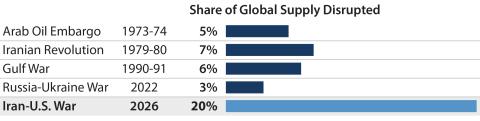
- Markets are now grappling with a scenario long discussed in theory but rarely thought of as a legitimate possibility — the effective shutdown of the world's most critical energy chokepoint. While the 1970s crises knocked out 7% of global oil supplies, the closure of the Strait of Hormuz affects 20%.
- With almost all global suppliers at maximum capacity, European leaders are beginning to realise that the LNG supplies they were counting on were not coming here as expected.
- Europe will start to feel the pain this coming month — perhaps within a few weeks.
Sources & Resources: IEEFA in Politico.
North America
How quickly could U.S. oil and LNG producers increase exports in response to the conflict?
- Oil and LNG are in very different situations. There is not a lot of room to respond to the crisis by expanding output. However, U.S. LNG capacity is definitely increasing due to long-planned infrastructure projects that were coincidentally set to come online. Meanwhile, U.S. oil exports just hit an all-time high, with markets and policy responding to the crisis with modest increases in oil and oil product exports.
- There is not much more room for oil exports to grow, but it’s likely that they could be more responsive to price increases than LNG, because LNG output has a hard cap set by infrastructure constraints.
- The gas market disruptions are much more evident in importing markets than in exporting markets, and thus have not affected North American gas or LNG markets much at all.
- Significant increases in U.S. exports could take months to materialize, and possibly a year or more. If continuing strikes or blockades cause prolonged disruptions to global oil and LNG production or trade flows, prices on international markets will rise.
- Higher prices would create an incentive for U.S. producers to increase output, but beyond limited short-term gains, ramping up production takes time, at minimum, months and in some cases a year or more. Much will depend on how long the conflict lasts.
Sources & Resources: Energy Mix; IEEFA in New York Times.
How could the crisis affect the economics of new U.S. projects like gas power plants and data centers?
- A growing issue for gas projects is the impact of fuel costs on the ultimate price paid by consumers for power. Utilities generally pass fuel costs directly through to consumers, which effectively eliminates the companies’ financial risk from gas price spikes. Customers are not as lucky, as was clearly evident in 2022, when Russia’s invasion of Ukraine sent gas prices soaring and pushed electricity costs from gas-fired power plants up sharply. In addition, weather-driven price spikes can result in significant unexpected costs being pushed onto U.S. consumers, as happened this past winter. Similar weather and geopolitical spikes cannot be ruled out in the years ahead. Finally, the growth of U.S. liquefied natural gas (LNG) exports could result in more persistent, long-term increases in gas costs and further boost price volatility.
Sources & Resources: IEEFA Report on Gas Power Plants and related webinar.
How could the Middle East crisis affect export markets in Canada?
- In the short term, for net energy exporters like Canada, conflict driven energy price spikes could lead to windfall gains, as realized export revenues, interim trade balances, and the government share of income receive a boost. Oil and gas producers stand to benefit from increased cashflow, income and potential increased distributions to their shareholders. Given energy markets’ long history of rebalancing, present conditions may prove transitory rather than permanent.
- In the medium term, infrastructure constraints, pipeline capacity, and LNG export terminal limitations restrict how fast exports can scale in response. Many Asian refineries are not optimized for Canada’s heavy, sour crude, thus limiting the number of buyers able to absorb large volumes without costly upgrades. Regulatory constraints – including unresolved issues regarding the introduction of an industrial carbon tax – may limit industry investment required to ramp up production.
- In the long term, structural demand destruction in Asia in response to the crisis –electrification, accelerated EV adoption, scaling of solar, batteries and other clean technologies, plus cancellation of proposed LNG projects – could shrink long-term markets for fossil fuels. Buyers looking to insulate their portfolios and supply chains from conflict-related disruptions may place a premium on Canadian sources of energy due to its reputation as a relatively stable supplier, with abundant reserves and no direct exposure to geopolitical conflicts and shipping chokepoints.
Sources & Resources: Canada’s oil and gas prices in Reuters, Asia and Middle East oil in Reuters, IEEFA’s Mark Kalegha in Canada’s National Observer , IEEFA Commentary, CBC on Canadian competitiveness.
Is the crisis likely to cause permanent demand destruction for Canadian crude oil and natural gas in Asia?
- Import-reliant countries tend to rethink their energy systems during supply disruptions. This could take the form of investing in redundancy via alternative oil and gas supplies, or what is effectively demand destruction, through energy efficiency initiatives or switching to different technologies that rely on different, cheaper, more secure fuel sources.
- However, this crisis is global, and it is the second such crisis in four years. Almost all Asian importing countries are reconsidering the role of oil products and LNG imports, with implications for long-term export markets, including Canada’s.
- During a dual oil shock in the 1970s, many Asian countries tried to reduce their dependence on oil imports. For example, Japan diversified its oil import sources and laid the groundwork for the modern LNG supply chain. Thailand and other countries explored and developed domestic natural gas deposits, transforming their economies to run on gas. Other importers like the U.S. began to explore alternative pathways, like solar power.
- This dual shock is different. It’s impacting more commodities than oil, including LNG, crude, and oil products. The best way to improve energy security is to not rely on vulnerable oil and gas imports in the first place. What has stopped that from occurring in the past is cost, infrastructure investment, and the perception that some of these technologies may not be able to do the job.
- For Canada, LNG – as a higher-cost energy carrier – may be more exposed over the long term. While power only makes up about a third of global LNG demand, a significant part of future growth that suppliers like Shell foresee is through the power sector. That future is in doubt as countries rethink their energy plans after two significant crises involving LNG. Gas consumption is still likely to grow in countries with expanding domestic supply, such as China, but imported LNG faces greater pressure from technology shifts and alternatives, including electrification and domestic biogas. Industries built on legacy, low-cost gas resources for high-heat processes and electricity are unlikely to compete using LNG due to its high cost and availability problems. For example, the global apparel industry may start to reshore manufacturing facilities based on energy costs.
Sources & Resources: IEEFA’s Christopher Doleman in DOB Energy.
South Asia
How is the Middle East crisis affecting energy prices and energy security in South Asia?
- The crisis has created a highly volatile situation for oil and gas markets, with risks to fuel prices, supply, and wider economic stability across South Asia.
- At its peak, the crisis disrupted around a quarter of global seaborne oil trade and roughly a fifth of global LNG supply. In India, this meant temporary shutdowns at major petrochemical producers, gas shortages and rising input costs for steel producers, and fertiliser production running at reduced gas allocations, with knock-on risks to food production.
- In India, the crisis pushed up fuel costs, inflation, borrowing costs, and government subsidy burdens, adding to fiscal stress. In Bangladesh, energy and power supply came under significant strain, and the country continues to carry a large subsidy burden even as the acute phase of the crisis eases.
Sources & Resources: IEEFA's Vibhuti Garg in AP and Fortune; Shafiqul Alam in The Financial Express Bangladesh; IEEFA op-eds in The Hindu and The Hindu Business Line; Swathi Seshadri in ET EnergyWorld; Saumya Nautiyal and Simon Nicholas in World Economic Forum; Kevin Morrison on the US-Iran deal and the slow return of oil and LNG flows.
Why are India and Bangladesh especially vulnerable?
- The core issue is import dependence, combined with exposure to the global spot market. India’s crude oil import dependence is now close to 89%, and it sources the majority from the Middle East.
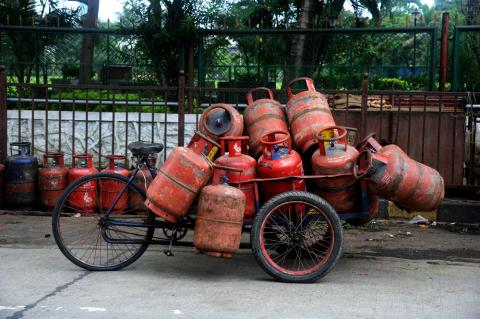
- India imports 60% of its LPG and 48–50% of its natural gas. Bangladesh is also exposed through imported energy and LNG purchases linked to volatile global markets. Bangladesh, India, and Pakistan together import almost two-thirds of their LNG via the Strait of Hormuz.
- India spends USD26.4 billion a year importing cooking gas alone, most of it shipped through the Strait of Hormuz. The country's strategic reserves cover only about 25 days of crude oil and LPG, and 10 days for LNG. China, by contrast, holds an estimated 1.2 billion barrels in strategic reserves and has reduced its exposure through rapid electrification — its EV push has displaced over 1 million barrels per day of oil demand.
Sources & Resources: IEEFA's Purva Jain in Scroll and The Independent; Vibhuti Garg in Scroll; Shafiqul Alam in The Daily Star; Purva Jain in an interview with The Hindu; Alasdair Docherty and Shantanu Srivastava in ET Energy World.
What could this mean for households, industry, and the wider economy?
- Higher fuel prices can feed into inflation, food prices, transport costs, subsidy burdens and industrial costs, making this both an energy security issue and a fiscal risk issue In India. Petrochemical shutdowns threatened 30,000 plastic MSMEs employing 5 million people, and steel producers faced rising freight and met coal costs.
- Bangladesh's power sector alone absorbs around 7% of the national budget: it recorded a revenue shortfall of USD4.53 billion against a USD65.1 billion budget in FY2024–25 and could face a further subsidy bill of around USD1.07 billion just to import LNG for April–June 2026.
- Bangladesh has also raised retail electricity tariffs by up to 17% in response to rising costs, with industrial consumers facing rates as high as BDT16.06/kWh (USD0.13/kWh), up from BDT13.62/kWh (USD0.11/kWh).
Sources & Resources: Vibhuti Garg in AP and Fortune; Shafiqul Alam in New York Times, The Business Standard Bangladesh, and The Financial Express Bangladesh; Swathi Seshadri in ET EnergyWorld and Outlook Business; Saumya Nautiyal and Simon Nicholas in World Economic Forum; Shafiqul Alam on fostering Bangladesh's energy transition and in The Business Standard
What should governments do in response?
- The answer is not simply more dependence on imported gas. Imported fuels can create both affordability and energy security risks. India has diversified crude import sources from roughly 20 countries to 40 by end of March 2026, and is now also leaning on the US as a new supplier — including a first structured long-term LPG import deal (2.2 million tonnes for 2026) and crude oil imports up around 50% year-on-year to USD9.9 billion. India and the US have also signed a dedicated pact on critical minerals and rare earths to reduce reliance on China.
- Supply diversification alone is insufficient. The focus should be on accelerating electrification, backed by renewable energy deployment, grid readiness, battery storage, and domestic supply chains for critical minerals. India's updated NDC 3.0, approved 25 March 2026, targets 60% non-fossil installed power capacity by 2035; the country already hit 50% five years ahead of schedule, in October 2025.
- Battery storage remains a bottleneck rather than a solved problem: nearly 75% of allocated 2-hour battery storage capacity awarded in 2025 falls into an "at-risk" tariff-viability category, and India's own battery cell manufacturing has reached only 1.4GWh against a 50GWh target — leaving it heavily reliant on Chinese cells even as it tries to cut oil dependence.
- On EVs specifically, localisation is uneven: components like chassis, wiring, and thermal systems are highly localised, but motors, power electronics, automotive chips, and rare-earth magnets remain import-dependent bottlenecks, with chips concentrated in China and magnets in Taiwan.
- For Bangladesh, distributed solar across its 87,230 villages could add over 2,100MW of capacity — more than the country's current installed renewable base — while reducing dependence on imported fuels.
Sources & Resources: IEEFA op-eds in The Hindu, The Hindu Business Line; Charith Konda in ET EnergyWorld; Shafiqul Alam in The Daily Star and The Business Standard Bangladesh; Vibhuti Garg and Saloni Sachdeva Michael on shifting India-US trade relations; Tanya Rana and Ruchita Shah on states and India's energy transition; Rahul Maity, Charith Konda, Prabhakar Sharma and Jyoti Gulia on EV component localisation; Charith Konda and Dhruv Garg on India's battery supply chain.
Can India reduce LPG dependence through electric cooking?
- Electric cooking (e-cooking) is roughly 25% cheaper than LPG even with the government subsidy, up from a 10% saving cited in IEEFA's 2025 study, the gap has widened as LPG prices have continued to rise through the crisis. Piped natural gas (PNG) remains around 14% more expensive than e-cooking, and could become costlier still.
- Scaling e-cooking will need a defined policy framework with measurable targets, along with incentives for consumers and manufacturers similar to the subsidy support LPG received in its early years. India's oil marketing companies are currently losing INR380 (USD4.08) per LPG cylinder, with cumulative losses of INR40,500 crore (USD4.4 billion) by May 2026.
- Electric cooking works best for urban households; rural India needs complementary options such as biogas cookstoves and concentrated solar cooking. Simply switching households from LPG to PNG does not solve the underlying problem, since both are imported fossil fuels.
Sources & Resources: IEEFA op-ed in The Hindu; Purva Jain in the World Economic Forum
Could Bangladesh face rationing or load-shedding if the crisis continues?
- Yes. Bangladesh could face a subsidy bill of around USD1.07 billion just to import LNG for its power needs in April–June 2026, and has already sought around USD2 billion in support from multilateral agencies.
- Renewable energy currently makes up only 2.3% of Bangladesh's power generation, against a global average of 33.8% — leaving the country with very little natural hedge against fossil fuel price spikes. Its reliance on expensive oil-fired peaking plants (10.7% of generation, versus just 0.02% in India) is a major driver of costs, separate from currency or import price effects.
- Rising freight costs and rerouted shipping continue to hit garment exports — Bangladesh's largest export sector — while remittance inflows from the Middle East face disruption. Renewable energy offers a structural hedge: once installed, renewable tariffs are fixed, insulating against fossil fuel price swings.
Sources & Resources: IEEFA's Shafiqul Alam in New York Times, The Financial Express Bangladesh, The Daily Star, and The Business Standard Bangladesh; IEEFA Report.
How is Pakistan affected by this crisis?
- Pakistan appears to have handled the fuel crisis in the wake of the current Iran conflict surprisingly well, especially on the supply side. Although the economy is suffering from the inflationary effects of rapidly rising energy and commodity prices, the country has not experienced any prolonged or crippling shortages.
- Pakistan’s solarization drive took place in 2022 after the Russia-Ukraine war broke out. Over the past three to four years, the country has seen a consistent decline in fossil fuel consumption, including oil, gas, and coal
- Since 2021, Pakistan has imported almost 50GW of solar panels, out of which almost 35GW is estimated to be already installed through both grid-connected and behind-the-meter setups.
- IEEFA recommends that the country can continue the solar rollout by sustaining tax incentives, net metering, and net billing schemes; bring in financing programs for community solar and the marginalized communities; and manage grid-based challenges requires investment in digitization and grid upgrades.
Sources & Resources: IEEFA's Haneea Isaad at Breathe Pakistan International Climate Conference 2026
Regional Media Contacts
Asia | Alex Yu [email protected] |
Australia | Will Poole [email protected] +61 408 030 524 |
Europe | Jules Scully [email protected] +44 7594 920255 |
North America | Susan Torres [email protected] +1 (908) 565-3451 |
South Asia | Prionka Jha [email protected] +91 9818884854 |