It's time for Australia to reduce its oil demand
Key Findings
Australia is highly reliant on imports of refined oil products, leaving it exposed at a time when the global market is relatively shallow due to the Iran conflict.
There is a material risk for Australia that supply will dry up as producing nations prioritise domestic demand over exports. Some are already implementing restrictions.
The Australian government should urgently consider steps to reduce oil demand, including by improving fuel efficiency and reducing discretionary travel.
The government should accelerate electrification of the transport and mining sectors for longer-term resilience, as well as fast-track a review of liquefied natural gas (LNG) taxation.
The International Energy Agency (IEA) recently urged countries across the world to address the potential economic impacts on consumers of the “largest supply disruption in the history of the global oil market” by implementing demand-reduction measures.
Many countries are acting on the IEA’s advice – or had already done so. For example, Thailand, the Philippines, Vietnam, Bangladesh and Pakistan have announced policies such as working from home, reducing non-essential equipment use and suspending non-essential travel for civil servants. Countries such as Sri Lanka and Bangladesh have introduced fuel rationing, with limits to daily fuel purchases, to avoid panic buying.
Australia, however, has not yet announced any measures to curb demand. Instead, the government recently announced a cut to the fuel excise. While that will provide welcome relief for consumers, it could also have the unintended consequence of incentivising increased demand by lowering prices. This is a surprising response for a country that is one of the most exposed worldwide.
Australia has the largest trade deficit in refined oil products in the world, is the largest importer of diesel, and has the lowest oil stockpiles of all IEA members – all by a wide margin. Australia’s domestic oil production only represents 5.6% of its demand, and domestic refining meets just 17% of local demand. As of 24 March, the country only held 30 days of diesel; 30 days of jet fuel; and 39 days of gasoline (petrol). In comparison, Japan and South Korea both hold over 200 days of stocks, and Thailand, which has already implemented demand reduction measures, reportedly has 95 days of reserves.
The country’s high reliance on refined oil products is particularly worrying given the shallowness of the global market, and the high exposure of its current suppliers to imports from the Middle East. IEEFA reviewed the top 10 exporters of refined oil products to identify who may be able to supply Australia’s key fuels of diesel, gasoline and jet fuel. The top 10 exporters, starting with the largest by dollar value, are: US, India, Netherlands, Singapore, South Korea, Russia, UAE, Belgium, China and Kuwait.
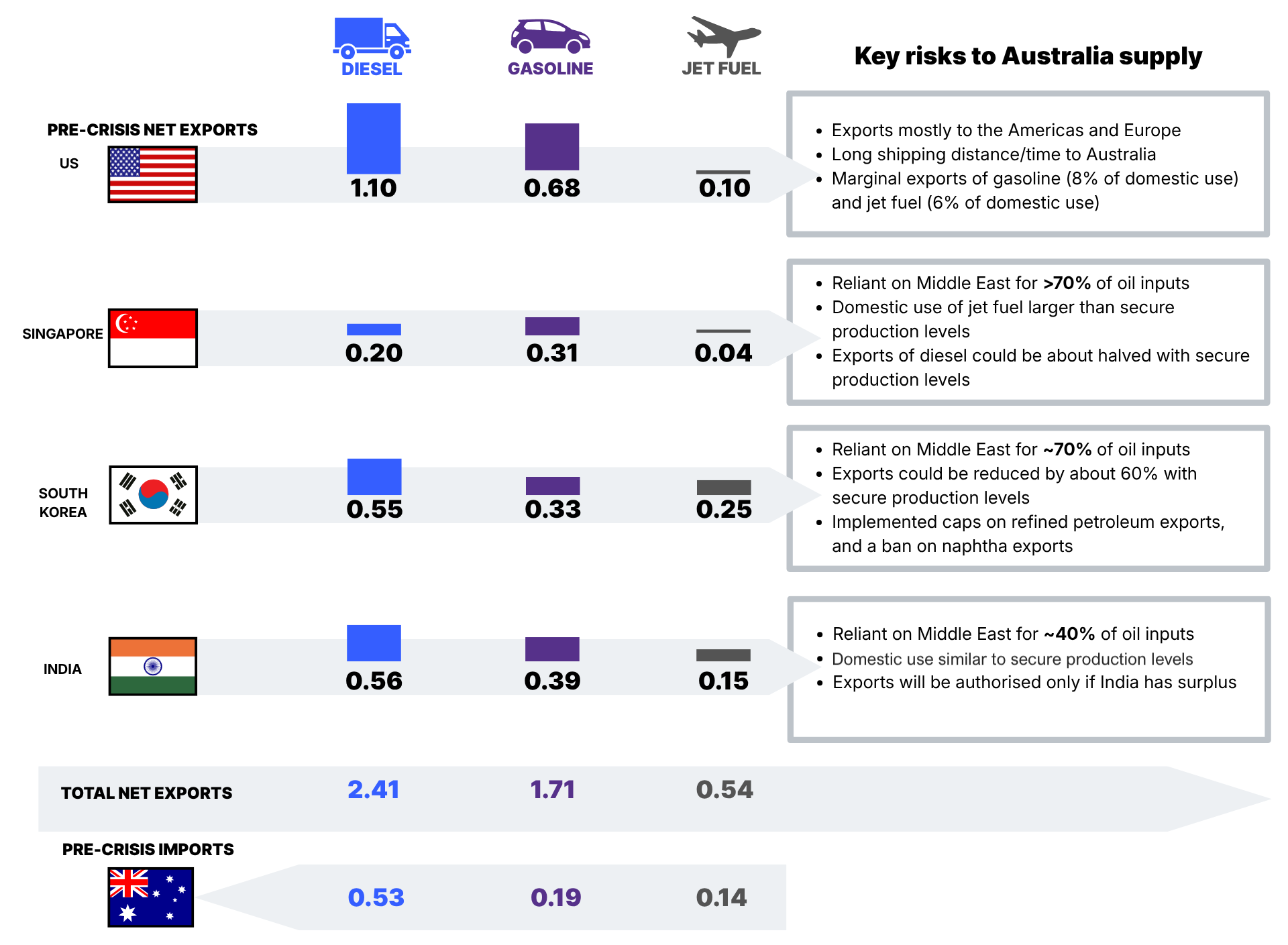
Imports of Russian oil are currently banned in Australia; imports from the Middle East are disrupted; China recently banned exports of those three fuels; and its distance makes Europe unlikely to be a realistic supplier. The remaining candidates to provide fuel to Australia are the US, Singapore, South Korea and India. The table below shows the net exports (exports minus imports) for those countries compared to Australian import volumes.
Table: Pre-crisis imports (Australia) and net exports (others) of key oil products, million barrels per day (mb/d)
Sources: APS, EIA (US and others), Singstat, PPAC, IEA, Argus, Reuters, SEAIR, Argus, HP, ET.
Note: Secure production levels represent production levels if imports from the Middle East are reduced by about 50% with no alternative suppliers secured.
The table shows just how big Australia’s demand for those three fuels is compared to exports from key potential suppliers. Australian imports represent 22% of diesel export volumes and 26% of jet fuel export volumes for the four key exporters analysed. It also shows how vulnerable exports from Asian countries are to Middle East supply disruptions, given that all three large exporters could find themselves with no or significantly reduced surplus for all three fuels if they cannot find alternative suppliers of oil inputs.
The US is the only exporter with safe input supply given that it is a net exporter of crude oil. This is reflected in Australia’s recent increase in imports from the country. Exports from the US currently go to the Americas and Europe, which have the benefit of being much closer. The Australian government’s new underwriting fuel security power could help secure additional supply from the US.
Lifting the ban on imports from Russia would not change the situation materially, given that Russia already banned exports of gasoline and does not export jet fuel. Russia’s only material exports are for diesel with about 1 million barrels per day (mb/d). However, Ukraine strikes have reportedly halted 40% of Russia’s export capacity.
There have also been reports that Australia has been in conversations with China (despite its current export ban) and Japan over fuel supply. China exports some diesel, gasoline and jet fuel, but the volumes are relatively small, at less than 0.9 mb/d in the first quarter of 2024. Exports of diesel and gasoline are marginal, at less than 10% of domestic demand, so that any constraint on oil inputs is likely to put them at risk.
As for Japan, it is only a marginal exporter of petroleum products, exporting about 8% of its refining output. The Middle East supplies 95% of its oil input, with 70% coming via the Strait of Hormuz. Japan would likely have to tap into its stockpiles to supply Australia.
The crisis is likely to have a prolonged impact on Australia. Once the conflict ends, it will take at least several months for oil production in the Middle East to resume at full capacity as many assets have been damaged and shut-in facilities cannot turn back on instantly. It then takes a while for oil to reach Australia – about 5-7 weeks to get to Singapore for example, a few days to get refined, and then 10-20 days to reach Australia. Receiving oil shipments today is no guarantee Australia will continue to receive them in the coming months given the lag in the supply chain.
Fortunately, there remain options available to the Australian government to avoid the worst impacts of the crisis. In the short term, the government should strongly consider measures to reduce demand so the country’s stockpiles can last longer – while limiting the impact on economic output. To start with, this may include measures to improve energy efficiency and reduce discretionary travel – such as working from home for public sector and office workers, reduced driving speed limits, and encouraging voluntary travel reduction.
For longer-term resilience Australia must urgently accelerate the electrification of transport and mining operations, which are currently lagging. In terms of cost impact, the most promising option is for the country to fast-track a review of liquefied natural gas (LNG) taxation, ensuring the country earns appropriate royalties on exports as prices are likely to be elevated for a long period. This increased revenue could help fund cost-relief and fuel-shifting measures.

Related Content