Reassessing oil in Uganda: global factors and possible solutions

Key Takeaways:
Uganda’s oil industry is delayed, over budget and likely to disappoint when it comes to financial returns.
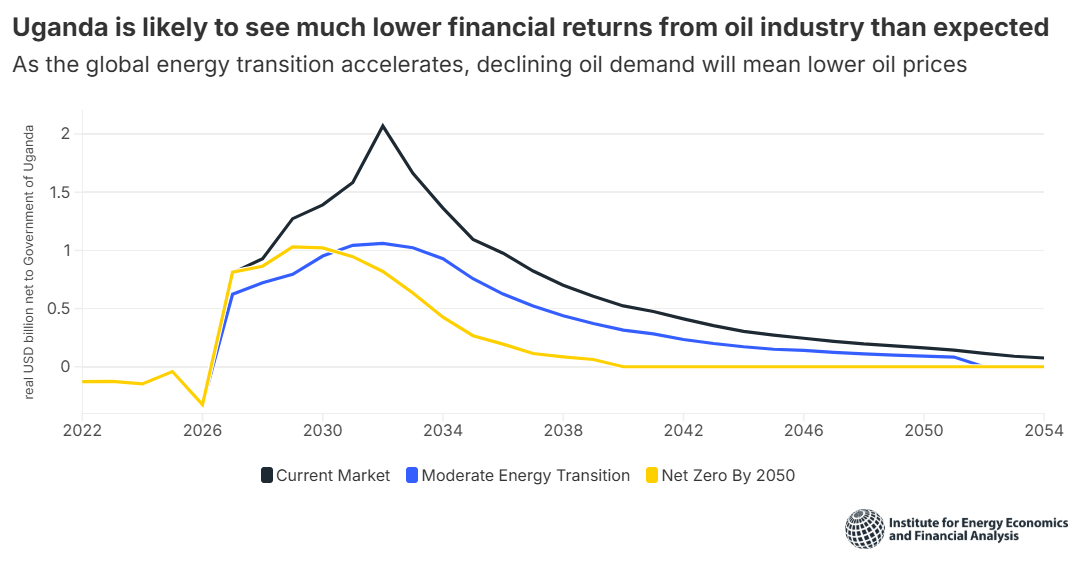
Accelerated global decarbonization could mean the value of Uganda’s oil falls as much as 34% for foreign investors and 53% for the country, compared to what could be expected today.
Sustained investment in electrified, climate-resilient industries may deliver stronger job creation, lower financial risk, and more stable growth than oil, especially as the global transition accelerates.
The development of an oil industry has long been touted for its transformative potential for the economy of Uganda. However, project delays, cost overruns, and changes in global oil and energy markets suggest investors will be left disappointed, and that the Ugandan economy is unlikely to reap promised rewards, according to two new reports from the Institute for Energy Economics and Financial Analysis (IEEFA).
The IEEFA analysis finds that amid weakening public finances, the long-term transformative potential of Uganda’s oil industry appears uncertain. Sustained multi-year investment in climate-resilient, electrified industrialization could be a lower-risk alternative for the use of limited oil revenues compared to investing more in the oil sector.
The first report, Reassessing oil in Uganda: How do investments in Uganda’s oil industry stand up in an accelerating global transition, examines the expected financial and economic returns from Uganda’s oil industry as it nears first production, and how global shifts that include the low-carbon transition will influence these outcomes. The report finds that the delays to get Uganda’s oil industry off the ground and the realities of a quickly decarbonizing world could mean Uganda sees much lower fiscal benefits from the oil industry than expected.
“Uganda has an increasingly narrow margin for error when it comes to the use of public resources,” said Matthew Huxham, independent consultant and co-author of the report. “Doubling down on oil through the refinery investment could reduce Uganda's import bill, but the investment could also undermine public debt sustainability, which would hamper long-run development. In this case, the country would be trading energy dependency for capital dependency.”
The second report, Climate-resilient development in Uganda: How a global transition and fiscal constraints could influence Uganda’s development choices, finds that plans for further public investment in the oil sector come with significant risk. Incorporating climate risk considerations into future planning processes will be critical if the Ugandan government is to deliver on the prosperity promised to its citizens.
"Uganda's development choices will be shaped by evolving fiscal conditions and climate-related financial risks," said Gaurav Upadhyay, an IEEFA energy finance analyst. "Our analysis suggests that careful prioritisation of public spending is increasingly important. A more diversified set of investments that support climate-resilient, electrified industrialisation could offer a lower risk pathway for income growth and job creation than large, debt-intensive commitments in the oil sector."