India’s electricity transition at the sub-national level sees progress on multiple fronts in different states
Coordinated centre-state action and targeted interventions will help ensure momentum is evenly spread across states
Key Takeaways:
All 21 states assessed, representing 95% of India’s power demand, have progressed across various dimensions of the transition. Even states that faced challenges earlier are now building momentum, presenting new opportunities for accelerated growth through targeted policies.
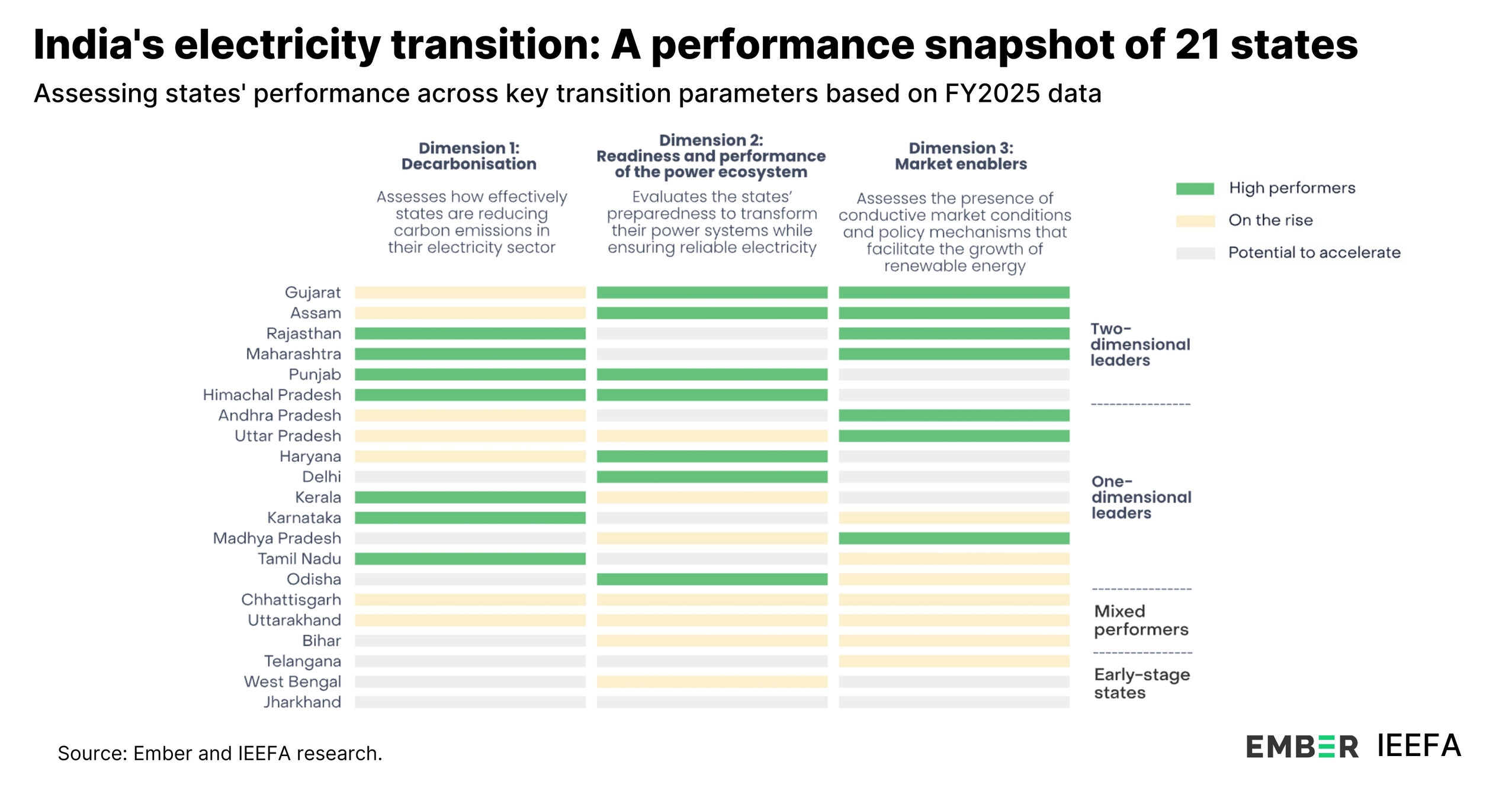
Karnataka, Himachal Pradesh, and Kerala have progressed well to decarbonise their electricity systems with a higher renewable energy share in their procurement mix and lower power sector emissions intensity. These states will gain more ground in their transition journey by addressing the gaps in their grid readiness, health of distribution companies (DISCOMs), and market-enabling conditions.
Delhi and Haryana remain ahead in terms of power ecosystem readiness and performance, supported by robust distributed solar adoption, reliable power supply, and relatively sound DISCOM performance. Chhattisgarh is also a notable performer, recording a minimal power shortage of 0.07% in FY2025, supported by moderate DISCOM performance.
Bihar’s policy proactiveness, such as offering a green tariff, solar-hour-aligned time-of-day (ToD) tariffs, rising electric vehicle (EV) adoption, and various auctions to incorporate energy storage in its portfolio, has made it well prepared to accelerate its transition. Focusing on tapping more of its renewable potential and increasing participation in short-term green markets offers significant gains.
Andhra Pradesh, Uttar Pradesh and Rajasthan also have strong policies in place. They are progressing on green hydrogen and have seen good EV adoption. Rajasthan has particularly excelled, supported by its well-established renewable policy landscape and the lowest green tariff premium. These states should now focus on translating these into robust renewable shares and strong system-wide performance.
23 February 2026 (IEEFA South Asia and Ember): India’s electricity transition at the sub-national level is no longer marked by a few leading states, but rather wider, albeit uneven, progress across states, according to the findings of a new joint report by the Institute for Energy Economics and Financial Analysis (IEEFA) and Ember.
The third edition of IEEFA and Ember’s Indian States’ Electricity Transition (SET) report, based on a three-dimensional framework, highlights that while some states are continuing to advance steadily in the fiscal year (FY) 2025, others have built momentum and a strong foundation for rapid progress. The uneven progress is owing to differences in resources, development priorities and institutional capacities.
“All the 21 states assessed have advanced on multiple fronts, even as the pace and areas of focus vary,” says Vibhuti Garg, Director – South Asia, IEEFA, and a co-author of the report.
“Such divergence is inevitable at the sub-national level given the structural and historical factors, including differences in resource endowment, development legacies, states’ fiscal and economic conditions, rural-urban composition, and institutional capacity within the power sector. Going forward, understanding these state-level differences and gaps in progress is essential for designing targeted policies and interventions,” she adds.
Co-author Ruchita Shah, Energy Analyst, Ember, says, “India’s electricity transition is maturing into a multi-speed transition, where instead of a single leader across all areas, we are witnessing new leaders in specific areas. This requires a more targeted approach to policies and interventions to ensure the momentum is evenly spread.”
Despite a change in methodology for SET 2026, including a recalibrated mode of measurement for the capacity addition parameter and the inclusion of hydro capacity, Karnataka remained a top performer in the decarbonisation dimension of the report. Himachal Pradesh and Kerala, too, did well in this dimension that tracks states’ progress in expanding renewable electricity and decoupling economic growth from emissions. Tamil Nadu, Maharashtra, and Rajasthan improved their performance in this dimension owing to their energy efficiency interventions, reflected in their State Energy Efficiency Index (SEEI) 2024 scores.
The readiness and performance of the power ecosystem dimension, which assesses the distributed solar adoption, power supply reliability, and DISCOM performance of the states, incorporated stakeholder feedback to strengthen the assessment parameters. These changes better align the dimension with the current realities.
Even after incorporating the changes to the parameters, Delhi and Haryana continued to perform strongly. Robust distributed solar adoption in these states, alongside reliable power supply and relatively sound DISCOM performance supported their performance. Chhattisgarh and Bihar, too, stood out in this dimension due to improvements in their DISCOM performance since the SET 2024 analysis. In FY2025, Chhattisgarh recorded a negligible power supply shortage of 0.07%, while Bihar recorded the highest percentage of progress in smart meter deployment (78% of its sanctioned meters) under the Revamped Distribution Sector Scheme (RDSS) as of March 2025. Assam, too, emerged as a notable performer, completing installation of 46% of its sanctioned smart meters under RDSS.
“For states with potential to improve on this dimension, targeted reforms could unlock faster progress. Strengthening DISCOM finances, ensuring timely subsidies, adopting cost-reflective tariffs, and enhancing billing and collection through digitisation and smart metering will help reduce risk perception and enable DISCOMs to scale renewable energy procurement effectively,” says co-author Saloni Sachdeva Michael, Clean Energy Specialist, IEEFA.
The final dimension, market enablers, examines state initiatives supporting adoption of EVs and green hydrogen, and measures like green tariffs and energy storage to accelerate the transition to renewable energy. There are also changes in the parameters of this dimension compared to SET 2024.
The changes result in significant movement from 2024. Andhra Pradesh, Uttar Pradesh and Rajasthan are now the strongest performers in this dimension. Their performance was supported by updated renewable energy policies, adoption of green tariffs and solar-hour-aligned time-of-day (ToD) tariffs. Uttar Pradesh demonstrated strong momentum in EV deployment, while Andhra Pradesh and Rajasthan also made moderate progress in this area.
Delhi recorded the highest EV adoption rate at 11.6%, while Assam followed closely with a strong 11% adoption rate in FY2025, reflecting notable progress. Assam also has an active renewable energy policy along with solar-hour-aligned ToD tariffs.
Bihar, too, is on the rise in this dimension. It introduced a green tariff provision for FY2026 and created a conducive policy environment for renewable energy (targeting around 24 gigawatts [GW] by FY2030) and EV adoption (8.2% in FY2025). It also offered a ToD tariff mechanism. While the state does not yet have operational energy storage capacity, it has made efforts via auctions to integrate storage into its portfolio. It can also now build momentum on its draft green hydrogen policy and accelerate its transition by utilising more of its renewable potential and increasing clean power procurement.
“States such as Maharashtra and Rajasthan need to strengthen DISCOM operations, boost short-term market participation, expand distributed solar and smart meters deployment to better prepare their power ecosystem for the transition. On the other hand, Haryana and Himachal Pradesh need to accelerate mobility transitions, deploy energy storage capacities and strengthen ToD tariff and green tariff mechanisms to progress on their transition journeys,” Ruchita Shah adds.
Meanwhile, West Bengal, Telangana, and Jharkhand are among the states that remained in the early stages of transition. “These states face structural barriers and will require foundational interventions, like institutional capacity building, improved DISCOM finances, updated planning frameworks and clear, and long-term policy signals, to transition effectively,” says co-author Tanya Rana, Energy Analyst, IEEFA.
Read the report: Indian States’ Electricity Transition (SET) 2026
Media contact: Prionka Jha ([email protected]); +91 9818884854, Tito Das ([email protected]); +91 9833621905
Author contact: Vibhuti Garg ([email protected]); Ruchita Shah ([email protected]); Saloni Sachdeva Michael ([email protected]); and Tanya Rana ([email protected])
About IEEFA: The Institute for Energy Economics and Financial Analysis (IEEFA) examines issues related to energy markets, trends, and policies. The Institute’s mission is to accelerate the transition to a diverse, sustainable and profitable energy economy. (ieefa.org)
About Ember: Ember is an independent energy think tank that aims to accelerate the clean energy transition with data and policy. It creates targeted data insights to advance policies that urgently shift the world to a clean, electrified energy future. (Ember-energy.org)