INR2.23 lakh crore invested in India’s EV sector (2020-2025), yet 82% of the required capital is still unmet
Harnessing capital inflows crucial to achieving nation’s 2030 targets
Key Takeaways:
India’s electric vehicle (EV) sector attracted ~INR2.23 lakh crore (USD25.6 billion) in investment from 2020 to 2025, or 18% of the estimated total investment needed by 2030.
In 2024 and 2025, EV investment announcements shifted decisively from three-wheelers to four-wheelers, driven by surging demand for premium electric cars.
Public charging infrastructure investment from 2020–2025 amounts to ~9.6% of the INR20,600 crore (USD2.36 billion) estimated to be required by 2030.
Commercial EV borrowers face interest rates of 15–33%, which offset the total cost of ownership advantages of EVs. An integrated financing platform—combining credit guarantees, residual value protection, battery-as-a-service, and co-lending—could bring rates closer to 8–12%.
25 February 2026 (IEEFA): India’s electric transport sector has attracted massive capital inflows over the past five years, but the industry needs a cohesive investment framework to achieve its 2030 goals, according to a new report by the Institute for Energy Economics and Financial Analysis (IEEFA).
By 2030, India targets electric vehicle sales comprising 30% of all private cars, 70% of commercial vehicles, 40% of buses, and 80% of two- and three-wheelers. Achieving these goals requires substantial investment in electric vehicle (EV) manufacturing, charging infrastructure, and supportive ecosystems.
IEEFA’s report Capital flows in India’s electric transport sector, provides the first consolidated view of realised investments from 2020–2025, identifies investment gaps, and outlines pathways to mobilise capital for the next phase of the nation’s electric transport transition.
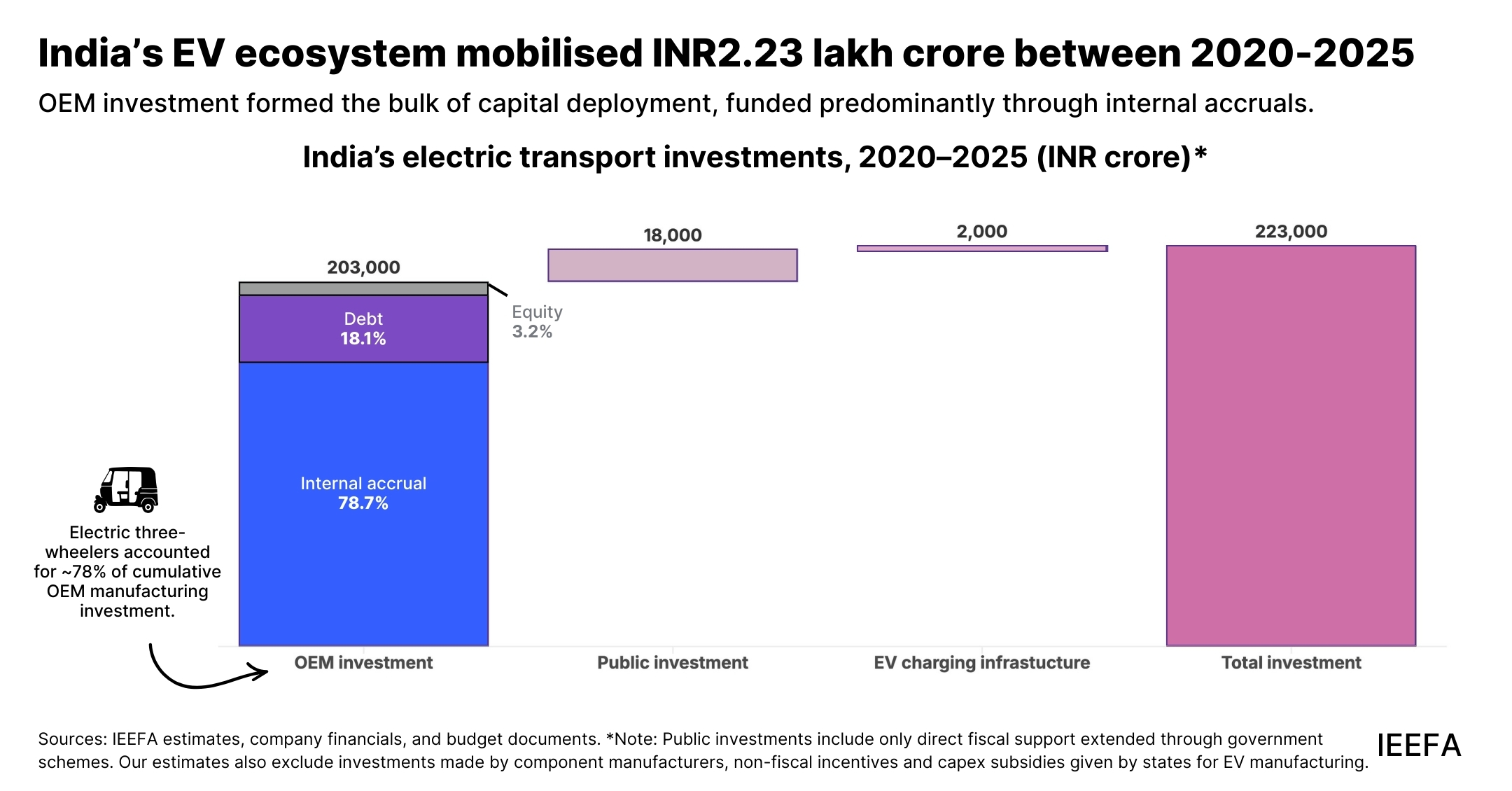
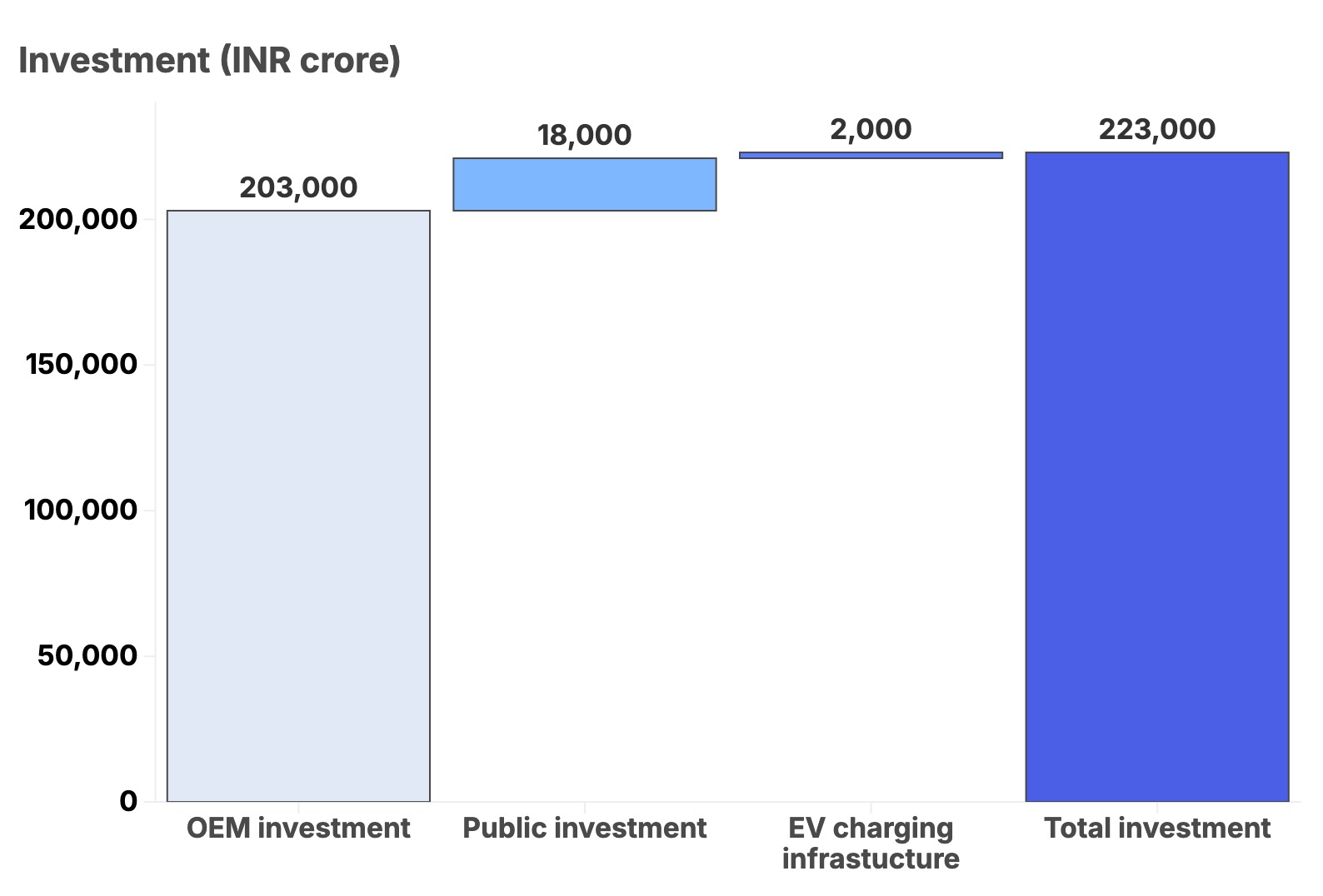
From an in-depth analysis of capital flows, the authors estimate INR2,23,119 crore (USD25.6 billion) was deployed across three core nodes of India’s electric transport ecosystem from 2020–2025: manufacturing capacity accounted for the bulk, followed by public subsidies and incentives, and EV charging infrastructure.
“While INR2.23 lakh crore is a significant capital mobilisation in just five years, it represents only about 18% of the INR12,50,000 crore required by 2030,” says co-author Subham Shrivastava, Climate Finance Analyst at IEEFA. “Mobilising the remaining INR10,26,881 crores (USD117.82 billion) by 2030 will require systemic financing reforms.”
A breakdown of the investments shows internal accruals accounted for the largest share of realised EV manufacturing investment (INR1,59,701 crore/USD18.32 billion), followed by debt (INR36,738 crore/USD4.22 billion) and equity (INR6,455 crore/USD740 million).
This aggregate pattern, however, masks meaningful variation across vehicle segments, where the balance between internal funding and external capital reflects differences in market structure, capital intensity, and firm composition. For instance, the electric three-wheeler segment— characterised by a highly fragmented OEM base—relied predominantly on internal accruals and some debt, whereas segments such as electric four-wheelers and two-wheelers, led by more established incumbents, exhibited a relatively more diversified financing mix.
“From 2020–2025, electric three-wheelers attracted the largest share (~78%) of investments among vehicle segments, due to the segment’s maturity and commercial-scale operations alongside its fragmented OEM base,” says co-author Saurabh Trivedi, Sustainable Finance Specialist at IEEFA. “However, recent investment announcements in 2024 and 2025 reveal a pivot towards electric four-wheelers, driven by rising demand for electric cars.”
India’s electric transport investments, 2020–2025 (INR crore)*
Sources: IEEFA estimates, company financials, and budget documents. *Note: Public investments include only direct fiscal support extended through government schemes. Our estimates also exclude investments made by component manufacturers, non-fiscal incentives, and capex subsidies given by states for EV manufacturing.
Government subsidies under the Faster Adoption and Manufacturing of Hybrid and Electric Vehicles (FAME) scheme and other Union- and state-level policies catalysed adoption by disbursing INR18,251 crore (USD2.09 billion) from FY2020–24.
However, investment in public EV charging has not kept pace with other segments of the EV sector. While public EV charging expanded significantly from 5,151 chargers in 2020 to 39,485 in 2025, India’s ratio of chargers to EVs remains far below global benchmarks.
Publicly available estimates suggest that INR20,600 crore (USD2.36 billion) of investment in charging infrastructure will be required for India to achieve its 2030 goals. Based on calculations of realised investment, the authors estimate that capital deployed from 2020–2025 accounted for only 9.6% of this amount, highlighting a significant investment gap.
“Investment in EV charging faces challenges due to limited investor interest, as public EV charging remains an unproven business model, with many charging stations reporting low utilisation rates and high initial costs,” says co-author Charith Konda, Energy Specialist at IEEFA.
With an estimated 82% of required investments still unmet, the central challenge is no longer policy ambition but the cost and structure of capital. The report points out that commercial EV borrowers face interest rates ranging from 15% to 33%, significantly eroding the total cost of ownership advantages that electric vehicles otherwise offer. High financing costs dampen demand, delay fleet expansion, and ultimately slow manufacturing capacity growth.
“The binding constraint is not a lack of capital in the system—it is how EV risk is priced,” says Shrivastava. “When lenders remain uncertain about battery performance, residual values, and cash-flow stability, that uncertainty gets reflected in higher interest rates.”
Bridging the INR10.3 lakh crore (USD117.82 billion) investment gap over the next five years will therefore require moving beyond traditional subsidy-led approaches toward structural risk-sharing mechanisms that lower the cost of credit and attract private capital.
IEEFA proposes an integrated EV financing platform that bundles partial credit guarantees, residual value protection, battery-as-a-service arrangements, and co-lending structures into a unified framework coordinated at the point of lending. Development finance institutions with existing guarantee infrastructure and banking relationships would anchor the platform—SIDBI for the MSME segment, including commercial two- and three-wheelers and small fleet operators, and IIFCL for larger commercial fleets, bus deployments, and institutional buyers.
“Manufacturers need predictable demand signals to scale capacity, but demand depends heavily on affordable credit,” Trivedi adds. “An integrated platform that shares risks appropriately across lenders, OEMs, and public institutions can reduce financing costs and unlock commercial-scale deployment.”
As EV sales volumes increase and performance data deepens, risk premiums can decline, underwriting can standardise, and capital recycling through securitisation can become viable. This would create a self-reinforcing investment cycle: lower financing costs drive higher adoption, which strengthens revenue visibility, reduces risk perception, and attracts more capital.
Ultimately, the transition from policy-driven adoption to financially self-sustaining scale will determine whether India’s electric mobility ecosystem can meet its 2030 ambitions.
Read the report: Capital flows in India’s electric transport sector
Media contact: Prionka Jha ([email protected]); +91 9818884854
Author contacts: Subham Shrivastava ([email protected]); Saurabh Trivedi ([email protected]); Charith Konda ([email protected])
About IEEFA: The Institute for Energy Economics and Financial Analysis (IEEFA) examines issues related to energy markets, trends, and policies. The Institute’s mission is to accelerate the transition to a diverse, sustainable and profitable energy economy. (ieefa.org)