Any takers for Australian green iron?

Supply crunch could open export markets worth AUD2.8 billion a year
Key Takeaways:
With many corporate emissions or green purchasing targets specific to steel setting a 2030 deadline, Australian green iron developers will need to move quickly to take advantage of this opportunity.
Corporate emissions reduction targets in key sectors such as automotive, wind, shipping and data centres could be an important demand driver for Australian green iron.
Steel producers, particularly in Japan and Korea, may struggle to secure sufficient renewable power to meet this demand, opening an opportunity for Australia to supply up to 5.5MTPA of green iron, worth an estimated USD2 billion (AUD2.8bn) a year.
Projected green steel demand to 2030 exceeds supply but there is significant uncertainty on both demand (due to policy, market shifts and varying corporate targets) and supply (as producers using a fossil-hydrogen mix transition).
12 March 2026 (IEEFA Australia): Australia is ideally placed to capitalise on rapidly emerging markets for green iron and counter forecast declines in its key commodity exports, according to a briefing note released today.
As countries, companies and consumers grow more climate-conscious, demand for green iron and steel is emerging in both traditional and new industries, just as Australia’s top exports—iron ore and coal—face prolonged decline, finds the note, Any takers for Australia’s green iron?
With the federal government staking AUD1 billion on this nascent industry, the analysis focuses on four key areas of potential demand for green iron made in Australia up to 2030: automotive, shipping, wind turbines and data centres.
“Australia has long sought to leverage its position as a commodity exporter to move further downstream into industrial production—primarily driven by the potential economic opportunities,” says the author Lachlan Wright, energy finance analyst, global steel, at IEEFA.
“Potential declines in Australia’s fossil fuel exports together with the country’s excellent renewable resources have prompted a fresh look at these downstream processing technologies—this time powered with renewable energy.”
IEEFA’s analysis finds the greatest opportunities lie with Australia’s biggest trading partners—China, South Korea and Japan—all major importers of Australian iron ore and metallurgical coal. Despite their vast steelmaking capacity, these countries lack the renewable energy capacity to meet Asia’s estimated demand for 5.5 million tonnes a year of green steel, opening the door for Australian exports worth an estimated USD2 billion (AUD2.8bn) annually.
“In the near term, domestic constraints on clean electricity supply could drive imports of green iron. Already, Glencore and other traders have established offtake agreements for hot briquetted iron (HBI), seemingly in anticipation of this trend” Mr Wright says.
“Even in the absence of further policies or public procurement, corporate commitments will drive an estimated 5.5MTPA of green steel demand across the region by 2030. Of this, about 20% is based on steel-specific commitments across the critical sectors of automotive, wind, shipping and data centres. The rest is estimated based on general corporate net-zero or supply-chain (Scope 3) targets.
APAC green iron demand estimated to exceed supply in near term

The transition to low- or zero-carbon iron and steel across sectors and markets is uneven, driven by corporate commitments and consumer demand as much as government policies and regulations. Nonetheless, the momentum is building and spreading in:
Automotive: Asia is a global automotive manufacturing powerhouse, consuming large amounts of high-specification steel, making it a likely prime mover for green iron and steel, driven by consumer preferences for cleaner EVs.
Shipbuilding: Global ship and container production is heavily concentrated in the region, where two-thirds of manufacturers have net-zero targets, underpinned by similar commitments from major shipping companies and global retailers downstream.
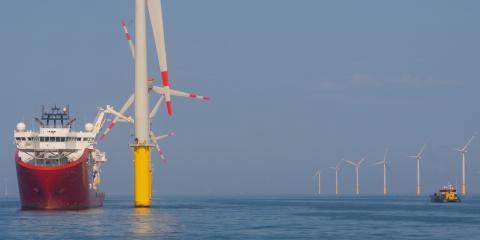
Wind turbines: The rapidly growing industry, led by China, is steel-intensive and a natural fit for green steel, given its key role in emissions reductions and strong climate commitments.
Data centres: Also steel-intensive, the AI boom combined with the big four tech companies’ net-zero commitments is expected to create strong demand for green steel in major data hubs in Singapore/Malaysia and Japan.
“The development speed of green iron projects (and associated renewables and electrolysers) in Australia will be key to capture the opportunity presented by corporate emission targets,” Mr Wright says.
“Potential green iron project developers in Australia will need to engage directly with these buyers. In particular, non-traditional steel buyers further downstream in high-growth and climate-committed sectors, such as automotive, wind, shipping and data centres, are most likely to pay the required initial premium.”
In the early stages, Australian green iron project developers will need to directly engage these downstream buyers to stitch together new supply chains. This will require bringing in steelmaker partners based in the region creating some complexity in commercial structures.
“Fortunately, models exist from other sectors (shipping, aviation, etc.), and in steel voluntary standards, certification and contractual models are already emerging to support these transactions,” Mr Wright says.
“Near-term corporate targets combined with constraints for Australia’s trading partners in deploying renewable energy provide a window of opportunity for green iron exports.
“Taking advantage of this opportunity will require Australian project developers and governments to move quickly to lock in offtake agreements and provide clear signals about the most viable projects and locations. This will give buyers the certainty needed to commit and help launch this new industry.”
Read the note: Any takers for Australia’s green iron?
Media contact: Amy Leiper, ph +61 414 643 446, [email protected]
Author contacts: Lachlan Wright, [email protected]
About IEEFA: The Institute for Energy Economics and Financial Analysis (IEEFA) examines issues related to energy markets, trends, and policies. The Institute’s mission is to accelerate the transition to a diverse, sustainable and profitable energy economy. (ieefa.org)