India's iron ore challenge is shifting from quantity to quality, new IEEFA findings show
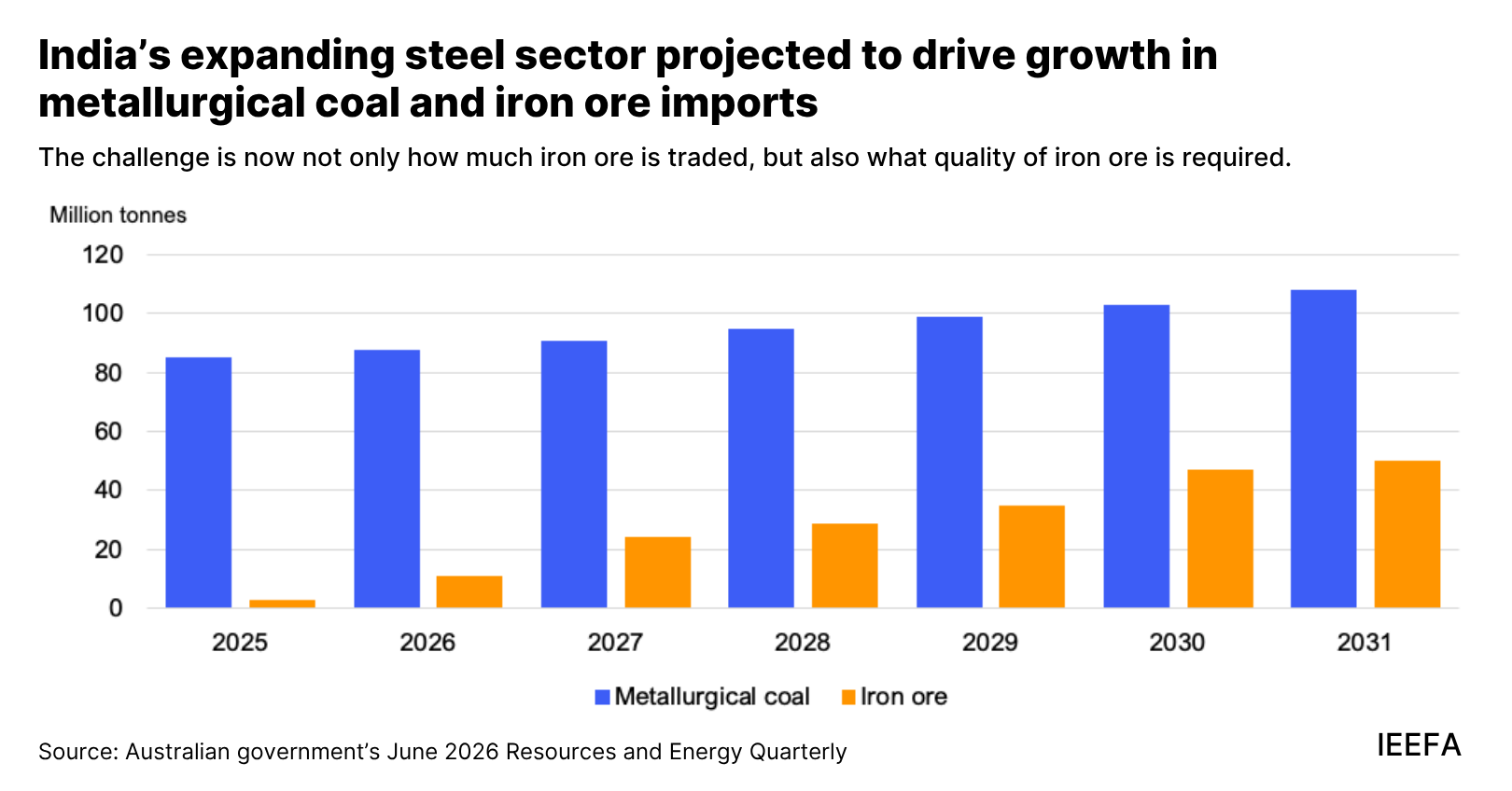
How India sources imported iron ore, and how much domestic ore it upgrades, could shape the country’s steelmaking technology choices, its dependence on imported coking coal, and the pace of steel decarbonisation.
Key Takeaways:
India’s iron ore challenge is shifting from securing sufficient supply to securing the right quality of ore needed for an expanding and lower-emissions steel industry.
As iron ore imports become more important, the type of ore India sources could influence steelmaking technology choices and long-term dependence on imported coking coal.
With global suppliers increasingly producing premium direct reduction-grade feedstocks and green iron, India should evaluate future iron ore sourcing through the lens of technology, energy security and industrial competitiveness — not simply cost.
Beyond Australia, Brazil is well positioned to benefit from India’s shift towards lower-emissions steelmaking, given its abundant high-grade iron ore resources and growing production of direct reduction (DR)-grade feedstocks.
12 August 2026 (IEEFA): India's long-standing iron ore advantage is entering a new phase, according to a new briefing note from the Institute for Energy Economics and Financial Analysis (IEEFA). As the country pursues one of the world's most ambitious steel expansion plans, the central question is shifting from whether it has enough iron ore to whether it has access to the right quality of ore for the steelmaking technologies it intends to build.
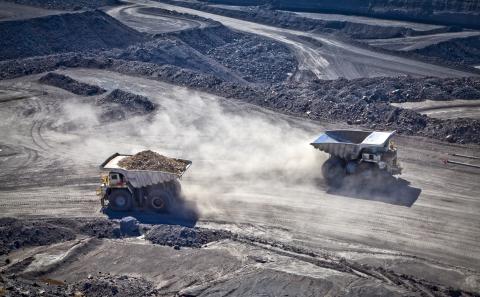
Under the proposed National Steel Policy 2025, the government reportedly aims to more than double crude steel production capacity to 400 million tonnes (Mt) by 2035–36, while cutting the sector's emissions intensity and reliance on coking coal. India produced around 289Mt of iron ore in fiscal year (FY) 2024–25, making it the world's fourth-largest producer, but a growing share of its remaining resources is medium- and low-grade ore that requires beneficiation. Many Indian ores also carry high alumina levels: An Indian study found that every 1% rise in alumina lifts coke consumption by 2.2% and cuts blast furnace productivity by 4%.
The note, 'India's looming iron ore challenge', stresses that upgrading domestic ore should remain the foundation of India's strategy. An inter-ministerial committee found that 66.5% of India's iron ore reserves are medium- or low-grade and require beneficiation before efficient use, yet the country's 27 beneficiation plants operate well below installed capacity. Expanding that capacity from around 136 million tonnes per annum (MTPA) to 170MTPA by FY2030 could require roughly INR51,000 crore (USD5.37 billion) of investment, alongside supportive policy such as reduced royalties for beneficiated low-grade ore.
"India's iron ore story is no longer just about volume," says Saumya Nautiyal, Energy Finance Analyst, Steel, South Asia, at IEEFA. "Upgrading more domestic ore through beneficiation has to be the foundation, but with more than 357Mt of steelmaking capacity under development, imports of premium ore will also grow. The grades India chooses to import will shape which steelmaking technologies it locks in, and how exposed the sector stays to imported coking coal."
The shift is already reshaping corporate strategy. On Tata Steel's fourth-quarter FY2025–26 earnings call, chief executive T.V. Narendran set out a post-2030 raw material approach built on securing domestic mining leases, expanding production where ore is available, and evaluating imported ore to complement domestic supply. Tata Steel has already trialled imported Canadian iron ore, with Narendran noting that lower-alumina ores can deliver better value in use, particularly for its expanding coastal plants.
A changing global market
Global demand growth is moving from a maturing China towards emerging producers, particularly Southeast Asia and India. Iron ore giant Vale has identified India as a strategic growth market, and the Australian government forecasts India's iron ore imports rising from 3Mt in 2025 to 50Mt in 2031. Industry estimates point the same way: The head of raw materials at Jindal Steel estimates that producing around 220Mt of steel by 2030 would require roughly 500Mt of iron ore, leaving a potential 40Mt gap even after planned mine expansions.
Quality, not just quantity, is at the heart of the shift. Blast furnaces can use a broad range of grades, but direct reduced iron (DRI) technologies need premium feedstocks of around 67% iron with fewer impurities, and demand for these is expected to grow.
"As the world moves towards lower-emissions steel, the global iron ore trade is changing in both scale and quality," says Simon Nicholas, Lead Analyst, Global Steel, at IEEFA. "Brazil and Australia are investing in premium direct reduction-grade products and green iron, and Oman is positioning itself as a green iron hub. That gives India a real choice, and future sourcing decisions should be judged through the lens of energy security and industrial competitiveness, not cost alone."
Why the choice matters for India
If conventional blast furnace-grade ore dominates future imports, it could entrench investment in blast furnace-basic oxygen furnace (BF-BOF) steelmaking and extend India's dependence on imported coking coal, of which the country already imports around 85%. Global Energy Monitor estimates that about 57% of India's announced capacity under development remains BF-BOF based. Greater availability of premium direct reduction (DR)-grade feedstocks, by contrast, could support a gradual expansion of DRI using natural gas, coal-derived syngas, and, over time, green hydrogen. Jindal Steel already owns one DRI plant in Oman and is developing another, and has said it is considering importing DRI because of a shortage of available metallics in India.
The note concludes that India's iron ore strategy is moving from securing sufficient volumes to securing the right quality of raw materials, and that future sourcing decisions should be guided not only by cost but by their implications for energy security, industrial competitiveness, and steel decarbonisation.
Read the briefing note: India's looming iron ore challenge
Author contact: Saumya Nautiyal ([email protected]), Simon Nicholas ([email protected])
Media contact: Prionka Jha ([email protected]); +91 9818884854
About IEEFA: The Institute for Energy Economics and Financial Analysis (IEEFA) examines issues related to energy markets, trends, and policies. The Institute's mission is to accelerate the transition to a diverse, sustainable, and profitable energy economy. www.ieefa.org