Key Findings
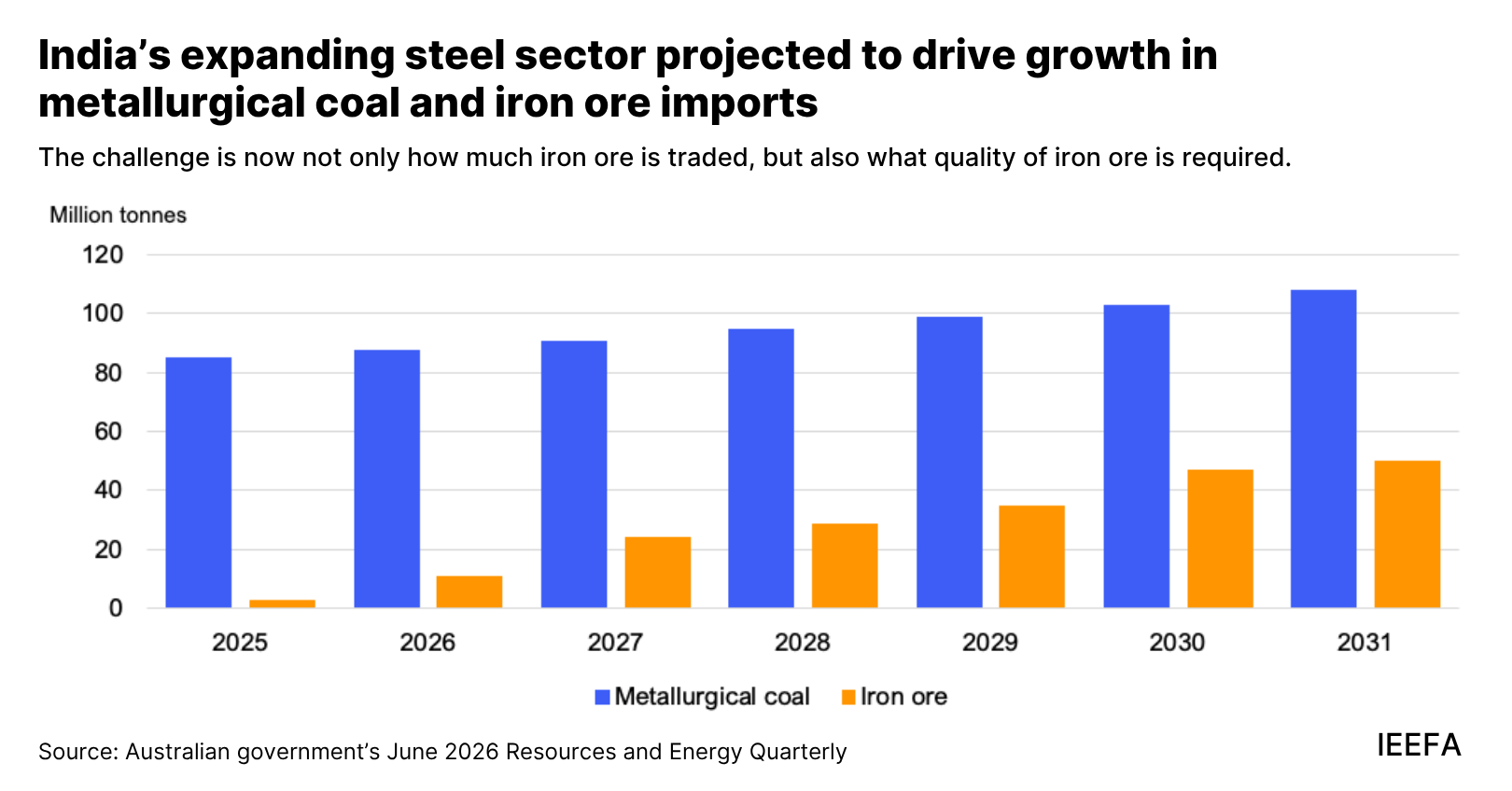
India’s iron ore challenge is shifting from securing sufficient supply to securing the right quality of ore needed for an expanding and lower-emissions steel industry.
As iron ore imports become more important, the type of ore India sources could influence steelmaking technology choices and long-term dependence on imported coking coal.
With global suppliers increasingly producing premium direct reduction-grade feedstocks and green iron, India should evaluate future iron ore sourcing through the lens of technology, energy security and industrial competitiveness — not simply cost.
Beyond Australia, Brazil is well positioned to benefit from India’s shift towards lower-emissions steelmaking, given its abundant high-grade iron ore resources and growing production of direct reduction (DR)-grade feedstocks.
Introduction
India’s abundant iron ore resources have long underpinned the growth of its steel industry. That resource advantage is becoming increasingly significant as India pursues one of the world’s most ambitious steel expansion plans. Under the proposed National Steel Policy 2025, the government reportedly aims to more than double crude steel production capacity to 400 million tonnes (Mt) by 2035–36, while reducing the steel sector’s emissions intensity and dependence on coking coal. Achieving these ambitions will require not only significantly more iron ore, but also iron ore of a quality that supports India’s evolving steelmaking technologies.
India produced around 289Mt of iron ore in FY2025, making it the world’s fourth-largest producer. It possesses one of the largest iron ore resource bases in the world. However, a growing share of India’s remaining iron ore resources comprises medium- and low-grade ores that require beneficiation to a higher grade. In addition, many Indian ores contain relatively high alumina levels, which reduce blast furnace productivity and increase energy consumption. An Indian study found that every 1% increase in alumina raises coke consumption by 2.2% and reduces productivity by 4%. Improving ore quality through beneficiation and pelletisation will therefore become important as India’s steel sector expands.
Improving domestic ore quality should remain the foundation of India’s long-term iron ore strategy. With more than 357Mt per annum of steelmaking capacity under development, access to premium iron ore is becoming an essential strategic consideration. The question is therefore shifting from whether India has sufficient iron ore to whether it has access to the right quality of ore for the steelmaking technologies it intends to deploy.
This shift is already influencing corporate strategy. During Tata Steel’s FY2026 fourth-quarter earnings call, Chief Executive Officer T.V. Narendran outlined a post-2030 raw material strategy based on three pillars — securing domestic mining leases, expanding production where iron ore is available, and evaluating imported iron ore to complement domestic supply. Rather than presenting imports as a substitute for domestic resources, Narendran described them as one way to improve supply flexibility, logistics and access to higher-quality, lower-alumina ores. Tata Steel has already trialled imported Canadian iron ore to assess both logistics and operational performance. Narendran noted that lower-alumina ores can deliver a better “value in use”, particularly for its expanding portfolio of coastal steel plants in India.
As India’s steel capacity expands and its transition to lower-emissions technologies accelerates, securing sufficient supplies of high-quality, low-alumina iron ore will become an increasingly important strategic priority.


Related Content