Key Findings
Odisha earned INR14,148 crore from coal and petroleum in financial year (FY) 2025, 13.1% of its own revenue. Fossil-fuel-dependent sectors contributed about a third of Gross Value Added (GVA), highlighting their major role in the state’s economy.
Renewables account for just 11.3% against the 33.01% Renewable Purchase Obligation (RPO) target for FY2026, leaving a 21.8 percentage-point gap. The target rises to 43.33% by FY2030.
Around INR1.1 lakh crore is needed by FY2036 for 10.7 gigawatts (GW) of new renewable energy, 2.7GW of pumped storage, 0.13GW of battery storage, and transmission upgrades. Blended and concessional finance will be important to raise funds.
A three-part approach is suggested: assess transition costs, develop a sustainable finance framework, and establish a dedicated fund for public, private, and climate finance across power and other transition sectors.
Odisha is one of India’s fastest-industrialising states and a major producer of steel, aluminium, and minerals. However, its economic and fiscal structure remains closely linked to fossil fuels and extractive industries, creating growing exposure to transition, market, and environmental risks. A structured sustainable finance framework at this time would help Odisha assess transition needs, mobilise capital, and direct investment towards renewable energy, industrial decarbonisation, and emerging green sectors while supporting a just transition.
Fiscal vulnerability from fossil-fuel dependence
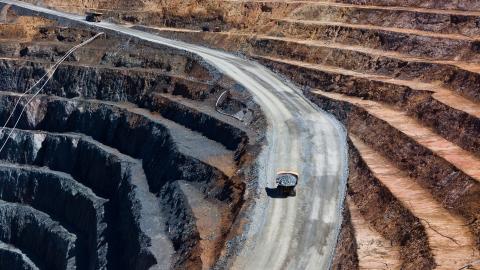
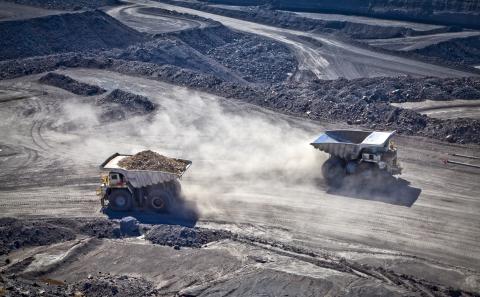
Fossil-fuel revenues form an important part of Odisha’s fiscal position. In financial year (FY) 2024–2025, the state received an estimated INR14,148 crore from coal and petroleum resources, equivalent to 13.1% of its own tax and non-tax revenues and 7.7% of total revenue receipts. Although this share has declined from 16.2% in FY2022–2023, it reflects stagnation in coal-related revenues rather than meaningful diversification of the revenue base. The state’s economic structure is similarly vulnerable, with mining and quarrying accounting for 12.9% of Gross Value Added (GVA) and energy-intensive manufacturing contributing 20.85%. Given the importance of mineral royalties and coal-related revenues to the state’s non-tax income, a sustained slowdown in fossil-fuel activity could affect fiscal stability, employment, and long-term economic growth.
Underutilisation of renewable energy potential
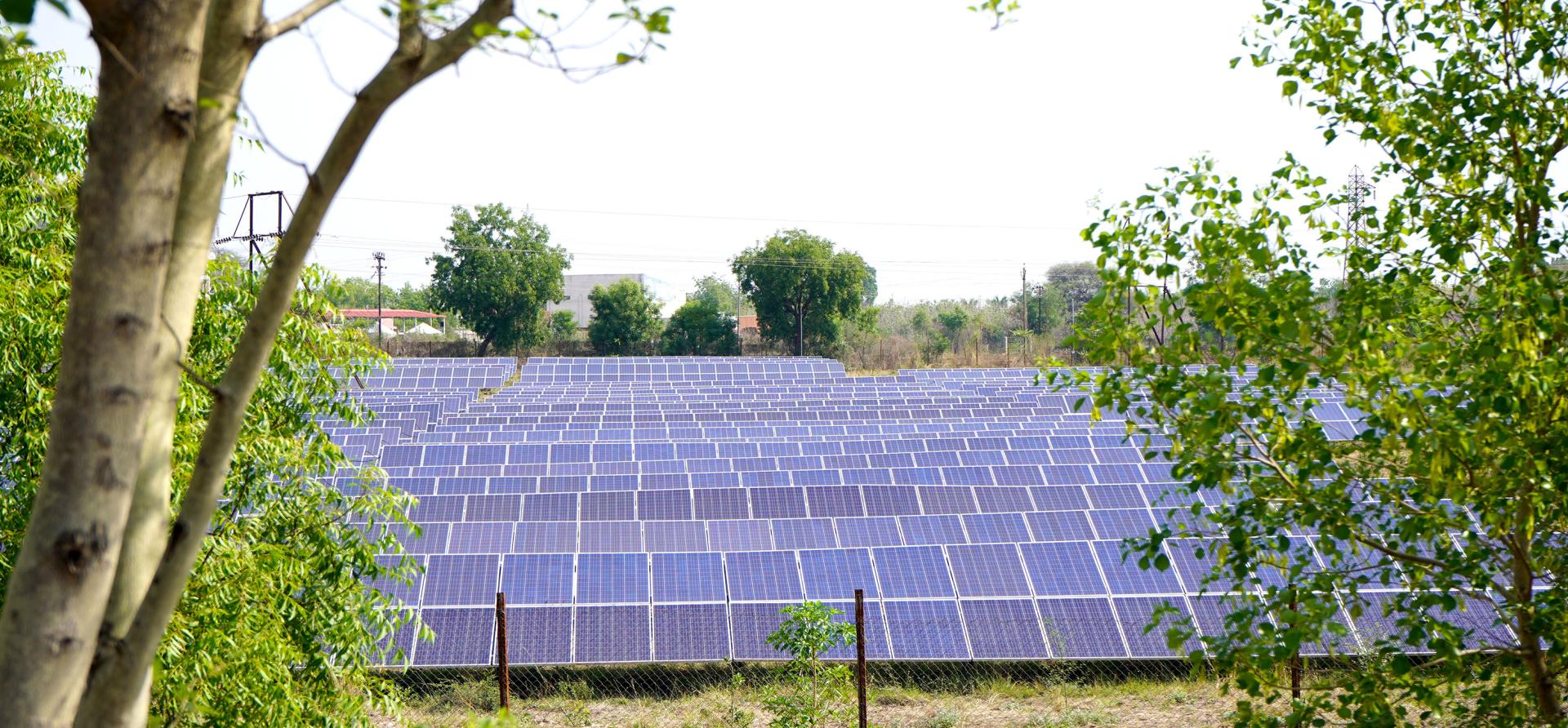
Odisha has substantial renewable energy potential but limited deployment. The state has an estimated solar potential of 139.5 gigawatts (GW), compared with only about 0.82GW of installed capacity. Wind potential is estimated at 12.13GW, but the state currently has no grid-connected wind capacity. Hydropower, the most mature renewable resource, has utilised only around 2.2GW of its estimated 7.6GW potential. As a result, Odisha’s power system remains heavily coal-dependent. Coal-fired generation has an emission intensity of 0.969 tonnes of carbon dioxide/megawatt hour (tCO₂/MWh), compared to the Indian grid average of 0.710tCO₂/MWh. Renewables currently account for only 11.3% of the state’s electricity demand, with non-hydro renewables contributing just 2.1%.
Growing Renewable Purchase Obligation (RPO) gap
With its limited renewable energy deployment, Odisha also faces a substantial RPO gap. For FY2025–2026, the national RPO target is 33.01%, while Odisha’s current share is approximately11.3%, including large hydro, resulting in a gap of nearly 21.8 percentage points. With the target rising to 43.33% by FY2029–2030, the state will require substantial additional investment to close the gap. Delayed compliance could increase power procurement costs and financial pressures on distribution utilities, with potential implications for consumers and industry.
Scale of investment required in the power sector
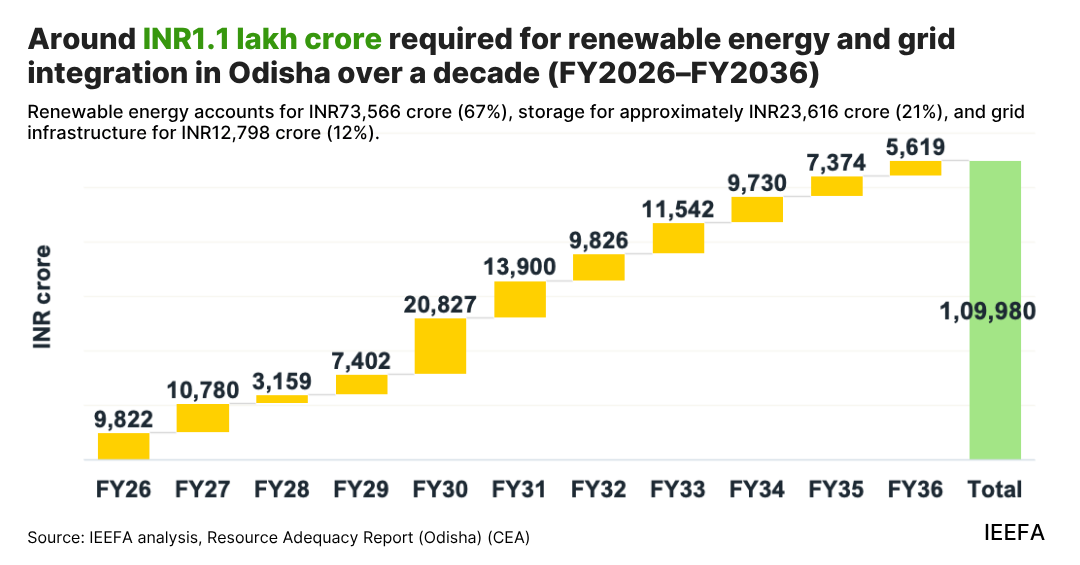
The Resource Adequacy Report of the Central Electricity Authority (CEA) indicates that Odisha will need to add approximately 10.7GW of renewable capacity between FY2025–2026 and FY2035–2036. This would comprise 6.25GW of solar, 1.90GW of wind, 1.93GW of distributed renewable energy (DRE), and 0.58GW of hydro. The state will also require 2.7GW of pumped storage and 0.13GW of battery energy storage, alongside significant investment in intra-state transmission infrastructure. The combined investment requirement for renewable generation, storage, and grid infrastructure is estimated at approximately INR1.1 lakh crore over the decade. Mobilising this scale of capital will require a combination of public and private investment, concessional and blended finance, and instruments such as viability gap funding (VGF), particularly for capital-intensive technologies such as floating solar and pumped storage.
Broader financing needs beyond the power sector
The transition will extend well beyond renewable energy and power infrastructure. Odisha will require significant investment in industrial decarbonisation, green hydrogen, electric mobility and public transport, energy-efficient buildings, sustainable cooling, and other emerging low-carbon technologies. At the same time, targeted financing will be needed for just transition measures, including worker reskilling, livelihood diversification, social protection, mine closure and land restoration, and economic diversification in coal-dependent districts. These investments highlight the need to view Odisha’s transition as a broader economic transformation rather than solely an energy sector shift.
A three-pronged financing strategy
Meeting these investment needs will require an integrated financing approach built around three priorities listed in the figure below.
Integrated financing approach under the three-pronged strategy
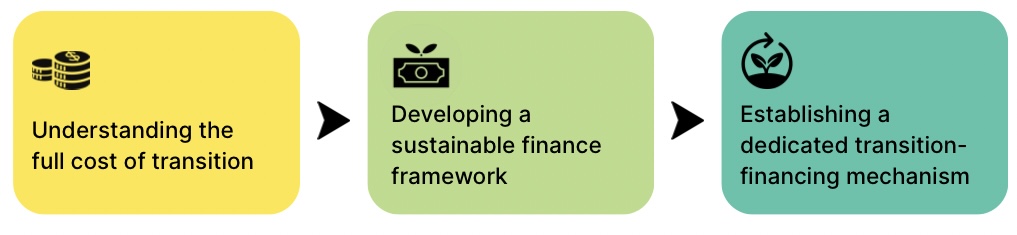
A comprehensive cost assessment can help identify investment requirements and priorities across sectors, while a sustainable finance framework can match different projects and risk profiles with appropriate sources and instruments of capital. A dedicated transition fund could then de-risk investments, support emerging technologies, and ensure that just transition priorities receive adequate and predictable funding. Odisha’s transition presents a fiscal challenge and an opportunity to build a more diversified and resilient growth model. A structured sustainable finance framework can help the state assess transition-related investment needs, develop a pipeline of bankable projects, mobilise public and private capital, and strengthen the capacity of state-level institutions to access emerging sources of green and transition finance. Early action can help reduce exposure to fossil-fuel-related risks while enabling Odisha to capture new investment and economic opportunities in the clean energy economy and support an equitable, orderly transition.

Related Content