New residential heat pumps save Germany €1.3 billion on LNG imports over three years
Germany can boost its energy security by cutting dependence on gas for power and heating
Key Takeaways:
Heat pumps have been displacing gas boilers in German homes, leading to significant savings on imports of liquefied natural gas (LNG) and strengthening energy security.
Germany is increasing its dependence on US gas, with about 92% of its LNG imports sourced from the US in 2025.
If Germany rapidly scales up technologies such as renewables, battery storage and cross-border grid connections, IEEFA estimates that the country could potentially source as low as 5% of its electricity from natural gas and hydrogen combined by 2045.
High costs and unproven technology mean that carbon capture and storage is not a near-term solution for Germany’s planned gas power plants.
31 March 2026 (IEEFA) | New household heat pump installations slashed Germany’s liquefied natural gas (LNG) import bill by €1.3 billion in the last three years, according to new research from the Institute for Energy Economics and Financial Analysis (IEEFA).
Germany installed almost 1.1 million residential heat pumps from 2022 to 2025, many of which displaced gas boilers.
If these heat pumps had not been deployed, Germany would have had to increase its LNG imports by around 16% in the three years between 2023 and 2025 and would have had to pay an additional €1.3 billion for importing LNG.
These savings replicate in subsequent years, as replacing gas demand with clean energy infrastructure generates compounded savings over the lifespan of the equipment.
“Heat pump installations have strengthened Germany’s energy security and reduced its vulnerability to high and volatile LNG prices,” said Ana Maria Jaller-Makarewicz, lead energy analyst, Europe, at IEEFA and co-author of the report.
“The Middle East crisis is Germany’s biggest wake-up call to electrify since Russia’s 2022 invasion of Ukraine. There is significant potential for Germany to accelerate heat pump deployment and curb its reliance on gas imports even further.”
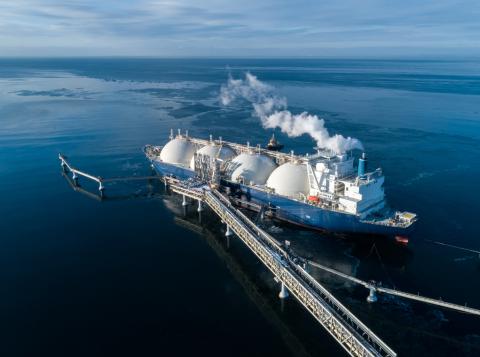
The report reveals Germany’s rising dependence on US LNG, the most expensive LNG for EU buyers. Germany sourced around 92% of its LNG imports from the US in 2025.
“Germany’s energy security was at risk in 2022 as more than half of its gas imports were from Russia. Four years later, Germany is potentially facing a high-risk new geopolitical dependence on US LNG,” said Jaller-Makarewicz.
German power utilities such as EnBW, RWE and Uniper continue signing long-term contracts and heads of agreements for LNG. But Germany’s LNG demand in the coming years might be much lower than the contracted LNG volumes.
If all of Germany’s current LNG import agreements materialise, the country would be contracted to import 26.2 billion cubic metres of LNG in 2030 — almost three times its 2025 LNG import volumes — and 10 billion cubic metres in 2045, when it aims to achieve greenhouse gas neutrality.
Germany plans to decarbonise gas power plants by relying on hydrogen-fired generation. But the report forecasts that hydrogen power plants will likely play a smaller role than German government forecasts because of their high costs and low efficiency.
If Germany significantly scales up technologies such as renewables, battery storage and cross-border grid connections, IEEFA estimates that the country could potentially source as low as 5% of its electricity from natural gas and hydrogen combined by 2045.
Carbon capture risks
High costs, long development timelines and a lack of reference projects mean carbon capture and storage (CCS) is not a near-term solution for Germany’s 10 gigawatts of planned gas power plants, in IEEFA’s view.
Germany’s new Carbon Dioxide Storage and Transport Act has opened the door to gas power plants with CCS potentially receiving future government support.
IEEFA estimates that attempting to decarbonise these new gas stations with CCS would require Germany to spend hundreds of billions of euros on subsidies.
“Germany faces significant technical and economic challenges if it uses CCS to try to decarbonise gas-fired power. There is no track record of CCS on gas plants in Europe, costs are prohibitively high, timelines extend beyond 2030, and infrastructure does not exist,” said Andrew Reid, an IEEFA energy finance analyst and co-author of the report.
“The risk is that reliance on CCS could delay more viable alternatives and expose Germany to high electricity costs and project failures.”
Press contact
Jules Scully | [email protected] | +447594 920255