India’s EV localisation gaining ground, but import dependence in chips and rare-earth magnets may hinder deeper value creation
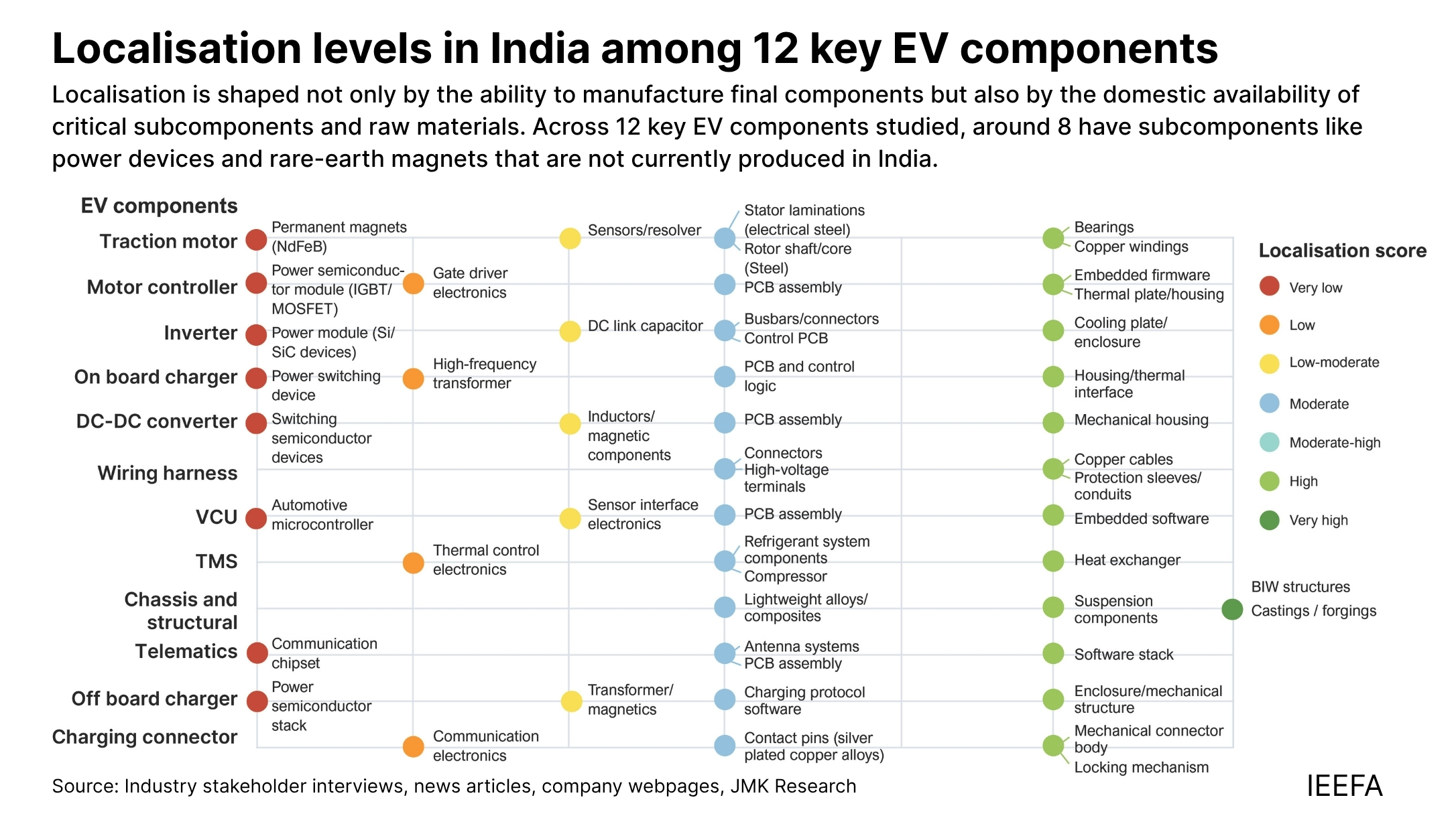
New IEEFA and JMK Research report finds several EV component categories, excluding batteries, could reach 90–100% localisation in India by 2030, but deeper domestic value creation will depend on developing upstream capabilities in semiconductors, magnets, and advanced materials.
Key Takeaways:
Electric vehicle (EV)-specific systems other than batteries, including motors, power electronics, thermal systems, chargers, and control units, account for a significant share of vehicle value and represent major localisation opportunities.
Recent announcements to manufacture powertrain systems, power electronics, and charging equipment could enable several non-battery component categories to reach 90–100% localisation by 2030 if planned manufacturing capacity is commissioned.
Around 60% of the recent EV non-battery component manufacturing announcements have been made by companies approved under the Production-Linked Incentive scheme for Automobile and Auto Components (PLI Auto). However, less than 10% of the INR25,938 crore (USD2.98 billion) available under the scheme had been disbursed by early 2026.
High localisation percentages do not necessarily translate into high domestic value creation because critical subcomponents, including semiconductors and rare-earth magnets, continue to be imported.
23 June 2026, IEEFA: India has made significant progress in localising electric vehicle (EV) manufacturing and could achieve 90–100% localisation across several high-value component categories other than batteries by 2030. However, it still needs to reduce dependence on imported semiconductors, rare-earth magnets, and specialised materials to achieve deeper domestic value creation, according to a new report by the Institute for Energy Economics and Financial Analysis (IEEFA) and JMK Research & Analytics.
The report, titled ‘Beyond battery packs: Localisation in manufacturing EV components’, finds that while India has successfully developed manufacturing capabilities for many structural and mechanical components, localisation remains uneven across the value chain. Components such as traction motors, power electronics, vehicle control units, and charging systems continue to rely heavily on imported subcomponents and raw materials.
Annual EV sales in India have grown around 14-fold since financial year (FY) 2020, creating opportunities for domestic manufacturing across the EV value chain. According to the report, localisation has progressed most strongly in areas that align with India’s existing automotive manufacturing strengths, including structural components, wiring harnesses, suspension systems, and braking systems.
Around 60% of recent EV component manufacturing announcements have been made by companies approved under the Production-Linked Incentive Scheme for Automobile and Auto Components (PLI Auto) scheme. However, the report finds that less than 10% of the INR25,938 crore (USD2.98 billion) available under the scheme had been disbursed by early 2026.
The report also makes a distinction between localisation and domestic value creation. A component assembled in India may still depend heavily on imported chips, magnets, and specialised materials, limiting the amount of value created within the country.
“Our analysis suggests that several EV component categories could be manufactured domestically over the coming years. However, the extent to which this translates into domestic value creation will depend on the development of capabilities in upstream materials, electronics, and component supply chains,” says Rahul Maity, Consultant at JMK Research & Analytics, and lead author of the report.
The report also finds that recent manufacturing investments are increasingly concentrated in powertrain systems, power electronics, and charging infrastructure. These have historically been among the most import-dependent segments of India’s EV ecosystem. Several of these component categories could achieve near-complete localisation by 2030 if manufacturing projects announced are commissioned successfully and supplier ecosystems continue to mature.
Semiconductors and rare-earth magnets remain among the most significant constraints to deeper localisation, according to the report. They are essential for EV motors, power electronics, charging equipment, and vehicle control systems, but global production remains concentrated in China and Taiwan.
“A number of factors could influence future localisation outcomes, including access to critical materials, cost competitiveness relative to established manufacturing hubs, supplier scale, component standardisation, and the development of domestic technology capabilities,” says Charith Konda, Energy Specialist at IEEFA, and co-author of the report.
The report identifies areas that need to be improved to fast-track localisation.
“Accelerating development of semiconductor and rare-earth magnet supply chains, expanding participation of EV startups in localisation programmes, promoting greater component standardisation, and increasing investment in indigenous research and development, all have a role to play,” says Prabhakar Sharma, Senior Consultant at JMK Research & Analytics, co-author of the report.
“Recent manufacturing investments indicate growing industry confidence in India’s EV component ecosystem, particularly in areas such as motors, power electronics, and charging equipment. These developments could significantly expand domestic manufacturing capability over the coming five years,” says Jyoti Gulia, CEO at JMK Research & Analytics, and co-author of the report.
The full report is available here: Beyond battery packs: Localisation in manufacturing EV components
Media contact: Prionka Jha ([email protected]); +91 9818884854
Author contacts: Rahul Maity ([email protected]), Charith Konda ([email protected]), Prabhakar Sharma ([email protected]), Jyoti Gulia ([email protected])
About IEEFA: The Institute for Energy Economics and Financial Analysis (IEEFA) examines issues related to energy markets, trends, and policies. The Institute’s mission is to accelerate the transition to a diverse, sustainable and profitable energy economy. (ieefa.org)
About JMK Research: JMK Research & Analytics provides research and advisory services to Indian and international clients across renewables, electric mobility, and the battery storage market. ( www.jmkresearch.com)