Australia needs oil shock absorbers

Crisis exposes limits of monetary policy to curb inflation
24 June 2026 (IEEFA Australia): Australia can shield itself from inflationary spikes driven by recurrent oil price shocks, which have tested the limits of traditional monetary policies, according to a report released today.
In a generation, Australia flipped from self-reliance on oil products to import dependence, a vulnerability laid bare by the Iran fuel crisis. This has made it increasingly difficult for the Reserve Bank of Australia (RBA) to stop the inflationary impacts of these events permeating the wider economy, finds the report Oil shocks expose the limits of monetary policy.
The vast majority of the nation’s three key oil products are imported: diesel (90%), jet fuel (80%) and petrol (68%). Ballooning domestic fuel consumption enhanced the impact of this shift on the economy, with diesel use increasing by 2.5 times while jet fuel use has almost doubled since 2000.
“Australia’s diesel use growth is at odds with other countries,” says the author Amandine Denis-Ryan, CEO of IEEFA Australia. “It is now the world’s largest importer of diesel, representing 10% of net global seaborne trade. Australia is also the third-largest importer of jet fuel and petrol. This is well above the country’s share of global GDP.”
This import dependence puts Australia at the mercy of global oil price spikes and supply disruptions. Since 2000, oil prices and costs have risen by 6.9% and 8.9% a year, respectively, well above inflation. Prices have also become increasingly volatile, in part due to geopolitical tensions.
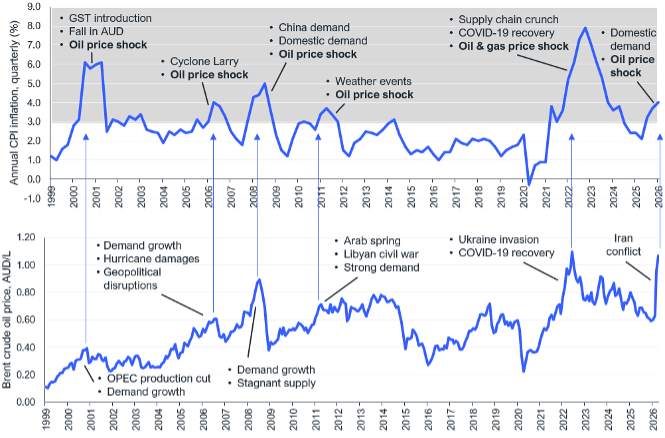
“This century there have been six main occasions when inflation exceeded the RBA’s target of 2–3%, with oil price shocks a primary driver for each,” Ms Denis-Ryan says.
Oil price rises affect inflation in three ways: directly through household transport expenditure, which added one percentage point to the CPI in March; indirectly by increasing the cost of goods and services, and; a disproportionate effect on inflation expectations, which can be self-perpetuating.
The RBA has traditionally relied on three main tools to stabilise prices: inflation targeting, increasing interest rates and forward guidance. Last month, it pulled its principal lever, raising interest rates by 0.25%, citing the risk of spillover effects from the oil shock in its decision.
“In the case of oil price shocks, central banks focus on countering spillover impacts of high oil prices on broad-based inflation, using a graduated set of responses depending on the likely magnitude of the spillover,” Ms Denis-Ryan says.
Contribution of oil price shocks to spikes in Australian inflation
“For severe shocks with a high chance of unanchoring inflation expectations, they will take forceful monetary policy action. In the case of an initial supply-side shock (as is the case with the Iran conflict), a forceful response can have high economic costs, potentially leading to a recession.”
Increasing fossil fuel price volatility and its recurrent impact on world economies have prompted some European central bankers to call for the transition away from fossil fuel dependence to accelerate to protect price stability.
“However, monetary action to constrain the spillover of oil price shocks makes it harder and more costly to transition to the very technologies that can protect the economy from the impacts of future oil price shocks,” Ms Denis-Ryan says.
To safeguard Australia against future oil shocks, the report makes three main recommendations:
- Accelerate transport electrification: Road transport can be near fully electrified by 2050, which would halve Australia’s oil use and cut the strongest influence on inflation. Achieving this shift will require further government support, particularly for freight electrification.
- Accelerate grid modernisation: Step 1 will require large volumes of electricity, equivalent to 42% of today’s demand. Accelerating grid upgrades and deploying innovative integration solutions are critical enablers to support transport electrification.
- Reduce the cost of finance for electric vehicles (EVs): EVs represent the largest investment required in the net zero transition (~AUD1.3 trillion to 2050) and most carry a cost premium. The RBA should consider introducing a targeted refinancing facility – providing substantially discounted loans to commercial banks for EV financing until they reach cost parity.
“Australia now has the option to sever its exposure to oil price shocks — and the inflation that follows – but it needs to take decisive action to turn around its growing oil addiction.”
Read the report: Oil shocks expose the limits of monetary policy
Media contact: William Poole, ph +61 408 030 524, [email protected]
Author contact: Amandine Denis-Ryan, [email protected]
About IEEFA: The Institute for Energy Economics and Financial Analysis (IEEFA) examines issues related to energy markets, trends, and policies. The Institute's mission is to accelerate the transition to a diverse, sustainable and profitable energy economy. (ieefa.org