Valuing the Future: Pennsylvania’s shrinking fossil fuel footprint leaves a widening fiscal gap
Key Takeaways:
Pennsylvania’s budget deficit will widen as state spending outpaces tax receipt growth.
The largest economic contributions from the state’s coal industry, its petrochemical sector, and its natural gas business are several years in the rearview.
Tax credits that are 26 times the size of effective tax rates on the fossil fuel industry are adding fuel to the fire.
The state’s tax policy toward natural resource extraction should be revised to align industry contributions with policy goals.
Pennsylvania’s budget is heading for a crisis and fossil fuels are not coming to the rescue, according to a new report out today from the Institute for Energy Economics and Financial Analysis (IEEFA). The report finds that the fossil fuel industry’s structural decline and the state’s prior decision to forego adequate tax revenue from the sector are important contributors to the state’s fiscal problems.
The state’s coal industry is declining, its petrochemical sector is stagnant, and its natural gas business has been a mixed bag, at best. Despite the paltry returns, Pennsylvania has given massive tax credits to the fossil fuel industry. IEEFA’s analysis shows that revising the state’s tax policy on natural resource extraction should be considered to align industry contributions with policy goals.
“The energy transition is in motion. The question now for policymakers is whether they want to play a role in deciding the destination,” said Trey Cowan, IEEFA energy finance analyst and co-author of the report. “Pennsylvania has a rich history of energy innovation and has established itself as an indisputable leader in energy production today. To maintain this record, it will be important to recognize what the fossil fuel industry can and cannot offer in the future. Neither job growth nor tax revenue growth is on the radar for the fossil fuel industry.”
Unlike most oil and gas-producing states, Pennsylvania has no severance tax on natural gas production. The figure below shows that Pennsylvania would have ample room to increase taxes on natural gas producers if the state used a different valuation method for natural gas extraction. The fees and levies charged by Pennsylvania are generous compared to the effective rates paid by other oil and gas-producing states. Currently, the fees that Pennsylvania producers pay on natural gas extraction are a tiny fraction of the state’s budget. As a percentage of total state taxes, Pennsylvania’s impact fees (levied primarily on horizontally drilled natural gas wells) are 0.3% of state tax revenues—a pittance compared with other states.
Major Sources of State Tax Receipts for Fiscal Year 2024. Pennsylvania’s Environmental Impact Fee is Drastically Less Than Other Peer States’ Severance Taxes.
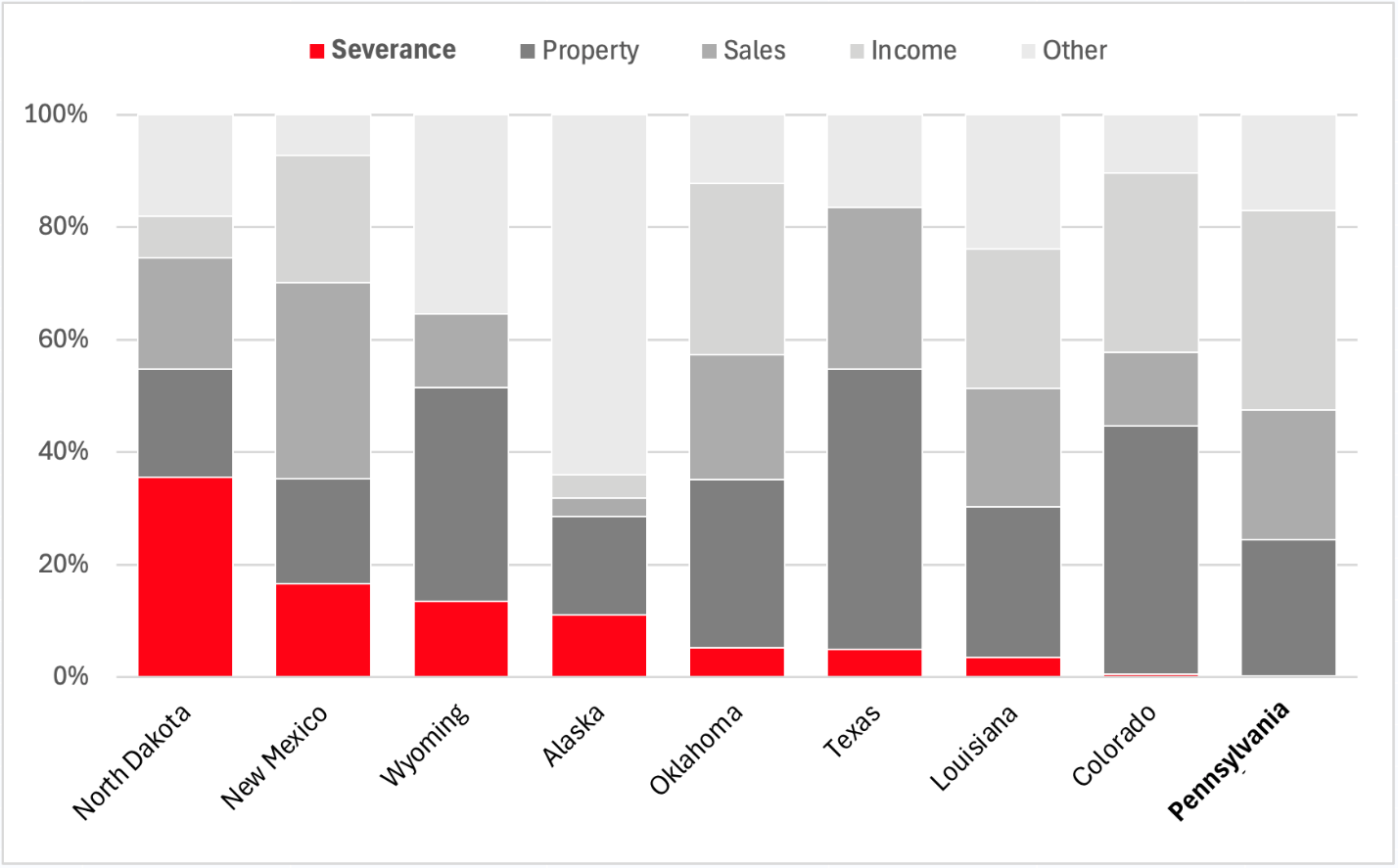
Source: IEEFA calculations from FY2024 Annual Comprehensive Financial Reports of ND, NM, WY, AK, OK, TX, LA, CO, PA and Pennsylvania Public Utility Commission.
Past fossil fuel booms do not absolve policymakers from the responsibility of addressing the consequences of the industry’s continued decline. The communities on the frontlines of energy production today deserve the chance to benefit from and participate in the energy system of the future. Ensuring that the ongoing transition is just should be central to policymakers’ agendas. This begins with an honest assessment of where the state’s fossil fuel sector has been and where it is trending—down.